
Risk Calculator: Absolute vs Relative Risk
This calculator helps you understand the real impact of drug benefits and side effects. Enter your baseline risk and the drug's effect to see the absolute difference versus the relative percentage change.
Absolute Risk: Your actual chance of the event
Relative Risk: How much the chance changed compared to your baseline
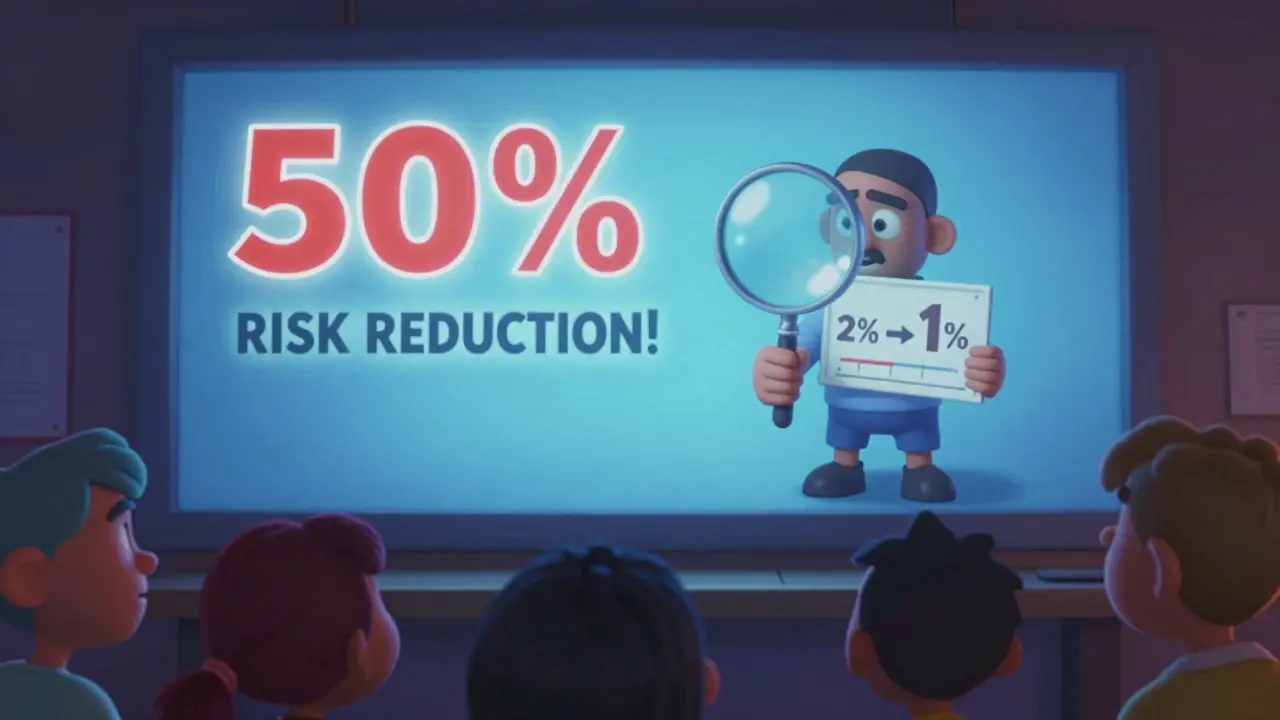
When you hear a drug reduces your risk of a heart attack by 50%, it sounds powerful. But what if that means going from a 2% chance to a 1% chance? That’s not a miracle-it’s a tiny shift. The difference between absolute risk and relative risk isn’t just math. It’s the difference between making an informed choice and being misled.
What Absolute Risk Really Means
Absolute risk is the real, honest number. It tells you how likely something is to happen to you, right now, in your life. If 1 in 100 people get a rare side effect from a drug, that’s 1%. If 1 in 10,000 get a serious reaction, that’s 0.01%. These numbers don’t change based on what group you’re comparing to. They’re just the facts.Think of it like this: You’re standing in a room with 100 people. If 3 of them will get a headache after taking a pill, the absolute risk is 3%. That’s it. No spin. No tricks. That’s your actual chance.
Doctors use absolute risk to decide if a drug’s benefit is worth it for you. For example, if a statin reduces your chance of a heart attack from 4% to 3% over 10 years, the absolute risk reduction is just 1 percentage point. That means 99 out of 100 people won’t benefit at all. But for that 1 person? It matters.
How Relative Risk Makes Things Look Bigger
Relative risk is a ratio. It compares two groups: people who took the drug versus those who didn’t. It doesn’t tell you the real numbers-it tells you how much one number changed compared to another.Let’s say your baseline risk of a stroke is 2%. A drug brings that down to 1%. The absolute risk reduction? Just 1%. But the relative risk reduction? 50%. That’s because 1 is half of 2. So the drug “cuts your risk in half.” Sounds impressive, right?
But here’s the catch: if your original risk was only 0.1% (1 in 1,000), and the drug lowers it to 0.05% (1 in 2,000), the relative risk reduction is still 50%. But now the absolute reduction is just 0.05%. That’s not a life-saving win-it’s a statistical whisper.
Pharmaceutical ads love relative risk because it turns small gains into big headlines. A drug that reduces cancer risk from 0.75% to 1.25%? That’s a 67% relative increase. But the absolute increase? Just 0.5 percentage points. Newspapers called it a “70% rise in cancer risk.” That’s terrifying. But in reality, your chance went from 3 in 400 to 5 in 400. That’s not a public health crisis. It’s a tiny uptick.
Why Both Numbers Matter
You can’t understand a drug’s true effect without seeing both. Relative risk tells you how strong the effect is. Absolute risk tells you how meaningful it is.Take venlafaxine, an antidepressant. In one study, 20% of people on the drug had sexual side effects. On placebo, it was 8.3%. The relative risk? 2.41. That means you’re more than twice as likely to have this side effect. Sounds bad. But the absolute difference? Just 11.7 percentage points. So for every 100 people taking it, 12 more will have this issue compared to those not taking it. That’s significant-but not catastrophic. Knowing both helps you weigh whether the mood improvement is worth the trade-off.
Same goes for benefits. A drug might reduce your risk of death from heart disease by 20% relative. But if your baseline risk was only 5%, the absolute benefit is just 1 percentage point. That means 100 people need to take the drug for one person to avoid death. That’s the Number Needed to Treat (NNT)-a crucial number that tells you how many people must be treated for one good outcome.
How the System Lets You Down
The problem isn’t just confusion. It’s design.A 2021 study found that 78% of direct-to-consumer drug ads in the U.S. only showed relative risk reductions. None mentioned absolute numbers. Why? Because 50% sounds better than 1%. And 90% sounds like a miracle when your risk drops from 0.001% to 0.00001%.
Patients have been burned by this. On Reddit, one doctor shared that a patient refused statins because they thought “cutting heart attack risk in half” meant half the people would be saved. That’s not how it works. It means your personal risk went from 2% to 1%. The patient didn’t understand the difference-and the ad didn’t help.
Even doctors struggle. A 2019 study showed 60% of surveyed physicians couldn’t correctly convert relative risk to absolute terms. If the people prescribing the drugs don’t fully get it, how can patients?
What You Can Do to Understand Your Risks
You don’t need a statistics degree. You just need to ask the right questions.- Ask: “What’s my chance of this happening without the drug?”
- Then ask: “What’s my chance with it?”
- Subtract the two. That’s your absolute benefit-or risk.
- If they give you a percentage like “50% reduction,” ask: “Reduction from what?”
- Ask for the Number Needed to Treat (NNT) or Number Needed to Harm (NNH). If they don’t know, that’s a red flag.
Visual tools help. Picture 100 people. Color 3 red if they’ll have a side effect. Color 1 blue if the drug helps. Suddenly, the numbers feel real. That’s why the Cochrane Collaboration recommends pictograms in patient materials. A simple drawing beats a confusing percentage every time.
What’s Changing-and What’s Not
There’s progress. In 2023, the FDA started pushing for clearer risk reporting in drug ads. The European Medicines Agency already requires both absolute and relative numbers in patient leaflets. Harvard Medical School now teaches statistical literacy to all med students. And 37 major journals use standardized risk communication templates.But the system still favors marketing over clarity. Drug companies spend billions on ads. They know relative risk sells. And until regulators force full transparency, you’ll keep seeing headlines that scream “50% reduction!” while hiding the truth: your risk barely budged.
Here’s the bottom line: If a drug’s benefit is small in absolute terms, it might not be worth the cost, side effects, or hassle. And if the side effect risk is low, but the relative risk sounds scary, you might be overreacting. The numbers don’t lie-but they can be dressed up to sound like something they’re not.
Know your absolute risk. Question the relative one. And never let a percentage make you feel like you need a miracle-when what you really need is clarity.
What’s the difference between absolute risk and relative risk?
Absolute risk is your actual chance of something happening-for example, a 2% chance of having a heart attack. Relative risk compares your risk with someone else’s-like saying a drug cuts your risk in half. That sounds big, but if your original risk was 2%, now it’s 1%. The absolute change is tiny, even though the relative change sounds impressive.
Why do drug ads use relative risk instead of absolute risk?
Because relative risk makes benefits look bigger and side effects seem less serious. A 50% reduction sounds better than a 1% absolute change. A 90% reduction in a rare side effect sounds like a miracle-even if your actual risk only dropped from 0.001% to 0.0001%. Ads use relative risk to sell, not to inform.
How do I know if a drug is really worth taking?
Ask for the absolute risk reduction and the Number Needed to Treat (NNT). If the NNT is 10, that means 10 people must take the drug for one person to benefit. If the NNT is 100, the benefit is very small. Also ask about side effects: what’s the absolute risk of those? Compare the benefit to the risk in real numbers-not percentages.
Can relative risk be misleading for side effects?
Yes. A drug might double your risk of a side effect (relative risk = 2.0), but if your original risk was 0.5%, now it’s 1%. That’s still very low. Doubling sounds scary, but the actual risk is still small. Always ask: what’s the starting number? Without it, you can’t judge the real danger.
What’s the Number Needed to Treat (NNT)?
NNT is how many people need to take a drug for one person to benefit. It’s calculated by dividing 1 by the absolute risk reduction. For example, if a drug reduces heart attack risk by 2% (0.02), the NNT is 50. That means 50 people must take it for one person to avoid a heart attack. A high NNT means the drug helps very few people.
Are there any tools to help me understand these numbers?
Yes. Many health sites use pictograms-like a grid of 100 people where colored dots show who benefits or has side effects. These are proven to help patients understand risk better than percentages alone. Ask your doctor if they have a visual tool. If not, search for “risk pictogram” online. Seeing 100 people makes the numbers real.

honestly this post saved me from taking a statin i didnt need. i was freaked out by the '50% reduction' ad, but after reading this i did the math and realized my risk went from 1.8% to 0.9%... like, im not gonna take a pill that gives me muscle pain for a 0.9% shot at not having a heart attack in 10 years. thank you for explaining it like i’m not a statistic.
you people are missing the point. if you’re 65 and have high cholesterol? yes, that 1% absolute reduction matters. if you’re 35 and healthy? nope. it’s not about the number-it’s about context. the system doesn’t give a damn about context, though. they just want you on the pill.
OMG I CRIED READING THIS 😭 like… i literally just took a blood pressure med because they said 'reduces stroke risk by 40%' and now i realize my risk was 0.2% and now it’s 0.12%??? i feel so manipulated. like, why do they even show us numbers if they’re just gonna twist them?? 😤
Relative risk is math. Absolute risk is reality. End of story. Stop letting pharma control your decisions with ratios.
i never knew about NNT before this. now i ask for it every time. my doctor rolled his eyes but gave me the number. turns out the NNT for my antidepressant is 8. that’s better than i thought. still gonna watch for side effects tho
ah yes the classic 'you're not special' medicine lecture. you think people don't know they're being sold snake oil? we do. we just don't have a choice. insurance won't cover the 'natural' version. the system is rigged. and this post? it's just another way to make us feel guilty for wanting to live longer.
so wait… are you saying the government and big pharma are LYING to us?? 😳 i knew it!! i told my mom last year that my anxiety med was just making me numb but she said 'the doctor said it cuts risk by 60%' and now i realize it was from 0.4% to 0.16%?? i feel so used 😭 i’m deleting my pill organizer today. #pharmalobby #wakeupeveryone
This is an exceptionally well-articulated exposition on risk communication in clinical pharmacology. The distinction between absolute and relative risk is not merely pedagogical-it is ethically imperative. The failure of regulatory bodies to mandate transparent reporting constitutes a breach of informed consent. I commend the author for citing the Cochrane pictograms, which have demonstrated efficacy in cross-cultural risk comprehension. Furthermore, the emphasis on Number Needed to Treat aligns with evidence-based guidelines from the BMJ and JAMA. This should be required reading for all medical trainees.
they’re watching us through the pills. i read somewhere that the coating on antidepressants has microchips that track your heart rate and send it to the FDA. that’s why they don’t want you to know the real numbers-they need to know if you’re still alive to keep collecting data. this post? it’s a distraction. the real danger is surveillance. 🕵️♀️💊
so let me get this straight… if i’m a 50 year old smoker with high blood pressure, and a drug cuts my heart attack risk from 10% to 8%, that’s only a 2% drop? but if i’m a 25 year old vegan, and the same drug cuts my risk from 0.5% to 0.4%, it’s still a 20% relative drop? so the drug is better for the vegan? that makes no sense. they’re just trying to sell to everyone.
you think this is about math? nah. it's about control. they want you to believe you need a pill for everything. if you’re healthy you’re broken. if you’re tired you need antidepressants. if you’re old you need statins. they don’t care if you live longer-they care if you pay monthly. absolute risk? relative risk? it’s all just smoke and mirrors to keep you buying. the only number that matters is how much your insurance pays them every month