Antihistamine Cross-Reactivity Risk Checker
Symptom Assessment
Please select your symptoms when taking antihistamines
Reaction History
Select antihistamines you've tried
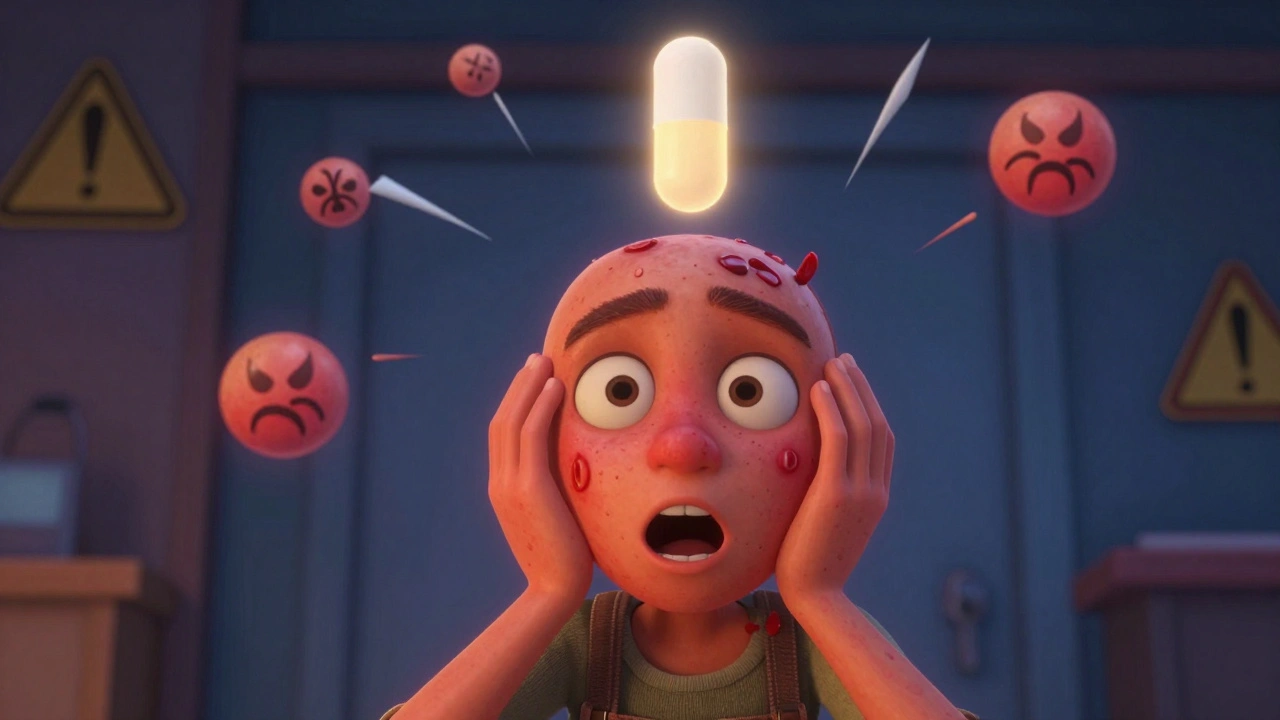
It’s a cruel twist: you take an antihistamine to stop your itching, sneezing, or hives-and instead, your skin gets worse. You break out in red, raised welts. Your throat feels tight. Your eyes swell. You didn’t expect this. You thought you were fixing the problem. But sometimes, the medicine meant to calm your allergies can trigger them. This isn’t a mistake. It’s a real, documented phenomenon called antihistamine allergy.
How Can a Medicine Cause the Very Thing It’s Supposed to Treat?
Antihistamines work by blocking histamine, the chemical your body releases during an allergic reaction. Most of the time, they do this perfectly. But in rare cases, they do the opposite. Instead of calming the H1 receptor-the main switch that turns on allergy symptoms-they accidentally flip it on. Think of it like a key that fits the lock but turns it the wrong way. In people with certain genetic differences in their H1 receptors, some antihistamines stabilize the receptor in its active state, not the inactive one. That means histamine keeps firing, even though you’ve taken the drug to stop it. The result? Urticaria (hives), swelling, or even anaphylaxis-triggered by the treatment itself.
This isn’t just theory. A 2017 case study in Allergol Select followed a woman with chronic hives who got worse every time she took loratadine, cetirizine, fexofenadine, or hydroxyzine. Her skin flared up even with low doses. Only after stopping all antihistamines and treating an underlying infection did her symptoms disappear. Her body wasn’t rejecting the drugs-it was responding to them like they were histamine.
Not All Antihistamines Are the Same-But You Can Still React to More Than One
Antihistamines fall into two main groups: first-generation and second-generation. First-gen drugs like diphenhydramine (Benadryl) and pheniramine cross into your brain, making you drowsy. Second-gen drugs like cetirizine (Zyrtec), loratadine (Claritin), and fexofenadine (Allegra) are designed to stay out of your brain, so they’re less sedating and last longer-up to 24 hours.
But here’s the catch: both types can trigger reactions. A 2018 case in the Korean Journal of Pediatrics showed a child who broke out in hives after taking ketotifen, even though skin tests for it came back negative. The only way to confirm the allergy? An oral challenge-giving the drug under medical supervision and watching closely. Symptoms didn’t show up right away. They appeared after 120 minutes. That’s why skin tests alone aren’t enough.
Even more confusing? Cross-reactivity doesn’t follow chemical rules. You might react to cetirizine (a piperazine) and then also react to fexofenadine (a piperidine), even though they’re structurally different. One study found patients reacting to multiple classes of antihistamines, suggesting the issue isn’t just about molecular shape-it’s about how your individual receptors respond. There’s no simple checklist like “if you’re allergic to this, avoid that.”
Why Standard Allergy Tests Often Miss This
Most doctors rely on skin prick tests or blood tests to diagnose allergies. But those tests don’t work well for antihistamine hypersensitivity. In the case described above, ketotifen showed a negative skin test-yet caused a full-blown reaction when swallowed. Why? Because skin tests measure IgE antibodies, which are involved in classic allergies. But antihistamine reactions may involve different immune pathways, or even direct receptor activation. That means a negative test doesn’t rule it out.
Diagnosing this requires a different approach: an oral challenge under supervision. You take a tiny dose of the antihistamine, then wait. You might need to wait up to two hours. If your skin starts breaking out, your blood pressure drops, or you feel dizzy-it’s confirmed. It’s risky, so it’s only done in a clinic with emergency equipment ready. But it’s the only way to be sure.

What Happens When You Can’t Use Any Antihistamines?
This is where things get hard. If you’re allergic to most or all antihistamines, your go-to tools for hives, hay fever, or insect bites are gone. That leaves you with fewer options. Some patients find relief with:
- Leukotriene inhibitors like montelukast (Singulair), which block a different part of the allergic pathway.
- Immunosuppressants like cyclosporine or omalizumab (Xolair), used for chronic hives that don’t respond to standard treatment.
- Topical treatments like cool compresses, antiseptic lotions, or low-dose corticosteroid creams for skin flare-ups.
- Addressing triggers-infections, stress, or autoimmune conditions can worsen hives. One patient’s symptoms cleared only after treating a hidden bacterial infection.
It’s not ideal. But it works. And it’s better than continuing to take something that makes you worse.
What You Should Do If You Think You’re Reacting
If you’ve taken an antihistamine and your symptoms got worse-especially if you’ve had hives, swelling, or breathing trouble-stop taking it. Don’t assume it’s just a bad day or that you need a stronger dose. Write down:
- Which drug you took
- When you took it
- How long it took for symptoms to appear
- What symptoms you had
Bring this to your doctor or allergist. Ask specifically: “Could this be an allergy to the antihistamine itself?” Don’t settle for “it’s probably just your allergies acting up.” Push for a referral to an allergy specialist who’s seen this before. Mention the 2017 and 2018 case studies-they’re real, and they’re published.
Also, check your medicine labels. Some combination cold and flu pills contain antihistamines you might not realize. Even topical creams or eye drops can trigger reactions if you’re sensitive.

What’s Next for Antihistamines?
Scientists are finally seeing the problem clearly. In 2024, researchers used cryo-electron microscopy to map exactly how antihistamines bind to the H1 receptor. They found not just one binding site, but two. That’s huge. It means future drugs can be designed to avoid the tricky spot that flips the receptor on. We might see next-generation antihistamines that work for everyone-even those with rare receptor mutations.
Right now, the best we can do is recognize this isn’t a myth. It’s real. It’s rare, but it’s serious. And if you’re one of the people it happens to, you’re not alone. There are doctors who know how to help. You just need to speak up.
Key Takeaways
- Antihistamines can sometimes cause hives or allergic reactions instead of preventing them.
- This happens due to rare genetic differences in H1 receptors, not a typical IgE allergy.
- Both first- and second-generation antihistamines can trigger reactions-even if they’re chemically different.
- Skin tests often miss this type of reaction. Oral challenges are the only reliable diagnostic tool.
- If you react to antihistamines, you’re not out of options. Alternatives like montelukast, omalizumab, or infection treatment can help.
Frequently Asked Questions
Can you be allergic to all antihistamines?
Yes, but it’s rare. Some people react to multiple antihistamines across different chemical classes-piperidines like fexofenadine and piperazines like cetirizine. This usually happens in people with underlying immune or receptor abnormalities. It doesn’t mean every antihistamine will cause a reaction, but testing each one under medical supervision is necessary to be sure.
Why didn’t my skin test show an allergy to cetirizine if I reacted to it?
Standard skin tests look for IgE-mediated allergies, like peanut or pollen reactions. Antihistamine hypersensitivity often works differently-it’s not about antibodies. It’s about the drug directly activating your H1 receptors. That’s why a negative skin test doesn’t rule it out. Oral challenges are the only way to confirm it.
Is this reaction permanent? Will I always be sensitive to antihistamines?
Not necessarily. Some patients have seen improvement after treating underlying conditions like chronic infections, thyroid disorders, or autoimmune issues. Others remain sensitive long-term. There’s no way to predict it. The key is avoiding known triggers and working with an allergist to find safe alternatives.
Are there any antihistamines that are safer for people with this issue?
No antihistamine is guaranteed safe. Even newer ones like bilastine or rupatadine have been reported to trigger reactions in rare cases. The only way to know is through controlled testing. Some patients tolerate H2 blockers like famotidine (Pepcid) better, but those are meant for stomach acid-not allergies. Always consult your doctor before trying anything new.
What should I do if I have a reaction while taking an antihistamine?
Stop taking the medication immediately. If you have swelling in your throat, trouble breathing, dizziness, or a rapid heartbeat, call emergency services. If it’s just a skin reaction, contact your doctor right away. Don’t try to “push through” the symptoms. Document everything and ask for a referral to an allergy specialist. This is not normal, and you deserve proper care.
man i thought i was the only one who got worse after taking zyrtec... thought it was just me being weird. my skin lit up like a christmas tree and my eyes swelled so bad i looked like a pufferfish. doc said it was 'just a coincidence' but i knew better. stopped everything and now i use cold showers and turmeric paste. weird as hell but it works.
Oh please. This is just the latest in a long line of pseudo-scientific medical fearmongering. You're telling me that a class of drugs with over 50 years of safe use-used by hundreds of millions-is suddenly 'reactivating histamine receptors' like some kind of villainous nanobot? Please. If your body 'reacts' to antihistamines, you're either misdiagnosed, overmedicated, or you've been binge-watching wellness TikTok. This isn't a breakthrough-it's a marketing ploy for alternative practitioners.
Antihistamine hypersensitivity is a real but obscure entity. H1 receptor allosteric modulation. Not IgE mediated. Confirmed via oral challenge. Diagnostic gold standard. Avoid all H1 blockers. Try montelukast. Or cyclosporine. Or omalizumab. If no improvement, screen for H. pylori, thyroid autoimmunity, or mast cell disorders. Case reports exist since 2017. Literature is thin but valid.
omg i think this happened to me last year 😭 i took claritin for my pollen thing and then my face looked like i got into a fight with a nettle bush. i thought i was dying. i cried in the pharmacy. now i just use ice packs and pray. also i found out my cold medicine had antihistamine in it and i had no idea 😅
Wow this is wild. I never knew antihistamines could do this. 🤯 So it’s like the drug thinks it’s histamine? That’s so trippy. I’m gonna check my meds now. Also, has anyone tried H2 blockers like famotidine for hives? I heard they’re less likely to trigger this? 🤔
It's fascinating how the medical community still clings to outdated diagnostic paradigms. The fact that skin prick tests-which measure IgE-mediated responses-are used as the primary tool for diagnosing antihistamine reactions reveals a profound epistemological flaw in allergology. We are applying a model designed for type I hypersensitivity to a phenomenon that is pharmacodynamic, receptor-based, and likely tied to polymorphic variations in the HRH1 gene. This isn't 'allergy' in the classical sense. It's a misfiring of molecular signaling. And yet, most physicians still dismiss patients who report this because they don't fit the textbook. This is why people suffer for years. This post should be mandatory reading for every medical student.
People like you are why medicine is broken. You read one case study and suddenly you're an expert. 'Stop all antihistamines'? What if you have chronic urticaria? You're just going to suffer? You're not helping. You're scaring people. I've been on Zyrtec for 10 years. I'm fine. Your fear is not science. It's fearmongering dressed up as awareness.
I’ve known someone who went through this. Took cetirizine for years. Then one day, she broke out in hives after the usual dose. She thought she was getting sicker. Turns out, it was the drug. She went through a year of testing, elimination, and eventually found a specialist who knew what to look for. It took forever. She’s now on omalizumab and doing okay. But the hardest part wasn’t the symptoms-it was the doctors who told her she was imagining it. I’m glad this article exists. Not because it’s common, but because it’s real for the people it happens to. And they deserve to be heard.