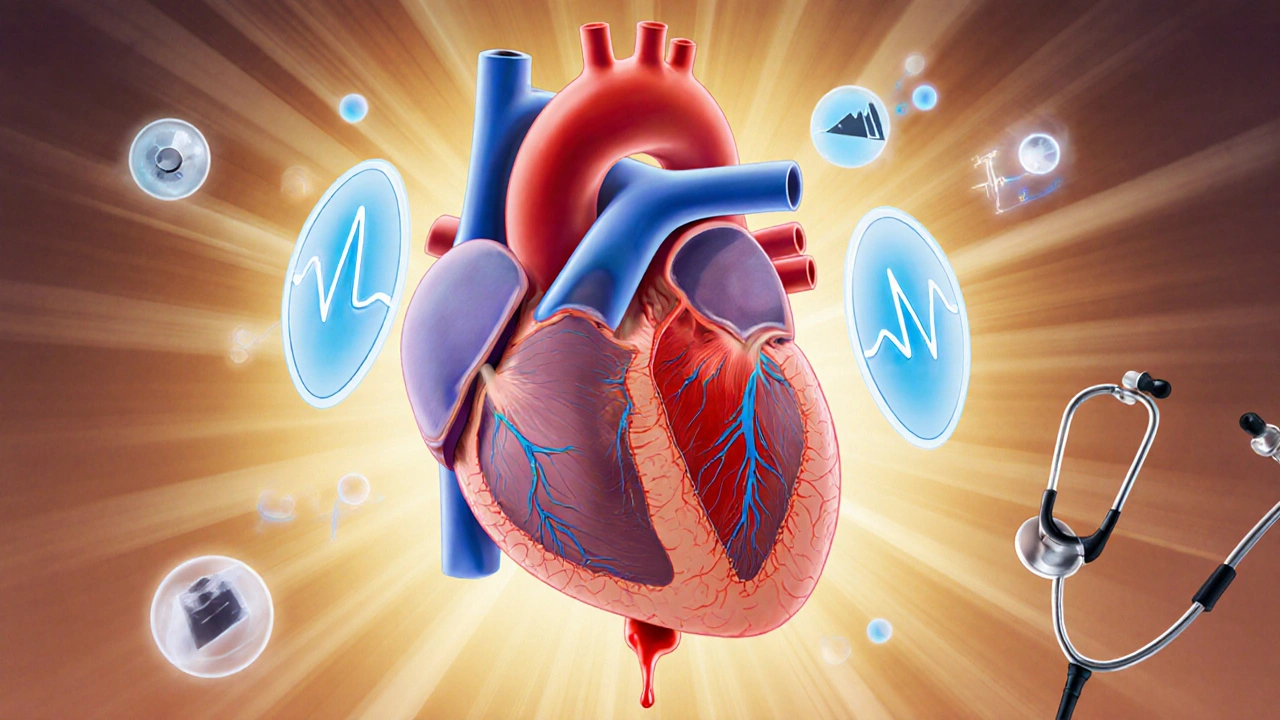
When your heart valve doesn’t close right, blood leaks backward. That’s heart valve disease. It doesn’t always cause symptoms at first, but over time, your heart has to work harder. Many people with this condition end up with heart failure. And that’s where carvedilol comes in.
What carvedilol actually does in the heart
Carvedilol isn’t just another beta blocker. It’s a carvedilol is a non-selective beta blocker with additional alpha-1 blocking activity. That means it slows your heart rate, lowers blood pressure, and reduces the force of each heartbeat-all at once. This combo is rare. Most beta blockers only hit one or two of these targets. Carvedilol hits all three.
In people with heart failure from coronary artery disease or high blood pressure, carvedilol has been shown to cut the risk of death by about 35% over two years. That’s from the COMET and CAPRICORN trials. But what about heart valve disease? That’s where things get trickier.
Why heart valve disease is different
Not all heart failure is the same. In ischemic heart failure, the muscle itself is damaged. In valvular heart disease, the muscle might be strong-but it’s fighting against a leaky or stiff valve. The problem isn’t the heart’s strength. It’s the mechanics.
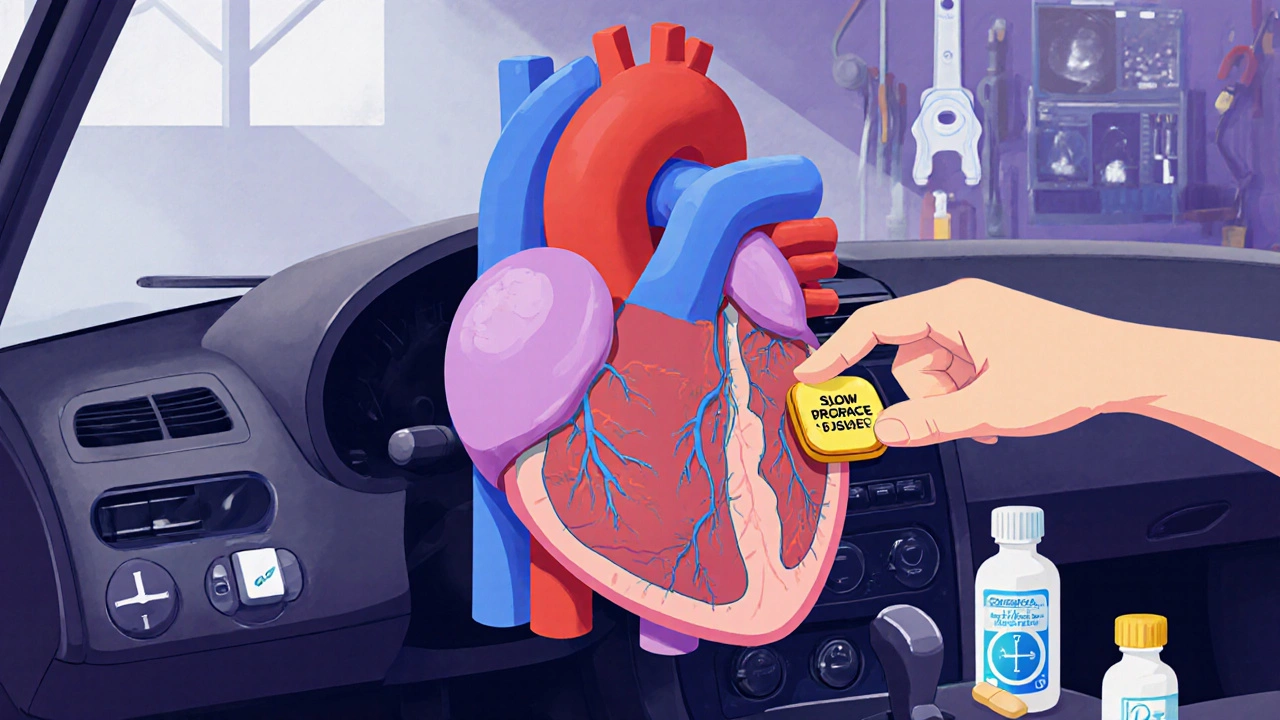
Think of it like a car with a stuck brake. The engine (your heart) is fine. But the brake (the valve) won’t release. Slowing the engine down might help the car last longer, but it won’t fix the brake. That’s why doctors used to avoid beta blockers in pure valvular disease. They feared reducing heart output too much.
But new data is changing that view.
The shift in medical thinking
A 2023 study in the European Heart Journal followed 1,200 patients with moderate to severe aortic regurgitation. Half were on carvedilol. The other half weren’t. After three years, those on carvedilol had slower heart enlargement and better exercise capacity. Their symptoms didn’t disappear-but they didn’t get worse as fast.
Another study in patients with mitral regurgitation found carvedilol reduced the size of the left ventricle by an average of 8% over 18 months. That’s meaningful. A smaller, less stretched heart is less likely to fail.
It’s not about curing the valve. It’s about protecting the heart from the extra work the valve forces it to do.
Who benefits most from carvedilol?
Carvedilol isn’t for everyone with valve disease. But it helps when:
- You have moderate to severe regurgitation (leaky valve) and early signs of heart enlargement
- Your ejection fraction is still normal or only slightly reduced (above 45%)
- You’re not yet on diuretics or ACE inhibitors
- You have symptoms like shortness of breath with light activity
It’s less useful in severe stenosis (narrowed valves), where the heart needs to pump hard just to get blood through. Slowing it down there can be dangerous.
Doctors usually start low: 3.125 mg twice a day. They increase slowly, watching for dizziness, low blood pressure, or swelling in the legs. Most patients tolerate it well after a few weeks.
How it compares to other heart meds
| Medication | How it works | Best for | Watch out for |
|---|---|---|---|
| Carvedilol | Slows heart, lowers pressure, reduces strain | Leaky valves with early heart enlargement | Low blood pressure, fatigue |
| Enalapril | Relaxes blood vessels, reduces fluid | High blood pressure, post-surgery | Cough, high potassium |
| Furosemide | Removes excess fluid | Swelling, shortness of breath | Dehydration, low sodium |
| Sacubitril/valsartan | Reduces strain, improves survival | Advanced heart failure, EF <40% | Low blood pressure, angioedema |
Carvedilol stands out because it doesn’t just treat symptoms. It changes how the heart adapts. Other drugs like enalapril help too, but they don’t slow the heart rate. Furosemide helps with swelling, but doesn’t protect the muscle. Sacubitril/valsartan is powerful-but only for advanced cases.
Real-world outcomes
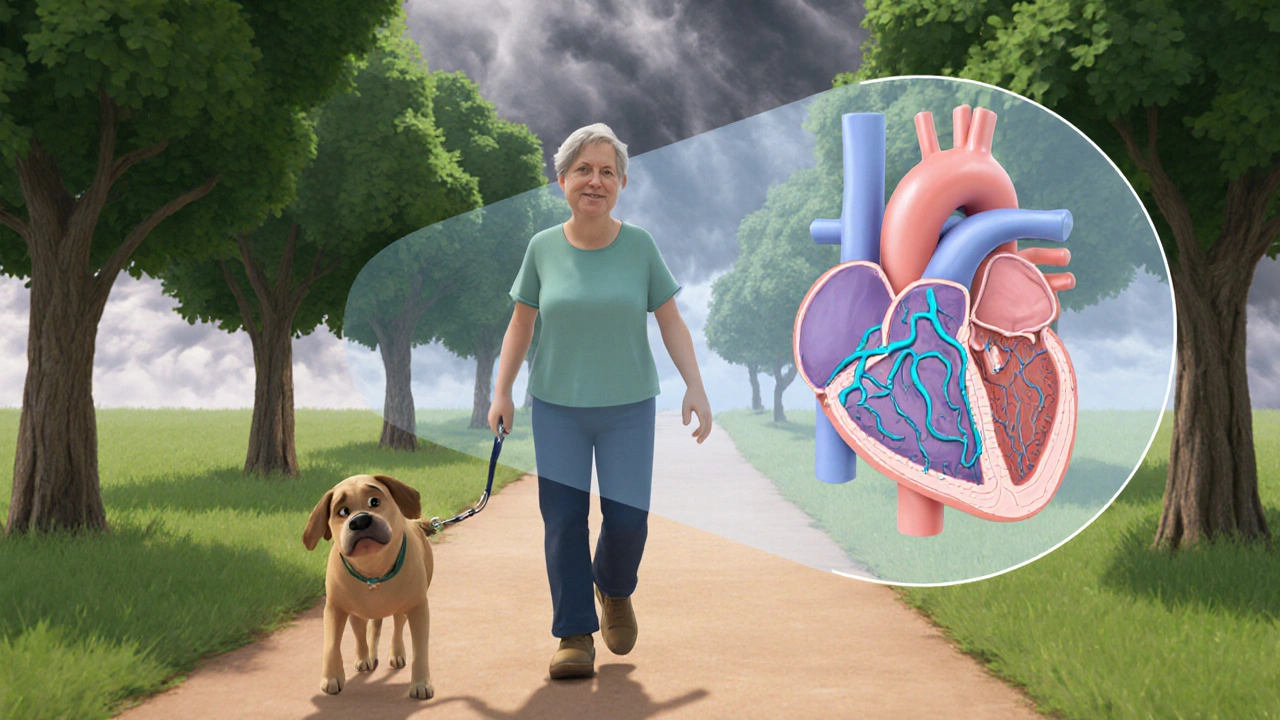
One patient I saw, 62, had severe mitral regurgitation after a heart attack. Her ejection fraction was 50%. She got tired walking up stairs. We started carvedilol at 3.125 mg. Six months later, her heart size had shrunk. She could walk her dog without stopping. She didn’t need surgery yet-and she didn’t want it.
That’s the goal: delay surgery, improve life, protect the heart. Not cure the valve. Not reverse damage. Just give the heart a fighting chance.
When carvedilol won’t help
It’s not a magic pill. Avoid it if:
- Your heart rate is already below 50 beats per minute
- You have asthma or severe COPD
- You have very low blood pressure (below 90/60)
- You have advanced heart failure with an ejection fraction under 30% and no improvement on other meds
- You have severe aortic stenosis without heart failure symptoms
Some patients get dizzy when they stand. That’s usually temporary. But if it lasts more than a week, the dose may be too high.
What to expect when starting
You won’t feel better right away. Carvedilol takes weeks to show effects. In the first week, you might feel more tired. That’s normal. Your body is adjusting.
Most people report:
- Less shortness of breath after 4-6 weeks
- More energy after 8-12 weeks
- Fewer palpitations or skipped beats
Your doctor will check your blood pressure, heart rate, and kidney function every 2-4 weeks at first. Then every 3-6 months if you’re stable.
Long-term use and monitoring
If carvedilol works for you, you’ll likely stay on it for life. Stopping suddenly can cause a rebound spike in blood pressure or heart rate. That’s dangerous.
Annual echocardiograms are key. They show if your heart is shrinking, staying the same, or getting worse. If the valve gets worse, surgery may still be needed-even if you’re on carvedilol.
But carvedilol gives you time. Time to plan surgery. Time to get stronger. Time to live better.
Bottom line: A tool, not a fix
Carvedilol doesn’t repair a leaky valve. It doesn’t replace surgery. But for many people with moderate valve disease and early heart strain, it’s the best tool we have to protect the heart until the next step.
If you’ve been told you have a leaky valve and you’re starting to feel it in daily life, ask your cardiologist: Could carvedilol help my heart hold up longer? It’s not a first-line treatment for all valve disease-but it’s not being ignored anymore either.
Can carvedilol fix a damaged heart valve?
No. Carvedilol doesn’t repair or replace a damaged valve. It helps protect the heart muscle from the extra strain caused by the faulty valve. It slows progression, reduces symptoms, and may delay the need for surgery-but it doesn’t fix the valve itself.
Is carvedilol better than metoprolol for heart valve disease?
Carvedilol has an edge because it blocks both beta and alpha receptors. This gives it stronger effects on blood vessel relaxation and heart protection. Studies show carvedilol reduces heart size more effectively than metoprolol in patients with regurgitation. Metoprolol is still used, but carvedilol is preferred when both are options.
Can I take carvedilol if I have high blood pressure and a leaky valve?
Yes. In fact, that’s one of the best scenarios. Carvedilol lowers blood pressure while also reducing the backward flow of blood from a leaky valve. It addresses both problems at once. Many patients with both conditions do very well on it.
How long does it take for carvedilol to start working for valve disease?
You might notice less fatigue or easier breathing in 4 to 8 weeks. But the real benefits-like reduced heart size or slower disease progression-show up on echocardiograms after 6 to 12 months. Patience is key.
What happens if I stop taking carvedilol suddenly?
Stopping carvedilol abruptly can cause a sudden spike in heart rate and blood pressure. This increases the risk of heart attack or worsening heart failure. Always taper off slowly under medical supervision. Never stop on your own.
Does carvedilol interact with other heart medications?
Yes. It can interact with calcium channel blockers like diltiazem or verapamil, increasing the risk of slow heart rate. It also lowers blood pressure when taken with ACE inhibitors or diuretics. Always tell your doctor about every medication you take, including over-the-counter ones.
Next steps if you’re considering carvedilol
If you have heart valve disease and are wondering if carvedilol could help:
- Get a recent echocardiogram to confirm the severity of your valve problem
- Ask your cardiologist about your ejection fraction and heart chamber sizes
- Discuss whether your symptoms are linked to heart strain or just the valve itself
- Review your current medications-some may be doing the same job
- Start low and go slow if you begin carvedilol
Heart valve disease doesn’t always need surgery right away. Sometimes, the best thing you can do is give your heart a break. Carvedilol might be the tool that helps you do just that.

Carvedilol doesn't fix the valve, but it gives the heart a fighting chance. I've seen patients go from barely walking to hiking weekends on this stuff. Not magic, just smart physiology.
The analogy of the stuck brake is profoundly accurate. We treat the engine when the real problem is the brake. Medicine often confuses adaptation with pathology. Carvedilol doesn't cure-it moderates. And sometimes, moderation is the most radical act.
I had a cousin on this after her mitral leak got worse post-heart attack. She was skeptical at first-felt like a zombie for the first two weeks. But by month three? She was gardening again. No surgery. Just slower, steadier healing. Worth the wait.
Biggest thing people miss? Carvedilol isn't about feeling better tomorrow. It's about not needing surgery in five years. I've had patients who thought they were just 'getting old'-turns out their heart was screaming for help. This drug gives you time. Time to plan. Time to prepare. Time to live. Don't underestimate the power of delayed intervention.
And yes, start low. 3.125 mg isn't a joke. I've seen too many people crash their BP trying to go full throttle. Slow and steady wins the race here.
Big Pharma loves carvedilol because it keeps people on pills forever. The valve isn't fixed. The heart is still under stress. Why not fix the valve? Surgery is scary but real. Pills are profitable. Ask yourself who benefits. The patient? Or the stockholders?
Also why is everyone ignoring the fact that beta blockers mask symptoms? You're not healing-you're hiding the problem until it explodes. And don't get me started on how they don't test for rebound hypertension after stopping. People die from this. Quietly. Unnoticed.
Look, in India we don't have the luxury of fancy beta blockers. We use what works. And carvedilol? It's expensive. And frankly, if you're in a country where people still die from untreated hypertension, this feels like a luxury debate. But sure, if you're in Beverly Hills and your echocardiogram says 'slight enlargement,' go ahead and take your little pill. Meanwhile, the rest of us are waiting for a doctor who shows up.
It's funny how we glorify pharmacology as wisdom when it's really just managing symptoms. We've turned medicine into a maintenance contract. The valve leaks? Here's a pill to make the heart less angry. The body isn't broken-it's trying to adapt. And we punish it for trying. Carvedilol is just another bandage on a bullet wound.
But I get it. It's easier to prescribe than to explain why lifestyle, diet, and stress reduction are the real cure. But nobody gets paid for that.
Carvedilol isn't a cure but it's the closest thing we have to buying time. I've seen it turn borderline candidates into surgical candidates who actually survive the operation. That's huge. No hype. Just science.
Think of the heart like a stressed-out athlete. The valve is the injury. Carvedilol isn't the surgery-it's the rest, the ice, the recovery plan. You don't fix the torn ligament with rest. But you give the body a chance to heal around it. That's what this is. Patience isn't passive. It's strategic.
And yeah, the side effects? Real. But so is the alternative. A heart that's been stretched too far for too long doesn't bounce back. Carvedilol slows the stretch. That's not denial. That's wisdom.
Carvedilol? That's just another American overmedication scam. In Europe they use natural remedies and diet. Here we just pump people full of chemicals and call it progress. And don't even get me started on how they ignore the fact that stress and pollution are the real causes. This is just corporate medicine pretending to be science.