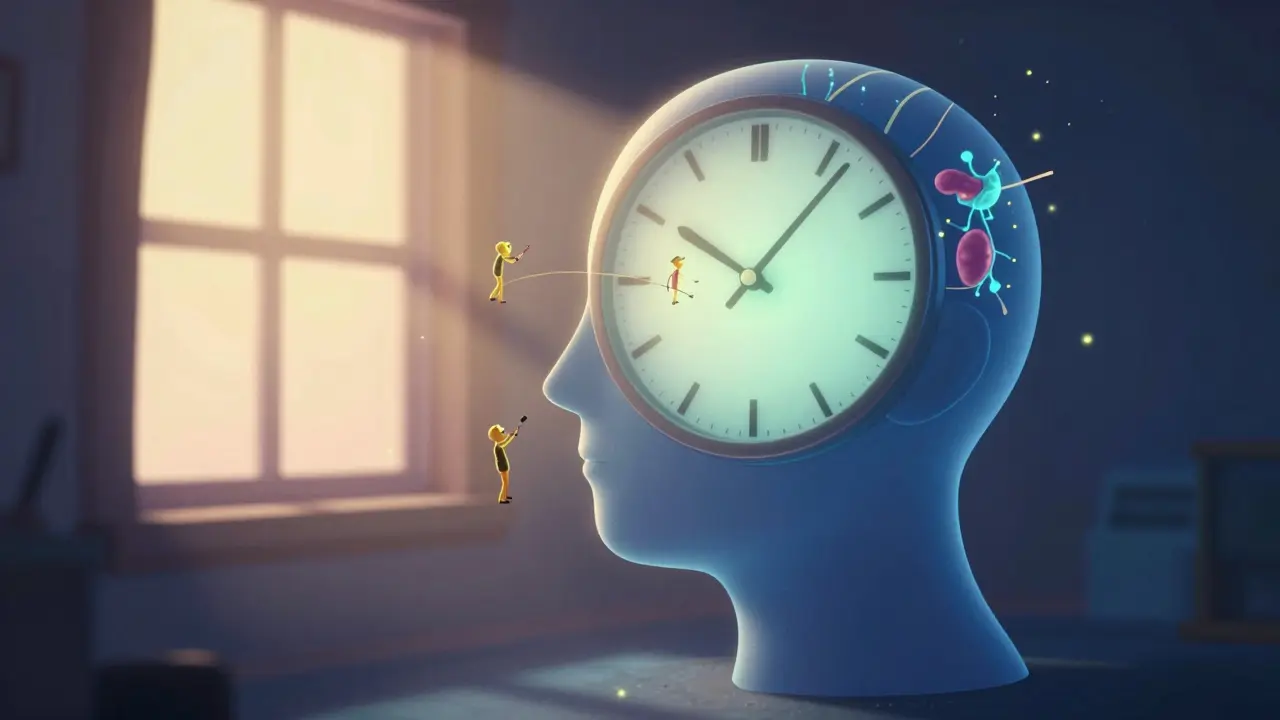
Most people think sleep problems are just about being tired. But what if your body is fighting against a clock it can’t control? That’s the reality for millions living with circadian rhythm disorders - especially jet lag and delayed sleep phase disorder. These aren’t just "bad sleep habits." They’re biological mismatches between your body’s internal timing and the world around you. And they’re more common - and more disruptive - than you think.
What Exactly Is a Circadian Rhythm?
Your circadian rhythm is your body’s 24-hour internal clock. It doesn’t just tell you when to sleep - it controls body temperature, hormone release, digestion, even when you feel most alert. This rhythm is driven by a tiny cluster of cells in your brain called the suprachiasmatic nucleus. Think of it like a conductor leading an orchestra: every organ and system in your body follows its lead.
Light is the biggest signal that resets this clock. When sunlight hits your eyes in the morning, your brain gets the message: "It’s time to wake up." At night, darkness triggers melatonin production - the hormone that makes you sleepy. But when that light-dark cycle gets thrown off, your whole system goes out of sync.
Jet Lag: When Your Body Gets Left Behind
Jet lag hits fast. You board a plane in London at 8 PM, land in Tokyo 12 hours later, and suddenly it’s 4 AM local time. Your body still thinks it’s 9 PM. You’re wide awake when everyone else is asleep. You drag through the day, nauseous, foggy, and exhausted.
This isn’t just fatigue. Studies show jet lag can drop your cognitive performance by 20-30%. That means slower reaction times, poor decision-making, even memory lapses. Eastward travel is worse because it forces you to go to bed earlier - something your body resists. Your natural rhythm runs slightly longer than 24 hours (about 24.2 hours), so delaying sleep (westward) is easier than advancing it (eastward).
How long does it last? Roughly one day per time zone crossed. Cross five zones? Expect 5-7 days to feel normal. That’s why frequent flyers - especially business travelers - often rely on melatonin, sleep aids, or caffeine just to keep up. But these are quick fixes. The real fix is light.
Here’s what works: If you’re flying east, get bright light in the morning at your destination. If you’re flying west, seek light in the evening. The "rule of 15" helps: 15 minutes of bright light exposure each day, timed correctly, can shift your clock by about one hour. Start adjusting your sleep schedule 3-5 days before departure. Even small shifts - going to bed 30 minutes earlier each night - make a big difference.
Delayed Sleep Phase Disorder: The Night Owl Trap
Jet lag is temporary. Delayed sleep-wake phase disorder (DSWPD) is chronic. People with DSWPD don’t choose to stay up late - their bodies force them to. Sleep onset typically happens between 3 AM and 6 AM. They wake up naturally between 10 AM and 1 PM. When they follow this schedule, they sleep just fine. But when they try to wake up at 7 AM for work or school? Disaster.
This isn’t laziness. It’s biology. A 2020 study found that people with DSWPD have melatonin onset about two hours later than others. That means their internal "sleep signal" doesn’t kick in until deep into the night. Genetics play a big role too - variations in genes like PER3 and CRY1 explain up to 40% of the timing differences in teens and young adults.
Imagine being a 22-year-old student who can’t focus in 8 AM lectures. Or a software developer whose brain works best at 2 AM but is stuck in a 9-to-5 job. Their sleep is normal - just misaligned. That’s why many end up using stimulants like modafinil just to survive the day. But that only makes things worse. Over time, it creates insomnia, anxiety, and a vicious cycle of sleep debt.
And it’s common. Between 7% and 16% of teens and young adults have DSWPD. Yet most never get diagnosed. Doctors assume it’s just poor discipline. But it’s not. It’s a neurological condition.

How to Fix It: Light, Melatonin, and Consistency
There’s no magic pill. But science has clear, proven tools.
For jet lag: Use light strategically. Wear blue-light-blocking glasses in the evening if you’re trying to advance your clock. Get outside for natural sunlight as soon as possible after landing. Avoid naps longer than 20 minutes. Hydrate. Skip heavy meals and alcohol. If you’re traveling for more than four days, adjust your sleep schedule gradually before you leave.
For DSWPD, the gold standard is a three-part approach:
- Morning bright light therapy: 30-60 minutes of 10,000 lux light exposure within one hour of your natural wake time. This tells your brain: "It’s morning."
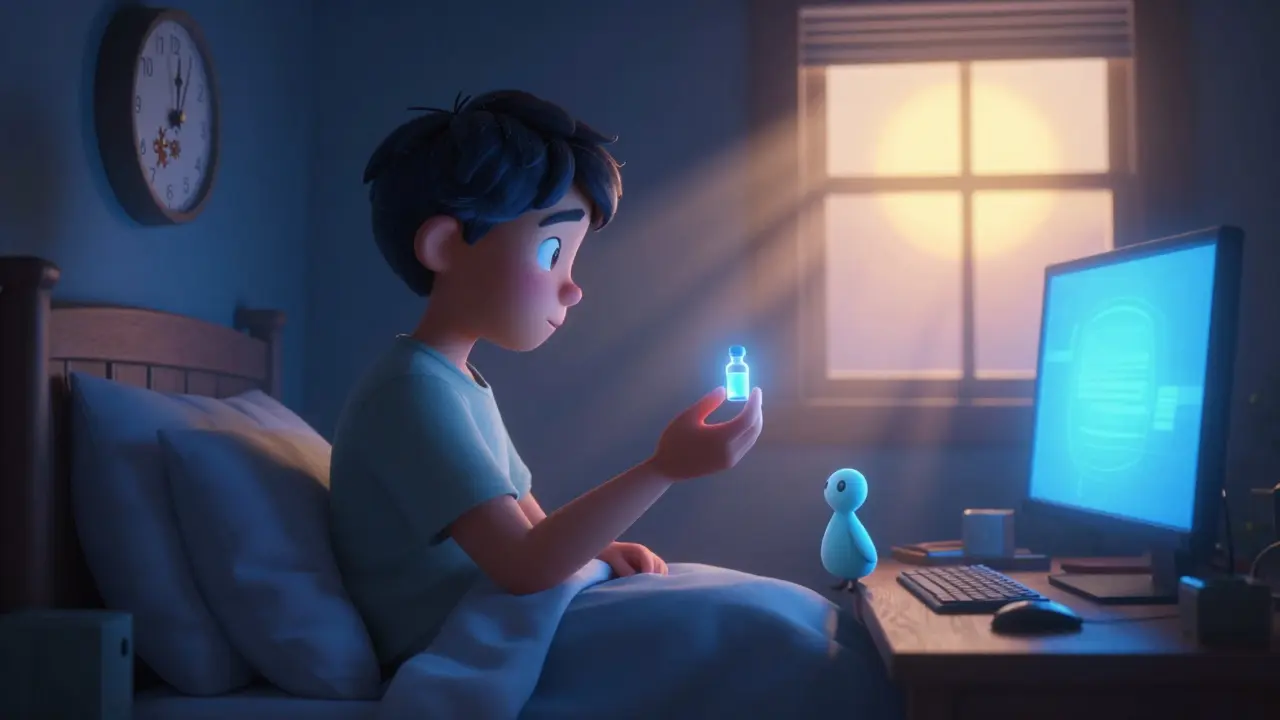
- Evening melatonin: 0.5 mg taken 5-7 hours before your desired bedtime. That’s half a milligram - not the 3-5 mg most people take. Higher doses don’t work better. They just make you groggy.
- Strict sleep schedule: Same bedtime and wake time every day - even on weekends. This is the hardest part. But skipping it on Friday night undoes weeks of progress.
A 2022 review found this combo moves your sleep phase forward by over two hours in four weeks. Single treatments? Only half as effective.
Real people report success. One 24-year-old in a 2023 Sleep Foundation survey shifted from 4 AM to 12 AM sleep by combining morning light with melatonin and a phone alarm that forced her out of bed. She started attending classes again. Another man, a night-shift worker, used timed light exposure to reset his clock after switching to days. His energy improved in six weeks.
Why This Matters Beyond Sleep
Ignoring circadian rhythm disorders isn’t just about feeling tired. Long-term misalignment increases your risk of serious health problems. Data from the UK Biobank shows people with untreated circadian disruption have a 29% higher risk of type 2 diabetes and a 23% higher risk of heart disease. Why? Because your metabolism, insulin sensitivity, and inflammation levels all follow your sleep-wake cycle. When that cycle is broken, your body starts to break down.
Even your immune system suffers. A 2021 study found that shift workers - who often have circadian misalignment - had 30% lower antibody response to vaccines compared to day workers. Your body can’t repair itself properly if it’s always running on the wrong schedule.
What’s Changing Now
The good news? Circadian medicine is finally getting attention. The latest sleep classification (ICSD-4, released in 2023) now requires objective measurements - like melatonin timing - to diagnose DSWPD. That means doctors can’t just dismiss it as "laziness."
New tools are helping. Apps like Timeshifter use algorithms to give personalized light and sleep advice based on your travel route or sleep pattern. Wearable devices now track your body temperature and light exposure to estimate your circadian phase. Some clinics offer saliva tests to measure melatonin timing - a simple, non-invasive way to confirm a diagnosis.
And companies are starting to adapt. Over two-thirds of Fortune 500 companies now have shift-work optimization programs. Universities are offering later class times for students with documented sleep disorders. It’s slow - but it’s happening.
What You Can Do Today
If you’re struggling with sleep that doesn’t fit the norm, here’s your action plan:
- Track your sleep for two weeks. Use a simple journal: when you go to bed, when you wake up, how you feel.
- Get morning sunlight - even on cloudy days. 15 minutes outside before 10 AM helps reset your clock.
- If you’re trying to sleep earlier, take 0.5 mg melatonin 6 hours before your target bedtime. Don’t take more.
- Stop using screens an hour before bed. Blue light delays melatonin even more.
- Don’t try to "catch up" on weekends. Consistency beats recovery.
It takes time. Most people don’t see results until after 4-6 weeks. But if you stick with it, your body will adapt. You don’t need to be a night owl or a morning person. You just need your rhythm to match your life.
Is jet lag worse when flying east or west?
Jet lag is typically worse when flying east. That’s because flying east forces you to go to bed earlier - which goes against your body’s natural tendency to delay sleep. Your internal clock runs slightly longer than 24 hours, so delaying sleep (westward) is easier than advancing it (eastward). Studies show eastward travelers experience about 37% more sleep disruption than those flying west.
Can melatonin cure delayed sleep phase disorder?
Melatonin alone is not enough. While it helps signal bedtime, most people with delayed sleep phase disorder need a combination of treatments: low-dose melatonin (0.5 mg) taken 5-7 hours before desired bedtime, plus bright light therapy in the morning, and strict sleep schedule consistency. Studies show this three-part approach moves the sleep phase forward by over two hours - far more than melatonin alone.
Why do I feel fine when I sleep late but exhausted when I try to wake up early?
Because your sleep quality isn’t the issue - your timing is. People with delayed sleep phase disorder sleep just as deeply and for just as long as others - when they follow their natural schedule. The problem comes when they’re forced to wake up earlier than their body allows. That’s when sleep debt builds, leading to fatigue, poor focus, and mood swings. It’s not laziness. It’s a biological mismatch.
Is delayed sleep phase disorder just teenage behavior?
No. While it’s common in teens and young adults - affecting 7-16% of this group - it can persist into adulthood. Many adults with DSWPD have had it since adolescence. It’s not a phase. It’s a persistent circadian rhythm disorder with genetic roots. It doesn’t go away on its own, and untreated, it can lead to chronic sleep deprivation and health risks.
How long does it take to fix a circadian rhythm disorder?
Jet lag usually resolves in 1-1.5 days per time zone crossed. For delayed sleep phase disorder, it takes longer. With consistent treatment - morning light, evening melatonin, and fixed sleep times - most people see noticeable improvement in 4-6 weeks. Full adjustment can take up to 8-12 weeks. Patience and consistency are key. Skipping the routine on weekends will reset your progress.
Just tried the 15-minute morning sunlight trick after reading this and wow-my 8 AM alarm doesn’t feel like a death sentence anymore 🌞
I’ve been living with DSWPD since I was 16, and honestly? This is the first time I’ve read something that didn’t make me feel like a lazy piece of shit. The part about melatonin being 0.5mg and not 5mg? Game changer. I was taking what the bottle said-no wonder I felt like a zombie. Started the light therapy + low-dose melatonin combo three weeks ago. I’m now sleeping at 1 AM instead of 5 AM. Not perfect, but I can finally show up to my 9-to-5 without looking like I got hit by a truck. Thank you for writing this. Seriously.
Thank you for sharing this. I’ve been telling my coworkers for years that ‘just go to bed earlier’ doesn’t work for people with circadian disorders. It’s not about willpower-it’s biology. I’m so glad we’re starting to see real research and clinical recognition of this. The UK Biobank stats on diabetes and heart disease? Chilling. We need more awareness, not more judgment.
LMAO so now we’re giving out medical advice like it’s a TikTok hack? ‘Take 0.5mg melatonin’ like it’s a damn vitamin C chew. Meanwhile, people are popping modafinil like M&Ms and calling it ‘productivity.’ You think this is a fix? Nah. This is just another bandaid on a broken system. The real problem? Society refuses to adapt to human biology. We’re all forced into 9-to-5 cages while our genes scream for midnight. Wake up. The clock isn’t broken-you are. Or rather, the whole damn structure is. 🤷♂️
As someone who works in neurology, I’ve seen this over and over. DSWPD isn’t a phase, it’s a phenotype. The PER3 and CRY1 variants? Yeah, they’re real. And yes, it’s genetic. But here’s what no one says: the real barrier is diagnosis. Most GPs don’t even know melatonin onset timing is a diagnostic tool. We need saliva test kits in primary care. Not just for teens. For adults who’ve been told they’re ‘just not disciplined’ for 15 years. This post? It’s a lifeline.
Why are people so obsessed with fixing their sleep when they could just adapt? I’ve worked night shifts for 12 years. You don’t need light therapy or melatonin-you need discipline. Stop scrolling at 2 AM. Stop drinking coffee after 4 PM. Stop making excuses. This isn’t a medical condition-it’s a lifestyle failure. If you can’t control your phone use, how are you supposed to control your life?
wait so if my body naturally wants to sleep at 4am but i have to wake up at 7am… that’s not laziness? i thought i was just a loser lol. i’ve been taking 5mg melatonin for 3 years and i still wake up at 3am wide awake. i didn’t know 0.5mg was the magic number. also-blue light blocking glasses? i have those but never used them. gonna try the morning sun thing tomorrow. thanks for this.
Have you ever considered that circadian rhythm disorders aren’t biological at all? They’re a product of artificial lighting. Before the Industrial Revolution, humans slept in two shifts-first sleep, then wakefulness, then second sleep. We were synchronized with natural cycles. Now? We’re trapped in a 24/7 electric cage. The real cure isn’t light therapy-it’s rejecting the entire modern schedule. Work 4-hour shifts. Live in natural light. Let your body follow the sun. The fact that we’re treating symptoms instead of the root cause? That’s the real pathology. We’ve turned biology into a bug to be patched. It’s not science. It’s techno-optimism dressed as medicine.
Just wanted to say-the part about weekend consistency? That hit me hard. I thought I was doing okay because I slept in on Sundays. Turns out, I was sabotaging 5 days of progress in 48 hours. Started sticking to my 12 AM - 8 AM schedule even on weekends. 3 weeks in. No more 2 PM crashes. I’m not a morning person, but now I’m functional. And honestly? I feel like I got my brain back.