
Clozapine Dose Adjustment Calculator
Critical Warning
Clozapine dose adjustments must be done under medical supervision. This calculator provides general guidance only.
When you’re taking clozapine for treatment-resistant schizophrenia, your life already involves careful monitoring-blood tests, regular check-ins, watching for side effects. But there’s one thing many patients and even some doctors overlook until it’s too late: smoking. If you smoke, or if you’ve recently quit, your clozapine levels could be dropping-or spiking-without you even realizing it. And that’s not just inconvenient. It can be dangerous.
Why Smoking Changes How Clozapine Works
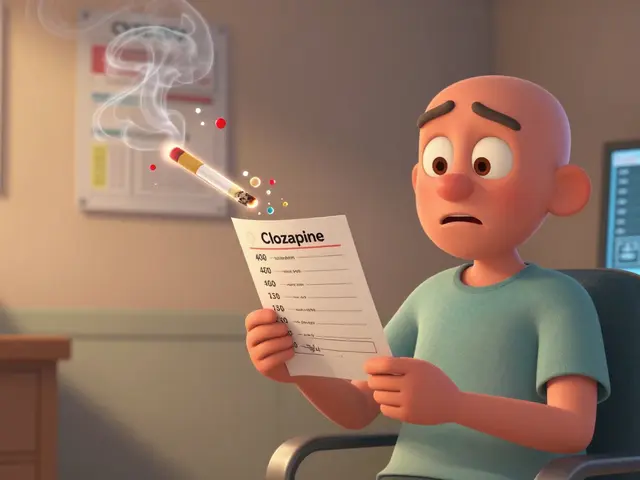
Clozapine doesn’t just sit in your body waiting to work. It’s broken down by enzymes, mostly one called CYP1A2. This enzyme lives in your liver and does the heavy lifting of metabolizing the drug so your body can get rid of it. But tobacco smoke doesn’t just harm your lungs-it tricks your liver into making way more CYP1A2 than normal. The chemicals in cigarette smoke, especially polycyclic aromatic hydrocarbons, activate something called the aryl hydrocarbon receptor. This triggers your liver to crank out extra CYP1A2 enzymes. More enzymes mean clozapine gets broken down faster. That means less of it stays in your bloodstream. Studies show that on average, smokers have 30% less clozapine in their blood than non-smokers. For some, the drop hits 50%. This isn’t theoretical. Real patients report it. One Reddit user shared that after starting to smoke, their clozapine level dropped from 400 ng/mL to 150 ng/mL-well below the therapeutic range. Their symptoms came roaring back. Their doctor had to bump their dose from 300 mg to 500 mg just to get back on track.The Dangerous Flip Side: Quitting Smoking
The problem doesn’t stop when you start smoking. It gets worse when you quit. When you stop smoking, your body doesn’t immediately stop making extra CYP1A2. It takes one to two weeks for enzyme levels to return to normal. But if you keep taking the same high dose you were on while smoking, your clozapine levels will start climbing. Fast. A case report from 2022 described a 45-year-old woman who quit smoking but kept her 400 mg daily dose of clozapine. Within days, her blood level shot up to 850 ng/mL-above the toxic threshold. She became extremely drowsy, her heart raced, and she nearly ended up in the ICU. Her dose had to be slashed to 250 mg. She was lucky. Others aren’t. Toxic clozapine levels can cause seizures, heart problems, and even a dangerous drop in white blood cells called agranulocytosis. That’s why the FDA includes a boxed warning for clozapine: the risk is real, and smoking status changes are a major trigger.Why Clozapine Is Unique
Not all antipsychotics react this way. Olanzapine is also broken down by CYP1A2, but not as heavily. Clozapine relies on CYP1A2 for 60-70% of its clearance. For most other drugs, that number is closer to 20-30%. That’s why clozapine is the most sensitive to smoking. Risperidone? Mostly handled by CYP2D6. Quetiapine? CYP3A4. Neither is significantly affected by tobacco smoke. But if you’re on clozapine, you’re in a different category. This isn’t just a side note-it’s the central issue in your treatment plan.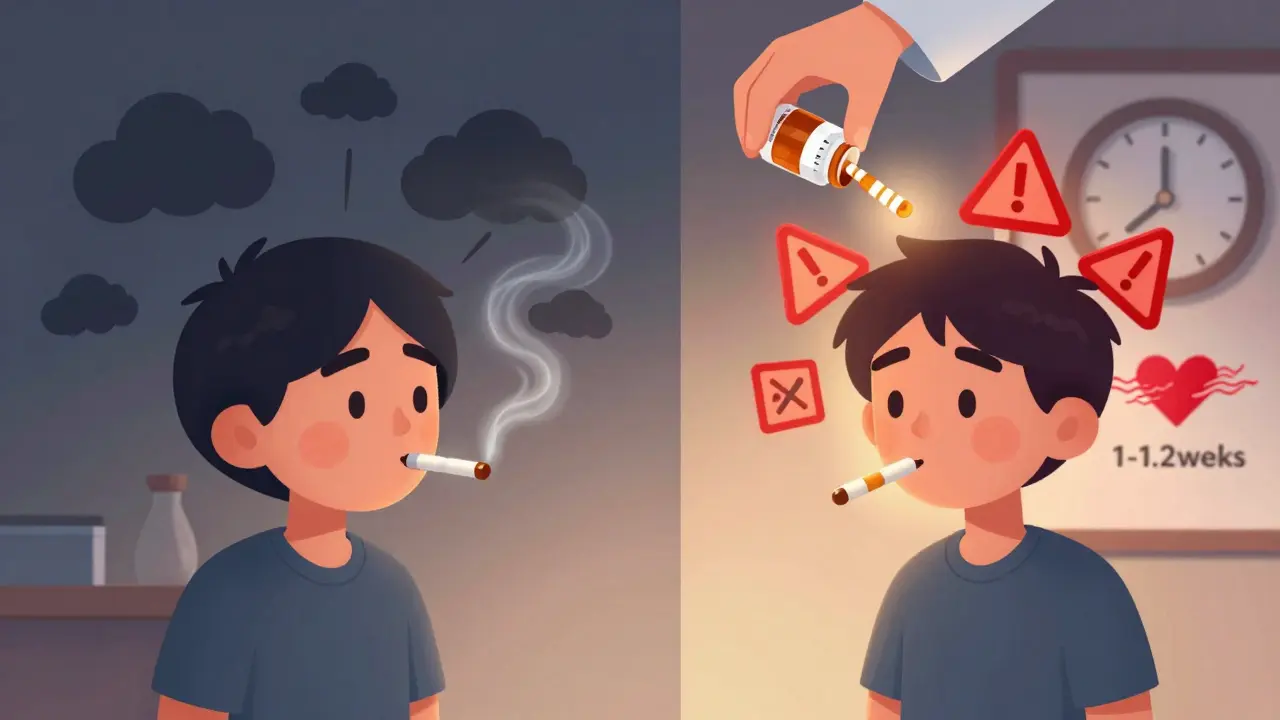
How Doctors Adjust Doses
If you start smoking while on clozapine, your dose usually needs to go up by 40-60%. That means if you were on 300 mg, you might need 450-500 mg. But you don’t just guess. You check your blood level first. The American Psychiatric Association recommends getting a clozapine level drawn before any dose change, and then again 4-7 days after adjusting. That’s the only way to know if you’re in the therapeutic range (350-500 ng/mL). If you’re below 300 ng/mL and still having hallucinations or paranoia, smoking is likely the culprit. When you quit smoking, the opposite happens. Dose reductions of 30-50% are typical. But here’s the catch: you can’t do it all at once. A sudden 50% drop in dose might be too aggressive if your enzyme levels haven’t fully normalized. Most clinicians reduce the dose by 20-25% at first, then recheck levels after 7-10 days.Genetics Make It Even More Complicated
Not everyone responds the same way. Your genes matter. Some people have a genetic variant called CYP1A2 *1F/*1F. They start with normal enzyme levels, but their bodies overreact to tobacco smoke. When they smoke, their clozapine levels crash harder than others. Studies show they may need even bigger dose increases than average. On the flip side, some people naturally produce less CYP1A2. They might need lower doses to begin with. If they smoke, the effect is still there-but not as dramatic. That’s why blanket rules don’t work. One size doesn’t fit all.What About Vaping?
A lot of people think switching to e-cigarettes avoids this problem. It doesn’t. A 2024 study from the University of Toronto found that e-cigarettes still induce CYP1A2-just slightly less than traditional cigarettes. If you vape, your clozapine levels are still likely lower than if you didn’t use nicotine at all. Don’t assume vaping is safe. It’s not.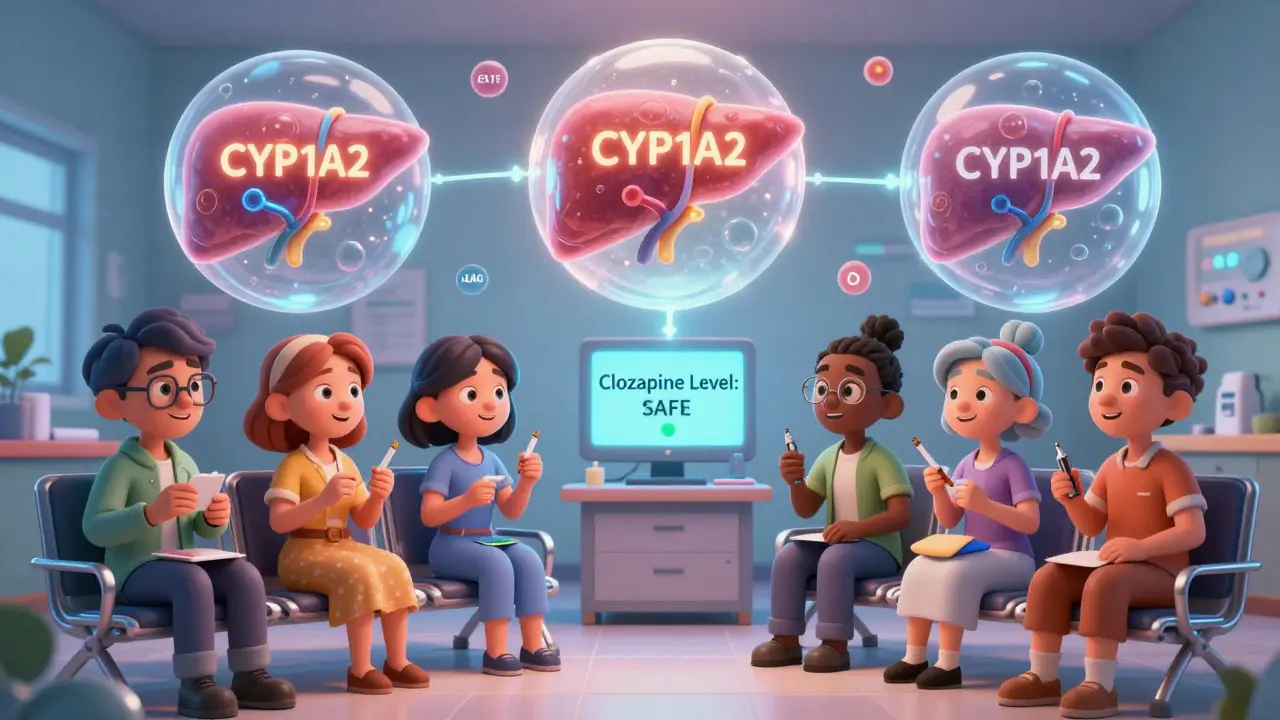
What You Should Do
If you’re on clozapine, here’s what actually works:- Always tell your doctor if you smoke, vape, or use nicotine patches/gum.
- Ask for a baseline clozapine blood level before any dose changes.
- If you start smoking, expect your dose to increase. Don’t wait until your symptoms return.
- If you quit smoking, tell your doctor immediately. Don’t assume your dose is still right.
- Get your levels checked again 7-10 days after any change in smoking habits.
- Don’t try to quit smoking on your own without medical support. The risk of toxicity is real.
Why This Matters Beyond the Numbers
This isn’t just about chemistry. It’s about your quality of life. Patients who’ve had their doses adjusted properly after quitting smoking often say they feel better than they have in years. One person on PatientsLikeMe wrote: “I tried to quit three times. Each time, I ended up hospitalized because my clozapine went toxic. This time, my doctor knew what to do. I’ve been stable for 14 months.” On the other hand, patients who aren’t monitored properly often cycle in and out of hospitalization. A 2021 study found that unmanaged smoking interactions led to 22% more hospital stays-and each one cost over $14,500. The good news? Hospitals and clinics are starting to catch on. Electronic health records now have alerts that pop up when a clozapine patient’s smoking status changes. One 2023 study showed these alerts cut adverse events by 37%.The Bigger Picture
About 60-70% of people on clozapine smoke-more than four times the rate of the general population. That’s not a coincidence. Smoking is often used to self-medicate side effects like sedation or cognitive fog. But it backfires by making the drug less effective. Researchers are working on solutions: sustained-release clozapine formulations that smooth out blood level swings, and genetic tests to predict who’ll need bigger adjustments. But right now, the best tool is simple: communication and monitoring. Clozapine remains the most effective treatment for treatment-resistant schizophrenia. But its power comes with responsibility. Ignoring smoking status isn’t negligence-it’s a preventable risk. And that risk doesn’t have to be yours.Does quitting smoking make clozapine more effective?
No-quitting smoking doesn’t make clozapine more effective. It makes it more dangerous if your dose isn’t lowered. When you stop smoking, your body slows down how fast it breaks down clozapine. That means the same dose can build up to toxic levels. You need to reduce your dose, not increase it, after quitting.
Can I just switch to another antipsychotic to avoid this problem?
You can, but it’s not always a good idea. Drugs like quetiapine or aripiprazole aren’t affected by smoking, but they’re not as effective as clozapine for treatment-resistant schizophrenia. Clozapine works when nothing else does. Switching might mean losing control of your symptoms. The better approach is to manage the interaction, not avoid the drug.
How long after quitting smoking should I wait before lowering my clozapine dose?
Don’t wait. Tell your doctor the day you quit. CYP1A2 enzyme levels start dropping within 48 hours, but it takes 1-2 weeks to fully return to normal. Most doctors reduce the dose gradually over 7-14 days, checking blood levels every week until they stabilize. Waiting too long risks toxicity.
Is it safe to use nicotine gum or patches while on clozapine?
Nicotine patches and gum don’t induce CYP1A2 the way smoke does, so they don’t lower clozapine levels. But they still deliver nicotine, which can affect your heart rate and blood pressure. They’re often safer than smoking, but you still need to monitor your clozapine levels and symptoms closely. Talk to your doctor before switching.
Why do some doctors not know about this interaction?
Many psychiatrists know, but not all. Clozapine is prescribed by specialists, but primary care doctors and even some pharmacists may not be aware. A 2023 survey found that 68% of psychiatrists routinely check smoking status in clozapine patients, but only 42% of non-specialists do. If your doctor doesn’t ask, bring it up. Your safety depends on it.
Can genetic testing help me manage my clozapine dose better?
Yes, but it’s not yet standard. Testing for the CYP1A2 *1F variant can show if you’re more sensitive to smoking’s effects. Some academic centers now offer this, especially for patients with unstable levels. It’s not a magic solution, but it helps personalize dosing. Ask your prescriber if pharmacogenetic testing is available in your area.
Tl;dr: quit smoking? tell your psychiatrist. NOW.
Let’s be real-clozapine doesn’t fix you. It just makes you less of a burden. And smoking? It’s the only thing that makes you feel human again. So yeah, maybe your levels crash. Maybe you need 500mg. So what? At least you’re not crying in the shower.