Sedative Combination Safety Checker
Check Your Medication Combination
Combining sedatives can multiply their effects, increasing the risk of respiratory depression and overdose. This tool helps you understand potential risks from common combinations.
Risk Assessment Result
What to do next
- Bring all your medications to your next doctor visit
- Ask: "Could any of these interact dangerously?"
- Never mix with alcohol
- Report symptoms: slow breathing, confusion, unresponsiveness
When you take one sedative, your body slows down a little. Take two, and it slows down more. But take three or more together? That’s when things get deadly - not because each one is strong, but because they multiply each other’s effects. This isn’t just a theoretical risk. It’s happening in real lives, every day, in homes, clinics, and emergency rooms across the country.
What Happens When Sedatives Combine?
Sedatives - including benzodiazepines like Xanax or Valium, opioids like oxycodone or hydrocodone, sleep aids like zolpidem, and even alcohol - all work the same way. They boost a brain chemical called GABA, which tells your nervous system to chill out. That’s fine if you’re using one, at the right dose, for the right reason. But when you stack them, the effect isn’t just added. It’s multiplied. This is called synergistic CNS depression.Instead of your breathing slowing from 16 breaths per minute to 12, it might drop to 8. Or 6. Or stop altogether. Oxygen levels in your blood can plunge below 90%, then 85%, then below 80%. At that point, your brain starts to die. Permanent damage can happen in under 5 minutes. Death follows quickly after.
The FDA first issued a formal warning in 2016: combining opioids with benzodiazepines increases the risk of fatal overdose by 2.5 to 4.5 times. That’s not a small increase. That’s a death sentence waiting to happen. And it’s not just opioids. Mixing alcohol with any of these drugs? Same result. Even some antidepressants - especially SSRIs - can interfere with how your body breaks down sedatives, causing dangerous buildups in your bloodstream.
Who’s at Highest Risk?
You might think this only happens to people who abuse drugs. But the truth is, most of these dangerous combinations are prescribed.Elderly patients are the most vulnerable. Why? Because their bodies process drugs slower. Their livers and kidneys don’t work as well. Their brains are more sensitive. A study of older adults found that those taking three or more CNS depressants had a 45% higher chance of being hospitalized for a fall. And falls? They’re not just bruises. They’re broken hips, brain bleeds, long-term disability, and early death.
Women are 1.7 times more likely than men to be prescribed multiple sedatives. People with depression? Twice as likely. Those on high-dose opioids (100 morphine milligram equivalents or more per day)? Their odds of also taking a benzodiazepine jump to 39%. And in 12% of cases, they’re drinking alcohol within two hours of taking their opioid.
The American Geriatrics Society Beers Criteria lists 34 medications that should be avoided in older adults - not because they’re useless, but because the risks outweigh the benefits. Yet, doctors still prescribe them. Patients still take them. And families don’t always know what’s in the medicine cabinet.
The Silent Epidemic in Prescriptions
You wouldn’t mix gasoline and diesel in your car. Why do we mix sedatives in our bodies?A 2020 review found that despite CDC guidelines warning against it, over 10% of patients on long-term opioid therapy were still getting benzodiazepines prescribed alongside them. That’s over 1 million people in the U.S. alone. Why? Because pain, anxiety, and insomnia often come together. Doctors want to help. But they’re not always trained to see the hidden danger.
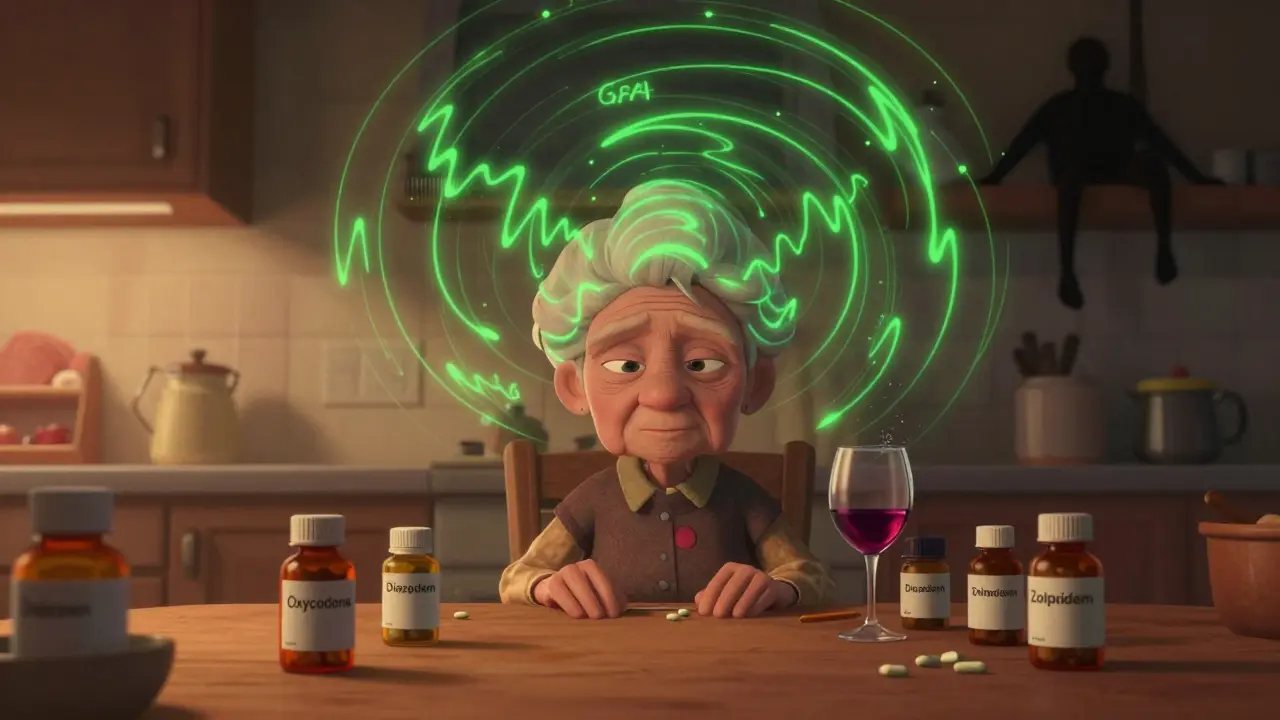
One patient I know - a 68-year-old woman with chronic back pain and insomnia - was prescribed oxycodone, diazepam, and zolpidem. Her doctor didn’t realize the combination. Neither did she. She started nodding off during meals. Then she fell in the bathroom. Her hip broke. She never walked the same again.
It’s not just opioids. Combining sleep aids with antidepressants, anti-anxiety meds with muscle relaxers, or even over-the-counter sleep remedies with alcohol? All of it adds up. A 2022 study found that nearly 70% of hospitalizations for major depression involved patients taking more than one CNS-acting drug. And doctors? They had little guidance on what was safe.
What You Can Do - Before It’s Too Late
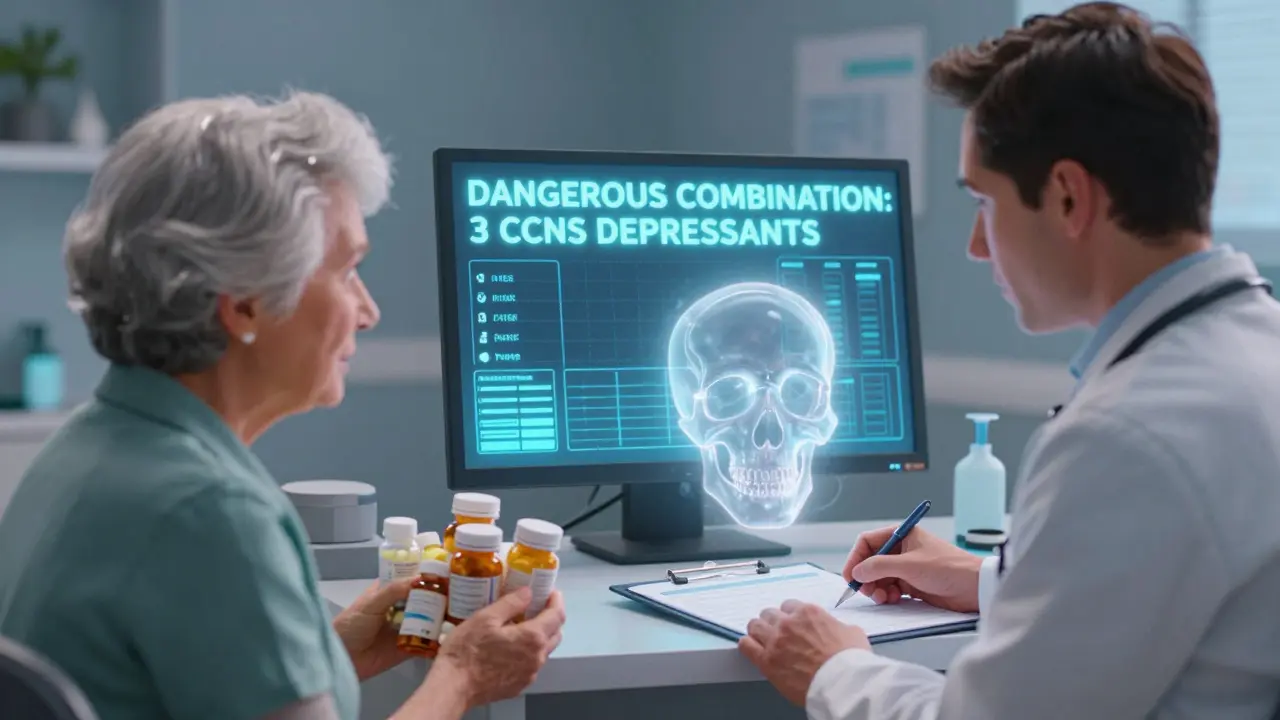
If you’re on more than one sedative, here’s what you need to do now:- Ask your doctor for a full medication review. Don’t wait for your annual checkup. Bring every pill bottle - including supplements and OTC sleep aids - and ask: “Could any of these be dangerous together?”
- Know the signs of overdose. Slowed breathing, confusion, unresponsiveness, cold or clammy skin, blue lips or fingernails. If you see these, call 911 immediately. Naloxone can reverse opioid overdoses, but it won’t help with benzodiazepines or alcohol. Only emergency care can.
- Never mix with alcohol. No exceptions. Not one drink. Not even a glass of wine with dinner.
- Check for deprescribing options. Studies show that carefully reducing or stopping one sedative can cut fall risk by 32% and cognitive decline by 27% in just 12 months. It’s not about quitting everything - it’s about finding the safest mix.
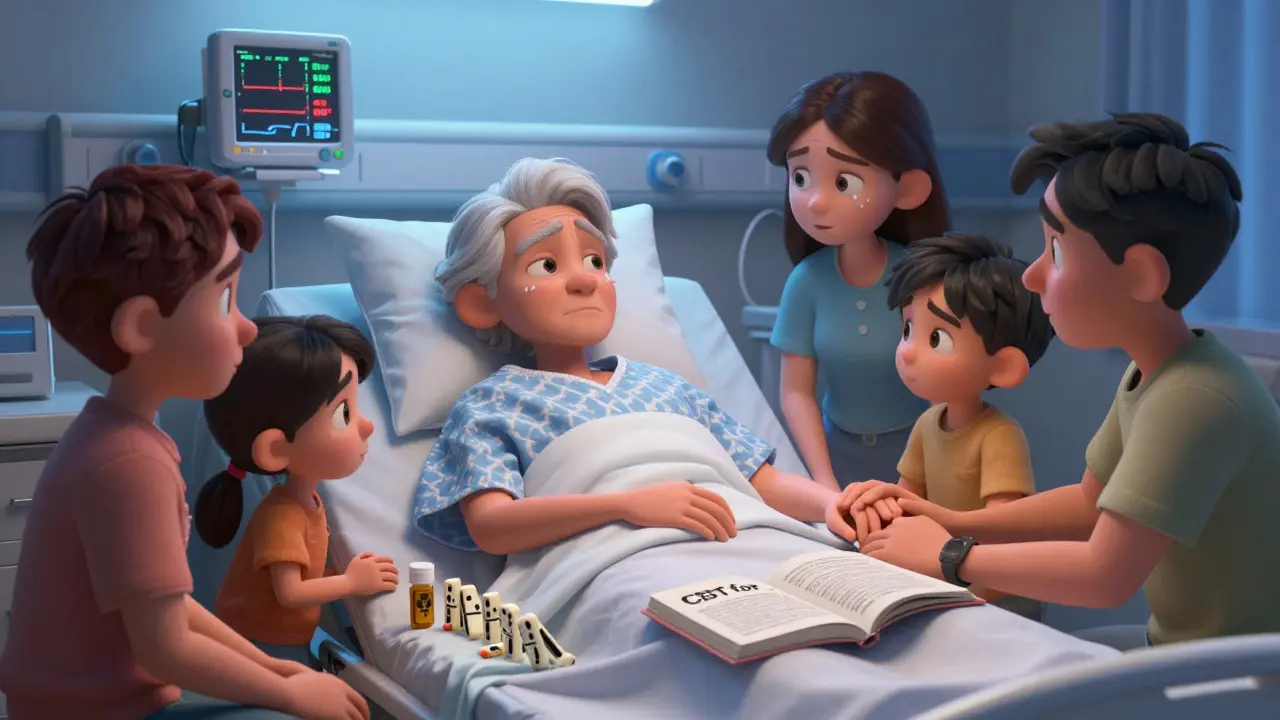
Some alternatives exist. For anxiety, cognitive behavioral therapy (CBT) works better than benzodiazepines long-term. For insomnia, sleep hygiene and CBT-I (cognitive behavioral therapy for insomnia) are proven, non-drug options. For chronic pain, physical therapy, acupuncture, or low-dose naltrexone may help - without the risk.
What’s Changing - And What’s Coming
Hospitals and clinics are starting to wake up. Electronic health record systems are being updated to flag dangerous combinations before a prescription is even written. A 2023 pilot program showed that when these alerts were mandatory, dangerous combinations dropped by 28%. By 2025, this will be standard in most major systems.Genetic testing is also entering the picture. Some people have variations in liver enzymes (CYP450) that make them process sedatives extremely slowly. Testing for these could prevent overdoses before they start. Early studies suggest this could cut risky combinations by 22% in vulnerable groups.
But technology alone won’t fix this. Awareness will. Education will. Asking questions will.
The Bottom Line
Combining sedatives isn’t just risky. It’s often deadly. And it’s happening under the radar - in prescriptions, in medicine cabinets, in quiet homes where no one realizes how dangerous the mix has become.You don’t need to be a drug user to be at risk. You just need to be taking more than one thing that slows your brain. If you’re unsure, talk to your doctor. If you’re caring for someone who is, speak up. Because in this case, silence isn’t safety - it’s a countdown.
Can combining sedatives be fatal even if I take them as prescribed?
Yes. Even when taken exactly as directed, combining multiple CNS depressants - like an opioid painkiller with a benzodiazepine for anxiety or a sleep aid - can lead to life-threatening respiratory depression. The FDA has issued formal warnings about this exact scenario. The danger isn’t about misuse; it’s about how these drugs interact physiologically. A 2016 FDA study found that combining opioids and benzodiazepines increases overdose death risk by 2.5 to 4.5 times, regardless of whether doses were prescribed correctly.
What are the most dangerous sedative combinations?
The most dangerous combinations include opioids with benzodiazepines (e.g., oxycodone + alprazolam), alcohol with any CNS depressant, and combinations involving three or more sedatives (e.g., opioid + benzodiazepine + sleep aid). Research shows that opioid-benzodiazepine pairs carry a 2.5-4.5x higher risk of fatal overdose than opioids alone. Mixing alcohol with these drugs increases the risk further, often leading to respiratory rates dropping below 6 breaths per minute - a level that can cause coma or death within minutes.
Are elderly patients more at risk from sedative combinations?
Yes, dramatically. Older adults metabolize drugs more slowly, and their brains are more sensitive to CNS depression. Studies show that seniors on three or more CNS-active medications have a 45% higher chance of hospitalization from falls, and their risk of cognitive decline increases by 27%. The American Geriatrics Society Beers Criteria specifically lists 34 sedatives and related drugs as potentially inappropriate for older adults due to these risks. Even low doses can cause confusion, dizziness, and impaired balance - leading to fractures and long-term disability.
Can antidepressants like SSRIs make sedative combinations worse?
Yes. SSRIs inhibit liver enzymes (CYP450) that break down many sedatives, including benzodiazepines, antipsychotics, and some sleep aids. This causes those drugs to build up in the bloodstream, increasing their effects. A 2022 study found that 69% of hospitalizations for major depression involved patients taking more than one CNS drug, and clinicians often had little guidance on these interactions. This can lead to unexpected sedation, respiratory depression, or even serotonin syndrome in rare cases.
Is there a safe way to stop using multiple sedatives?
Yes - but not on your own. Stopping multiple sedatives suddenly can trigger seizures, severe anxiety, or rebound insomnia. The safest approach is deprescribing: a planned, gradual reduction under medical supervision. Studies show that structured deprescribing reduces fall risk by 32% and cognitive decline by 27% over 12 months. Your doctor may switch you to non-drug therapies like CBT for anxiety or insomnia, or replace long-acting benzodiazepines with safer alternatives. Never stop cold turkey.
Man, I never realized how sneaky this stuff is. I thought if your doc prescribed it, it was safe. But stacking benzos, opioids, and sleep meds? That’s like juggling chainsaws and calling it a hobby. My uncle did this exact combo-oxycodone, Xanax, and melatonin (yeah, really)-and woke up in the ER with his oxygen at 78%. He’s fine now, but he won’t touch that cocktail again. And no, he wasn’t some junkie. Just an old guy trying to sleep and stop hurting. Scary how easy it is to slide into this.
Doctors don’t always connect the dots. They see pain, anxiety, insomnia-three separate boxes-and check each one. Nobody’s looking at the whole damn puzzle.
I work in geriatric care, and this is the silent crisis no one talks about. I’ve seen 82-year-olds on five CNS depressants-diazepam for anxiety, zolpidem for sleep, oxycodone for arthritis, sertraline for depression, and muscle relaxers for spasms. And yes, they’re all prescribed by different specialists. No one’s talking to each other. No one’s reviewing the whole list. And the patients? They’re too scared to ask. They think if they mention feeling dizzy or confused, they’ll be labeled ‘noncompliant’ or ‘cognitively impaired.’
But here’s the thing: deprescribing works. One patient I had was on three sedatives. We tapered one at a time over six months. She went from falling three times a month to zero. Her memory improved. Her mood lifted. She started gardening again. It’s not about taking everything away-it’s about finding the minimum effective dose. And sometimes, the minimum is zero.
PLEASE share this. I’m not a doctor, but I’m a caregiver, and I’ve seen this happen too many times. If you’re on more than one sedative, print out a list of every pill you take-including OTC stuff like NyQuil, Benadryl, or melatonin-and bring it to your doctor. Ask: ‘Is this combo safe?’
Also-seriously-don’t use ‘sleep aids’ with alcohol. Even one drink. Even if it’s ‘just wine.’ That’s not relaxation. That’s Russian roulette with your brain.
And if you’re helping an older relative? Check their medicine cabinet. I found 14 different meds in my grandma’s drawer. Half were expired. Three were CNS depressants. She didn’t even know what half of them were for. We got her on CBT-I. No more zolpidem. She sleeps better. And she’s alive.
❤️ You can save someone. Just ask. Just check. Just care.
I cried reading this. Not because I’m emotional (though I am) but because this is the story of so many quiet, invisible people. My aunt, who never said a word about her panic attacks, just took her lorazepam and hoped for the best. My cousin, who drank wine with his tramadol because ‘it helps me relax.’ They didn’t know. They didn’t ask. And now? They’re gone.
But here’s the thing: we can change this. Not with outrage. Not with blame. With gentle, persistent, loving questions. ‘Mom, what’s this pill for?’ ‘Dad, have you talked to your doctor about cutting back?’
It’s not about being brave. It’s about being present.
As someone who’s helped elderly patients through deprescribing, I can tell you this: the moment you reduce one sedative, everything improves. Sleep gets deeper. Anxiety doesn’t vanish-it becomes manageable. Balance returns. Cognitive fog lifts.
The myth is that these drugs are ‘necessary.’ The truth? They’re often crutches. And crutches, when used too long, rot the muscles.
CBT-I for insomnia? Works better than zolpidem. Mindfulness for anxiety? Better than alprazolam. Physical therapy for chronic pain? Beats opioids every time.
It’s not about giving up drugs. It’s about choosing better tools. And yes-it’s possible. I’ve seen it. Hundreds of times.
Let’s be real. This isn’t about ‘safe prescribing.’ It’s about profit. Pharma companies make billions off combo packs. They fund studies that downplay risks. They pay doctors to prescribe. They don’t care if you die-as long as your insurance pays.
And don’t get me started on the ‘non-drug alternatives’ they toss in at the end like a feel-good footnote. CBT-I? Costs $1,200 out of pocket. Who can afford that? Not the 60-year-old on Social Security. So they keep the pills.
This isn’t a medical issue. It’s a capitalist one. And until we fix that, people will keep dying in quiet rooms with pill bottles beside them.
You’re not broken. You’re not weak. You’re just trying to survive. And if you’re reading this because you’re on more than one sedative? You’re not alone. I’ve been there. I took Xanax, trazodone, and melatonin because I couldn’t breathe at night. My doctor said ‘it’s fine.’ I almost didn’t make it.
But I asked for help. I said ‘I think this is too much.’ And guess what? My doctor didn’t judge me. She sat down. We made a plan. One med at a time. Therapy. Sleep journal. No alcohol. Period.
Now? I sleep like a baby. No pills. Just me, my breath, and a damn good blanket.
You can do this too. Not today. Maybe not tomorrow. But one step. One conversation. One ‘no’ to a refill. You’ve got this.