
Think of corticosteroids like a fire extinguisher: you don’t want to keep it running, but when a flare-up hits, you’ll be glad it’s there. These powerful drugs-like prednisone, hydrocortisone, and dexamethasone-can shut down inflammation in as little as 24 hours. For someone in excruciating pain from a lupus flare, a gout attack, or a severe asthma episode, that speed is life-changing. But here’s the catch: the longer you use them, the more your body pays the price.
How Fast Do They Work? And Why That’s a Double-Edged Sword
Corticosteroids mimic cortisol, your body’s natural stress hormone. When you’re under pressure-whether from an injury, infection, or autoimmune attack-your adrenal glands release cortisol to calm things down. Synthetic versions do the same, but way harder and faster. A 2021 study in Arthritis & Rheumatology showed that within one week, corticosteroids cut disease activity scores by 2.1 points. NSAIDs? Just 0.7. Placebo? Barely any change.
That’s why doctors reach for them. For a sudden asthma attack, a single course of oral steroids can cut hospital stays by nearly two days. For a peritonsillar abscess, they reduce the need for surgery by 27%. In rheumatoid arthritis or vasculitis, they’re often the bridge until slower-acting drugs like methotrexate kick in. But that bridge has weight limits.
The Hidden Costs: What Happens After the Relief
Short-term use-say, 5 to 14 days-is generally safe for most people. But even then, risks jump. A review of 1.5 million patient records found that within 30 days of starting corticosteroids:
- Sepsis risk increased by 430%
- Chance of blood clots went up by 230%
- Fracture risk rose by 90%
And these aren’t rare events. They’re common enough that the American Academy of Family Physicians calls this a public health blind spot. Why? Because many of these prescriptions are for conditions where steroids offer almost no benefit-like the common cold, sinus infections, or back pain. In fact, nearly half of all outpatient steroid prescriptions in the U.S. are for these non-approved uses.
And then there’s the body’s reaction. Weight gain? That’s not just water retention. A 2023 survey of 1,200 steroid users found an average 12.4-pound gain in just eight weeks. Insomnia? 63% reported it. Blood sugar spikes? 41% needed new diabetes meds. And for some, it sticks around.
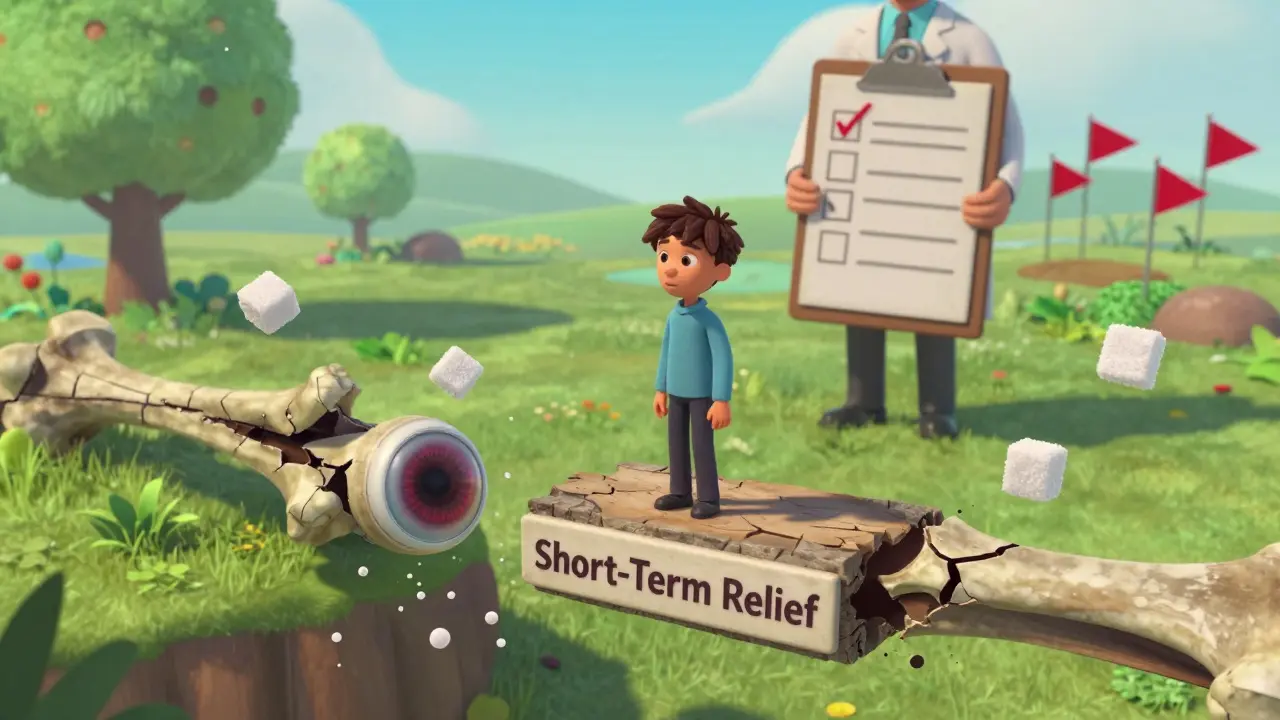
Long-Term Use: The Silent Damage
Once you hit three months of daily use, the damage becomes structural-and often irreversible. Bone loss starts as early as week four. Studies show you can lose 3-5% of your bone density every month on high-dose steroids. That’s why the American College of Rheumatology says: if you’re on more than 7.5mg of prednisone daily for over three months, you need a DEXA scan. And if you’re on more than 20mg for over four weeks? You should be on calcium, vitamin D, and a yearly bone-strengthening shot called zoledronic acid.
Cataracts? They develop faster. Diabetes? Steroids can trigger it, even in people with no family history. Muscle weakness? That’s common. Mood swings? Yep. And once you stop, some effects don’t go away. The Steroid Recovery Project found 29% of long-term users reported permanent changes-like cataracts, osteoporosis, or type 2 diabetes-even after quitting.
Who’s Most at Risk? And Why It’s Not Just the Elderly
You might think it’s older adults. And yes, people over 65 get prescribed steroids 2.3 times more often than those under 45. But here’s what’s worse: rural patients get inappropriate prescriptions 1.7 times more than urban ones. Why? Fewer specialists. Less access to alternatives. And often, a doctor’s quick fix for symptoms they can’t fully diagnose.
And it’s not just about dosage. It’s about duration. The European League Against Rheumatism says no one with rheumatoid arthritis should stay on more than 5mg of prednisone daily beyond six months without a specialist review. But in real life? Many stay on it for years. That’s because tapering is hard. And stopping too fast? That can cause adrenal insufficiency-your body forgets how to make its own cortisol. That’s why any course longer than 14 days needs a slow taper, often over a week or more.
What’s Changing? Better Tools, Better Rules
The tide is turning. In December 2023, the FDA approved fosdagrocorat-the first selective glucocorticoid receptor modulator (SGRM). It works like prednisone to fight inflammation but causes 63% fewer blood sugar spikes. That’s huge. It won’t replace steroids overnight, but it’s the first real alternative in decades.
Health systems are catching up too. In January 2024, the American College of Physicians launched “Steroids Smart”-a program that requires pre-authorization for any course longer than 10 days in Medicare Advantage plans. Electronic health records now auto-flag inappropriate prescriptions in 87% of U.S. hospitals. Early results? A 31% drop in misuse.
And patient education? It’s working. The Arthritis Foundation says 68% of side effects could be avoided with proper monitoring. But only 42% of primary care doctors follow all the guidelines. That gap is where the harm happens.

When to Use Them-and When to Say No
Here’s the practical rule: corticosteroids are for emergencies, not maintenance.
Use them if:
- You’re having a severe flare of lupus, rheumatoid arthritis, or vasculitis
- You’re in the hospital with a severe asthma or COPD attack
- You have a life-threatening allergic reaction or an abscess that might need surgery
Avoid them if:
- You have a cold, sinus infection, or bronchitis
- You have nonspecific back pain or mild joint pain
- You’re already on long-term NSAIDs or DMARDs that haven’t been given enough time to work
And if you’re prescribed a course longer than 14 days? Ask: “What’s the plan to get me off this?” If there isn’t one, get a second opinion.
Monitoring Is Non-Negotiable
If you’re on steroids for more than three months, you need a plan:
- Baseline DEXA scan
- Monthly blood sugar checks
- Quarterly eye exams
- Calcium (1200mg) and vitamin D (800IU) daily
- Annual bone shot (zoledronic acid) if on high doses
These aren’t optional. They’re survival tools. And they’re cheaper than hospital stays.
Can I stop corticosteroids cold turkey if I feel better?
No. Stopping suddenly can trigger adrenal crisis-your body can’t produce cortisol fast enough, leading to dangerously low blood pressure, vomiting, confusion, or even coma. Even if you feel fine, you must taper slowly under medical supervision. The rule: any course longer than 14 days needs a taper over at least 7 days. For longer use, tapering may take weeks or months.
Are steroid injections safer than pills?
Injections-like cortisone shots into a joint-are safer for short-term relief because they deliver the drug locally, not systemically. But they’re not risk-free. Too many injections in one joint can damage cartilage. Repeated systemic injections (into muscle or vein) still raise blood sugar and bone loss risks. One injection every few months is fine. Monthly shots? That’s a red flag.
Why do some people gain weight so fast on steroids?
Steroids increase appetite and change how your body stores fat-especially around the abdomen, face, and neck. They also cause fluid retention. This isn’t just “eating more.” It’s a biological shift. On average, users gain 12.4 pounds in eight weeks. The weight often drops after stopping, but some fat redistribution, like moon face or buffalo hump, can be permanent.
Do corticosteroids cause diabetes?
Yes. Steroids make your liver release more glucose and block insulin’s ability to move sugar into cells. This can trigger type 2 diabetes in people with no prior risk. In long-term users, about 7% develop diabetes that persists even after stopping. Regular blood sugar checks are critical-especially if you’re overweight, over 45, or have a family history.
Is there a safe dose of corticosteroids for long-term use?
There’s no truly safe long-term dose. But the goal is to use the lowest possible amount for the shortest time. For chronic conditions, doctors aim for 5mg or less of prednisone daily, and only if no other treatments work. Even then, it’s not a cure-it’s damage control. Alternatives like biologics or SGRMs are now preferred for long-term management.
What Comes Next?
The future isn’t about avoiding corticosteroids-it’s about using them smarter. With new drugs like fosdagrocorat and better monitoring tools, we can reduce harm while keeping the benefits. But until then, the message is clear: don’t treat them like routine medicine. They’re powerful. They’re fast. And they’re dangerous if misused. If you’re prescribed them, make sure you know the exit plan. Because the relief is real-but the cost? It can last a lifetime.

Corticosteroids are a lifesaver when you're in acute pain, but I've seen too many patients get stuck on them because no one has a clear exit strategy. Doctors prescribe them like candy and never follow up. The real issue isn't the drug-it's the system that lets it become a default.
Let’s be real-half these prescriptions are just doctors being lazy. A patient walks in with back pain, they hand out prednisone like it’s a free sample at Costco. No wonder we’re drowning in steroid-induced osteoporosis and diabetes. It’s not medicine, it’s medical malpractice dressed up as convenience.
You call this an article? This is just a glorified FDA pamphlet with footnotes. The real story is how pharmaceutical companies have been pushing corticosteroids for decades because they’re cheap to make and patients keep coming back for refills. Fosdagrocorat? That’s not innovation-that’s a rebranding play to lock in another decade of profits. The system doesn’t want cures. It wants maintenance.
I know someone who was on prednisone for 18 months after a lupus flare-and she’s doing better than ever now because she had a team that monitored her like a hawk. DEXA scans, blood sugar logs, eye checks, calcium, zoledronic acid-you name it. It’s not scary if you’re proactive. The fear comes from ignorance, not the drug. Education saves lives.
There’s a deeper philosophical question here: if a drug gives immediate relief but destroys long-term health, is it really healing-or just postponing suffering? We treat symptoms like enemies to be annihilated, not signals to be understood. Corticosteroids are the ultimate Band-Aid on a ruptured artery. We celebrate the temporary stoppage of bleeding while ignoring the hemorrhage beneath.
Anyone who thinks this is a public health blind spot is either lying or delusional. This has been known since the 1970s. The problem isn’t ignorance-it’s greed. Hospitals make money on steroid prescriptions. Pharmacies profit on follow-up meds for side effects. Insurance companies pay for the hospital stays later. It’s a revenue stream. You don’t fix a system that’s designed to profit from your suffering.
been on prednisone for a gout flare last year. 5 days. felt like a new person. then i got lazy and didn’t taper right. ended up with insomnia and weird mood swings for months. never thought about how it messes with your brain chemistry. now i ask every doc: ‘what’s the exit plan?’ if they look confused, i walk out. no cap.
In my country, corticosteroids are often the only affordable option for chronic inflammation. We don’t have access to biologics or SGRMs. So when someone says ‘avoid steroids,’ they’re not seeing the reality. For many, it’s not a choice between safety and risk-it’s between pain and paralysis. The solution isn’t to ban them-it’s to make alternatives accessible.
Why are we even talking about this like it’s a mystery? In India, we’ve known for decades that Western medicine overrelies on steroids. It’s a colonial hangover-imported drugs, imported habits, imported ignorance. Our Ayurvedic systems had safer anti-inflammatories for centuries. But no, we’d rather swallow pills made in Ohio than trust what our ancestors knew. Progress is a lie.
Let me tell you something. I’ve been a rheumatology nurse for 17 years. I’ve seen people on prednisone for 12 years straight because their doctors didn’t know how to taper, didn’t have time to educate, and didn’t care enough to refer. I’ve held patients’ hands while they cried because they lost their vision from cataracts they didn’t know were coming. I’ve watched their bones crumble. This isn’t a ‘public health blind spot.’ It’s a systemic betrayal. And now we’re patting ourselves on the back because some EHR flagged a prescription? That’s not progress. That’s a Band-Aid on a gunshot wound.
The most alarming statistic here isn’t the 430% increase in sepsis-it’s that only 42% of primary care doctors follow all the guidelines. That means nearly 6 out of 10 patients are being managed without even basic safety protocols. This isn’t an issue of patient ignorance. It’s a failure of clinical governance. We need mandatory continuing education on steroid risks, not just automated EHR flags.