GAHT Medication Interaction Checker
Check how common medications may affect your gender-affirming hormone therapy. Based on the latest clinical evidence.
Select Your Current Medications
Your Results
When you're on gender-affirming hormone therapy (GAHT), your body is changing in ways that matter deeply to your identity and well-being. But what happens when you're also taking other medications-antibiotics, antidepressants, HIV drugs, or even over-the-counter supplements? These aren't just background details. They can change how well your hormones work, or even push your body into dangerous territory.
How Hormones and Medications Talk to Each Other
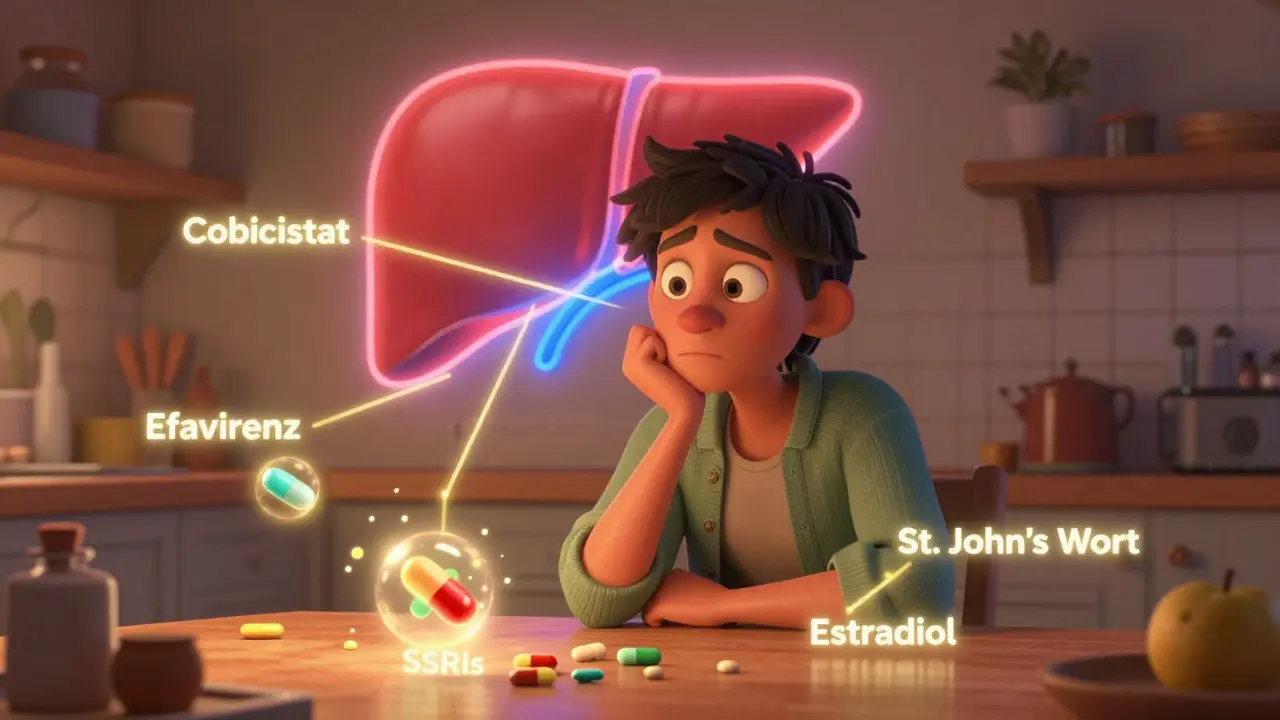
Your body doesn’t treat hormones and other drugs as separate things. They all use the same metabolic pathways, especially enzymes in your liver. The most important one is called CYP3A4. It’s like a busy factory worker that breaks down drugs so your body can get rid of them. Estradiol-the main hormone used in feminizing therapy-is processed mainly by this enzyme. So if something else slows down or speeds up this factory, your hormone levels can swing wildly. For example, if you're taking cobicistat (part of some HIV treatments like Stribild or Descovy), it shuts down CYP3A4. That means your estradiol doesn’t get broken down as fast. Studies show estradiol levels can jump by 40% to 60% within two weeks. That’s not just a small change-it can lead to blood clots, high blood pressure, or mood swings. On the flip side, efavirenz (used in older HIV regimens) turns on CYP3A4. That speeds up estradiol breakdown, dropping levels by 30% to 50%. You might start feeling like your hormones aren’t working anymore: less breast development, more fatigue, or a return of unwanted body hair. Testosterone, used in masculinizing therapy, is handled differently. It’s mostly broken down by enzymes called 5-alpha reductase and aromatase. That means fewer drug interactions overall. But if you're on carbamazepine (a seizure or mood stabilizer), it still activates CYP3A4 and can lower testosterone levels enough to reduce its effects. You might notice less muscle gain, lower energy, or decreased libido-even if you’re taking the right dose.HIV Medications and GAHT: A Delicate Balance
Transgender people are 3.4 times more likely to be living with HIV than cisgender people. That means many people on GAHT are also on antiretroviral therapy (ART). The good news? Most modern HIV drugs play nicely with hormones. But the old ones? Not so much. NNRTIs like efavirenz and nevirapine are the biggest red flags. They can slash estradiol levels so hard that some people stop seeing the benefits of hormone therapy. In one study, 8 out of 12 case reports showed this drop. If you're on one of these, your provider should check your estradiol levels every 3 months after starting ART. You might need a higher hormone dose-or switch to a different HIV drug. The newer HIV drugs are much safer. Integrase inhibitors like dolutegravir (Tivicay) actually raise estradiol by 25% to 35%. That’s usually not a problem, but it’s still worth monitoring. If you’re on a boosted protease inhibitor like darunavir/cobicistat, your estradiol will likely rise. No need to panic-but do tell your doctor. They might reduce your estradiol dose slightly to avoid side effects. The one exception? GnRH agonists like leuprolide. These are often used to block puberty in teens or to suppress natural hormones in adults. They don’t interact with any HIV drugs. That’s one of the few clear-cut answers in this whole field.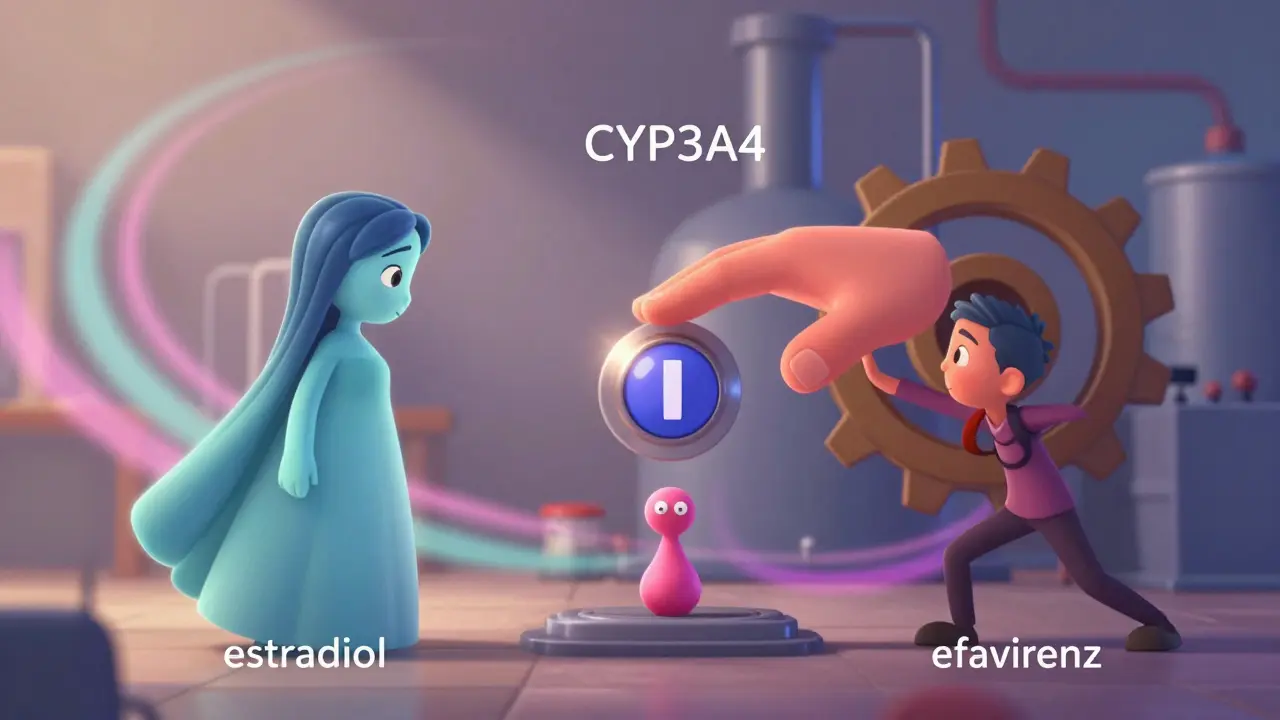
PrEP and Hormones: No Need to Worry
If you’re on PrEP to prevent HIV, you might be anxious about whether it’ll interfere with your hormones. The good news? It doesn’t. A major 2022 study followed 172 transgender people taking tenofovir/emtricitabine (Truvada or Descovy) while on GAHT. The results? Hormone levels changed by less than 5%. Tenofovir levels didn’t budge either. You can take PrEP and GAHT together without adjusting either. Even the newer long-acting injectable PrEP, cabotegravir (Apretude), shows no known interactions in early data. But because it’s so new, there aren’t many studies yet. If you’re starting it, your provider should still track your hormone levels for the first few months just to be safe.Psychiatric Medications: The Hidden Risk
Transgender people are 2.5 times more likely to have depression, anxiety, or PTSD. That means many are on antidepressants, mood stabilizers, or antipsychotics. And here’s where things get murky. SSRIs like fluoxetine (Prozac) and sertraline (Zoloft) can block CYP2D6, another liver enzyme that helps break down estradiol. That means your estradiol might build up-possibly leading to side effects like breast tenderness, nausea, or mood swings. It’s not always obvious, and most doctors don’t check for it. The real danger comes from drugs that speed up metabolism. Carbamazepine (Tegretol), phenytoin (Dilantin), and rifampin (an antibiotic for TB) all crank up CYP3A4. If you’re on one of these, your estradiol levels can crash. One study found 17 cases where testosterone therapy made antidepressants less effective. That doesn’t mean the antidepressants stopped working-it means the body’s hormonal shift changed how the brain responded. Some people needed their antidepressant dose raised by 25% to 50% within six weeks. Here’s the problem: almost no psychiatric drug trials include transgender people. A 2021 analysis found only 3% of antidepressant studies included trans participants. That means we’re guessing a lot. If you’re starting GAHT and already on psychiatric meds, watch for changes in mood, sleep, or energy. Don’t assume it’s just "adjusting to hormones." It might be a drug interaction.
What You Should Do Right Now
This isn’t about fear. It’s about control. You deserve to know what’s happening in your body. Here’s what to do:- Make a full list of everything you take-prescription, over-the-counter, herbal, vitamins. Even melatonin or St. John’s wort can interfere.
- Bring it to every appointment. Don’t assume your doctor knows. Only 41% of U.S. endocrinology clinics have standardized screening for these interactions.
- Ask for hormone level checks after starting or changing any new medication. Estradiol and testosterone levels should be checked 4 to 6 weeks after a new drug is added.
- Know your HIV meds. If you’re on efavirenz, talk to your provider about switching. If you’re on cobicistat, ask if your estradiol dose needs adjusting.
- Track your symptoms. Did your breasts stop growing? Did your mood drop? Did your energy vanish? These aren’t "just in your head." They could be drug interactions.
What’s Changing in 2025
The science is catching up. The NIH-funded Tangerine Study is tracking 300 transgender adults on GAHT and 12 common psychiatric drugs. Preliminary results are due in mid-2025. That’s the first large-scale look at how antidepressants, antipsychotics, and mood stabilizers interact with hormones. The FDA now encourages drug companies to include transgender people in clinical trials. Gilead Sciences, maker of Truvada and Descovy, now requires GAHT interaction testing in all new PrEP trials after their 2022 study proved it was possible-and necessary. But until then, you’re still the most important part of your care. You know your body better than any chart or study. If something feels off, speak up. Your hormones aren’t just chemicals-they’re part of your identity. And you deserve treatment that respects that.Can I take birth control pills with feminizing hormone therapy?
No. Birth control pills contain synthetic estrogen (ethinyl estradiol), which is much stronger and riskier than the bioidentical estradiol used in gender-affirming therapy. Combining them increases your risk of blood clots, stroke, and high blood pressure without adding any benefit. If you need contraception, talk to your provider about non-hormonal options like copper IUDs or condoms.
Do herbal supplements like saw palmetto or black cohosh interfere with GAHT?
Yes, and they’re often overlooked. Saw palmetto acts like an anti-androgen and can boost the effects of spironolactone or cyproterone, leading to low potassium or excessive fatigue. Black cohosh may mimic estrogen and raise estradiol levels unpredictably. Neither is regulated, so dosing is inconsistent. Always tell your provider if you’re taking them-even if you think they’re "natural" or "safe."
Is it safe to take thyroid medication with testosterone?
Yes, but your thyroid levels may change. Testosterone can increase the amount of thyroid-binding proteins in your blood, which lowers your free thyroid hormone levels. That doesn’t mean your thyroid is failing-it just means your body is holding onto less active hormone. Your provider should check your free T3 and free T4 levels, not just TSH, if you’re on testosterone. You might need a small dose adjustment.
Can I take painkillers like ibuprofen or acetaminophen with GAHT?
Yes, these are generally safe. Neither ibuprofen nor acetaminophen affects the liver enzymes that break down estradiol or testosterone. But if you’re on long-term, high-dose NSAIDs (like ibuprofen), be cautious about kidney function, especially if you’re also on spironolactone. Both can stress your kidneys. Stick to the lowest effective dose.
What if I need surgery? Should I stop my hormones?
No, unless your surgeon specifically asks you to. Recent guidelines from WPATH and the Endocrine Society say there’s no need to stop hormones before surgery. In fact, stopping them can increase your risk of blood clots and emotional distress. Keep taking your hormones as usual unless your care team gives you a clear, evidence-based reason to pause.

Just wanted to say this post saved my life. I was on efavirenz and my estradiol dropped so hard I thought I was going back to dysphoria. My doctor didn’t even know to check levels until I brought this up. Now I’m on dolutegravir and my mood and body are finally stable. You’re not crazy if things feel off-your body’s talking, listen to it.
Also, never stop your hormones before surgery. I did that once and regretted it for months.
THIS. So many docs still think trans people are just ‘taking hormones’ like vitamins. We’re talking about complex biochemistry here. You deserve providers who get it.
Thank you for the thorough breakdown. I’ve been on spironolactone and sertraline for years and never realized CYP2D6 inhibition could be raising my estradiol. My breast tenderness has been constant but I assumed it was just part of the process. Will schedule a blood test this week.
Also, I appreciate the note about thyroid-binding proteins. My TSH was always ‘normal’ but my free T3 was low. This explains why I felt so tired despite ‘good’ labs.
People these days think every pill is a magic bullet. Back in my village in Punjab, we used neem leaves and turmeric for everything. Now you got folks on five different meds and freak out because their estrogen went up 10%.
Maybe if you just ate better and stopped stress you wouldn’t need so many chemicals. I’m not saying you’re wrong, but maybe you’re overcomplicating it. Your body knows what to do if you let it.
Why are we even giving hormones to people who can’t even decide if they’re male or female? This is just science being hijacked by woke ideology. You want to look like a woman? Get a wig and some makeup. Don’t poison your liver with estrogen because you think it’ll make you ‘feel better.’
And now we’re giving PrEP to everyone? Next thing you know, we’ll be giving testosterone to toddlers. This is America, not a lab experiment.
bruh i just took ibuprofen with my estradiol and now my boobs hurt more 😩 maybe its the placebo or maybe its the drugs idk but im scared now 🤡
Just read this after my doc switched me from efavirenz to dolutegravir. My energy came back in like 2 weeks. I didn’t realize how drained I was until it was gone. Also, stopped the black cohosh after this. No more weird mood swings. Thanks for the clarity.
Also, if you’re on PrEP and GAHT, you’re fine. No need to stress. Just keep checking in with your provider.
In India, we have a saying: ‘The body is a river, not a machine.’ When you force it with pills, you forget to listen to its rhythm.
I’ve seen men take testosterone and lose their voice, their sleep, their peace. And women take estrogen and forget their hunger, their anger, their joy.
Maybe the real question isn’t what drugs interact-but what are we trying to fix? The body? Or the world that made us feel broken in the first place?
So many people think this is just about hormones but it’s about your whole system
Don’t ignore your liver
Don’t ignore your kidneys
Don’t ignore your mental health
And don’t let anyone tell you your symptoms are ‘all in your head’
You’re not overreacting
You’re surviving
There’s a deeper layer here that no one talks about. The medical system doesn’t just ignore trans bodies-it actively misinterprets them. When a trans woman on estradiol has a mood crash, it’s labeled ‘hormonal instability.’ When a cis woman on birth control has the same crash, it’s ‘PMS.’
When a trans man on testosterone has fatigue, it’s ‘testosterone isn’t working.’ When a cis man has the same fatigue, it’s ‘stress’ or ‘aging.’
We’re not just fighting drug interactions-we’re fighting the assumption that our biology is a glitch to be corrected, not a system to be understood.
This isn’t just about CYP3A4. It’s about who gets to define what ‘normal’ means.
And the answer? Not us. Not yet.
Let’s be brutally honest: this whole field is a regulatory dumpster fire. Drug companies don’t test interactions because it’s expensive. Doctors don’t track levels because they’re overworked. Patients don’t speak up because they’re afraid of being labeled ‘difficult.’
The fact that we’re still debating whether birth control pills are dangerous with GAHT in 2025 is a moral failure.
This isn’t science. It’s triage with a white coat.
And the people paying the price? The ones who can’t afford specialists, can’t afford time off work, can’t afford to be ‘difficult.’
So yes, track your meds. Yes, demand labs. But also know-you’re not broken. The system is.
Here’s the truth they won’t tell you: hormones don’t change your identity. They reveal it.
The body doesn’t lie. If estradiol makes you feel more like yourself, it’s not because of chemistry-it’s because your soul was always there, buried under layers of social expectation.
Drugs are just tools. The real transformation is internal. The pills just let your truth breathe.
And if someone tells you your pain is ‘just a drug interaction’? They’re not seeing the person. They’re seeing a lab report.
Don’t let them win.
Did you know the FDA approved estrogen in 1938 for ‘nervous women’? Same year they banned cannabis. Same year they started labeling homosexuality as a mental illness.
Now we’re told estradiol is ‘safe’ but only if you’re ‘properly monitored.’
Who monitors the monitors?
Big Pharma owns the labs. The NIH funds the studies. The doctors get their continuing education from drug reps.
And you think this is science?
This is control dressed up as care.
Ask yourself-why is there no study on trans people and ayahuasca? Or fasting? Or sunlight? Why only pills?
The real interaction isn’t between drugs.
It’s between power and the body.
One thing I’ve learned from tracking my labs for 5 years: hormone levels are a snapshot, not a story.
I had one test where my estradiol was 220 pg/mL-‘dangerously high.’ I felt fine. No clots, no headaches, no mood swings.
Three months later, same dose, same time of day, it was 140. I felt sluggish, cold, emotionally numb.
My provider wanted to lower my dose. I asked for a second test. It came back 198.
Turns out, the machine was miscalibrated.
So yes-check your levels. But don’t let a number dictate how you feel. Your lived experience is data too.
And if your doctor dismisses that? Find a new one.