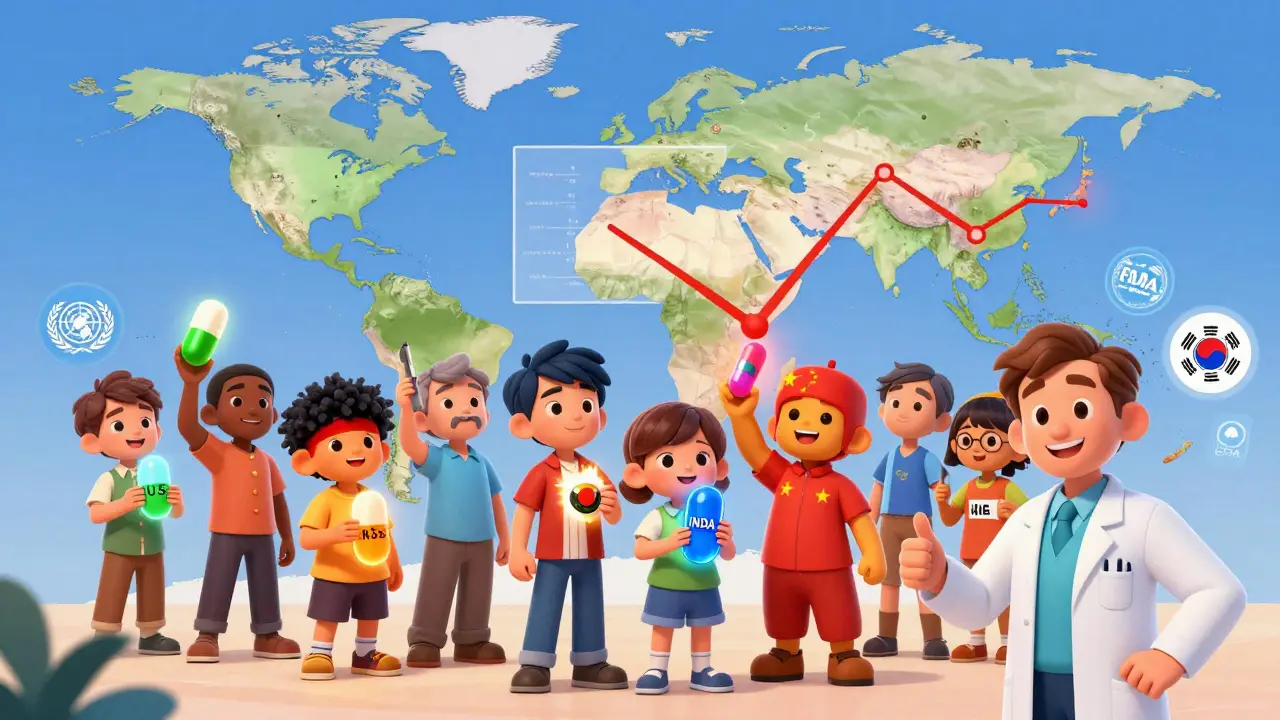
When you pick up a prescription at the pharmacy, you might not think about where the pill came from or how its price was decided. But across the world, governments are running different experiments to make medicines affordable - and the results are wildly different. In the U.S., 9 out of 10 prescriptions are filled with generics. In Germany, doctors are required to prescribe them. In India, half the world’s generic pills are made. And in China, a single government bid can slash a drug’s price by 90%. This isn’t just about cost. It’s about access, quality, and survival.
How Generics Work - And Why They Matter
Generic drugs are exact copies of brand-name medications, once the patent expires. They contain the same active ingredient, work the same way, and are held to the same safety standards. But they cost far less - often 80% to 90% cheaper. That’s not magic. It’s policy.
The U.S. led the way in 1984 with the Hatch-Waxman Act, which created a clear path for generic manufacturers to prove their drugs are bioequivalent without repeating expensive clinical trials. Since then, generics have saved Medicare alone $142 billion in 2025, or $2,643 per beneficiary. That’s money that goes back into care, not drug company profits.
But here’s the catch: generics don’t automatically lower prices. They need help. Countries that just let the market decide often see little change. The real savings come from smart rules - rules that push pharmacies, doctors, and insurers to choose generics.
The U.S. Model: High Usage, High Branded Costs
The U.S. fills 90.1% of prescriptions with generics - the highest rate in the developed world. That’s impressive. But here’s what most people don’t realize: even with that level of generic use, the U.S. still pays more for drugs than any other country. Why? Because the brand-name drugs are crazy expensive.
When a new drug hits the market, companies set prices based on what the market will bear - not production cost. Generics come in later and drive down prices for older drugs. But they can’t touch the high-cost new ones. So overall, public-sector drug prices in the U.S. are 18% lower than in peer countries - not because generics are cheap, but because the government negotiates hard on the ones it buys.
The FDA approved 11,342 generic products by the end of 2024. Among them, 1,842 got special fast-track status as Competitive Generic Therapies (CGT). One example: Zenara Pharma’s generic version of Sertraline Hydrochloride, approved in August 2025. It hit the market in under a year - a win for patients who need antidepressants.
Europe’s Messy Patchwork
Europe has a paradox. The European Medicines Agency (EMA) approves generics for all 27 member states. But then each country sets its own price. That means the exact same pill can cost 300% more in one country than its neighbor.
Germany mandates substitution - pharmacists can swap a brand for a generic unless the doctor says no. Italy doesn’t. In the Netherlands, they use a clever trick: they compare prices to non-EU countries like Norway and the UK to force prices even lower. The result? Dutch generics are among the cheapest in Europe.
Still, this patchwork creates chaos. Manufacturers must navigate 27 different pricing systems. Pharmacists get confused. Patients wonder why their neighbor pays less. The OECD found that identical generics vary wildly in price - and that’s not just inefficient. It’s unfair.
China’s Billion-Dollar Bidding War
China’s Volume-Based Procurement (VBP) policy is like a giant auction. The government picks a drug - say, a blood pressure pill - and invites manufacturers to bid. The lowest bidder gets to supply 80% of the country’s hospitals for the next year.
The results? Average price drops of 54.7%. In some cases, prices fell 93%. Amlodipine besylate, a common hypertension drug, dropped from $2.50 per pill to $0.17. That’s life-changing for millions of Chinese patients.
But there’s a dark side. When margins shrink below manufacturing cost, companies stop making the drug. In 2024, 12 provinces in China ran out of Amlodipine for six to eight weeks. Patients couldn’t get their meds. The China Generic Pharmaceutical Association found that 23% of manufacturers were losing money on VBP contracts. That’s not sustainable.
India: The Pharmacy of the World
India makes 20% of the world’s generic drugs by volume - more than any other country. It’s not just about scale. It’s about speed. Under Section 84 of the Patents Act, India can issue compulsory licenses - basically, override patents - if a drug is too expensive or not available.
That’s why so many HIV and hepatitis C drugs from the U.S. and Europe are available in India for pennies. But this has a cost. The FDA issued 17% more warning letters to Indian manufacturers between 2022 and 2024, mostly over data integrity issues. Some labs were falsifying test results. It’s not all bad - many Indian companies are world-class. But the pressure to cut costs is pushing some to cut corners.
South Korea: The 1+3 Rule That Backfired
South Korea tried to fix generic market chaos with a simple rule: only three generics can be approved for each drug, based on the first bioequivalence study submitted. The goal? Stop endless copies flooding the market.
It worked - kind of. Between 2020 and 2024, redundant entries dropped by 41%. But new generic launches fell by 29%. Why? Because manufacturers saw the system as a barrier, not a pathway. If you can’t be first, why bother? The result? Less competition. Slower price drops. And fewer choices for patients.
They added a pricing system too: generics that meet quality and price standards get 53.55% of the brand price. Those that meet only one? 45.52%. The rest? 38.69%. It sounds fair. But when margins are this tight, manufacturers cut research, testing, and quality control. It’s a race to the bottom.
The Hidden Cost: Quality at Risk
Everyone wants cheaper drugs. But no one wants a bad drug.
Dr. Anant Jani of the Access to Medicine Foundation warns that aggressive price controls are already hurting quality. In India, FDA inspections found more labs falsifying data. In China, manufacturers are skipping stability tests. In South Korea, some generics are being pulled from shelves because they don’t meet bioequivalence standards.
WHO recommends a minimum 15-20% gross margin for manufacturers to stay in business. Without that, they can’t invest in quality control, training, or new equipment. And when they can’t, patients pay with their health.
What’s Next? The Big Changes Coming
By 2028, the U.S. Inflation Reduction Act will force Medicare to negotiate prices on 10-20 high-cost drugs each year. That could cut branded drug revenues by 25-35%. That’s a wake-up call for pharma - and a huge opportunity for generics.
The EU is working on a new Pharmaceutical Package, expected to pass in late 2025. It aims to harmonize pricing rules and give bonuses to the first generic to enter the market. If it works, it could cut approval times by 12-15%.
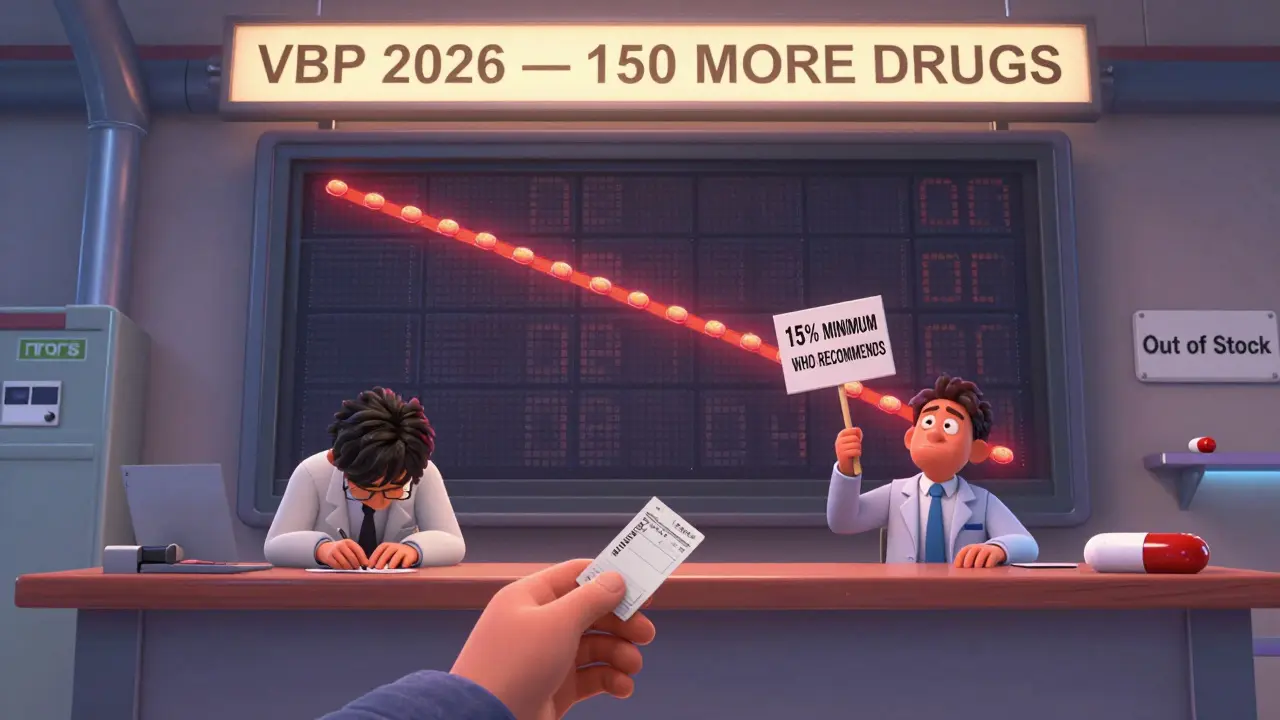
China’s VBP program is expanding in January 2026. Another 150 drugs will be up for bid. Prices will drop even further - possibly below cost. Will manufacturers keep producing? Or will shortages become routine?
And then there’s the wave of expiring patents. Between 2025 and 2030, $217-236 billion in annual branded drug sales will lose protection. That’s a $180-200 billion opening for generics. But only if policies let them in fast enough.
What Works? The Real Rules for Success
After studying dozens of systems, three things stand out:
- Clear bioequivalence standards - generics must prove they work the same way. The 80-125% AUC and Cmax range isn’t arbitrary. It’s science.
- Education for doctors and pharmacists - when providers understand generics, substitution rates jump 22-35%. Patients trust them. If they’re skeptical, they won’t take the drug.
- Reasonable margins - if manufacturers can’t make a living, they’ll leave. And then you get shortages. No one wins.
There’s no one-size-fits-all model. But the best systems combine competition, transparency, and fairness. They don’t just cut prices. They protect quality. And they make sure patients don’t pay the price in silence.
Are generic drugs really as safe as brand-name drugs?
Yes - when they’re made and regulated properly. The FDA, EMA, and other global agencies require generics to match the brand in active ingredients, strength, dosage form, and bioavailability. That means they work the same way in your body. But quality varies by manufacturer. Some companies cut corners to meet price targets, especially in markets with weak oversight. That’s why regulatory inspections and transparency matter more than ever.
Why do some countries have drug shortages with generics?
When governments force prices too low, manufacturers stop making the drug. In China, VBP bids sometimes set prices below production cost. In South Korea, the 1+3 policy discouraged new entrants, reducing competition. In India, price pressure led some labs to cut testing. The result? No one produces it - and patients go without. Sustainability requires profit, not just savings.
Do insurance plans always favor generics?
Not always. In the U.S., Pharmacy Benefit Managers (PBMs) sometimes set higher copays for generics than for branded drugs - especially if they get kickbacks from brand manufacturers. Patients think they’re saving money by choosing generics, but their out-of-pocket cost is higher. Always check your formulary. Ask your pharmacist. Don’t assume.
Can I trust generics from countries like India and China?
Many are safe - and essential. India supplies 20% of the world’s generics. China is a major producer. But inspections have risen sharply: FDA import alerts for quality issues jumped from 1,247 in 2020 to 2,183 in 2024. Look for products approved by your country’s regulator. Avoid unregulated imports. Not all generics are equal.
Will generic prices keep falling forever?
No - and that’s a good thing. Prices can’t drop below manufacturing cost forever. When they do, companies stop making the drug. The goal isn’t zero cost. It’s affordable cost. The smartest systems balance affordability with sustainability. That means letting manufacturers earn enough to stay in business - without overcharging patients.
Generics are just another way the system screws patients while pretending to help. We got 90% usage but still pay the most because Big Pharma owns the game. The FDA approves everything but doesn't enforce quality. You think that Indian pill is safe? Nah. It's just cheaper poison with a label.
And don't get me started on China. They're flooding the market with junk and calling it progress. We need tariffs not subsidies.
Stop. Just stop. You can't have cheap drugs without quality control. Period. The data is clear: when margins drop below 15%, labs cut corners. And when labs cut corners, people die. This isn't a debate. It's a public health emergency.
India makes over 20% of the world's generics. We don't cut corners-we cut costs smartly. Yes, there are bad actors. But most factories here follow WHO standards. The real problem? Western regulators who don't understand our scale. We feed the world. Don't act like we're the villains.
I work in a rural pharmacy. Patients rely on generics every single day. What I see isn't about politics-it's about access. A diabetic patient choosing between insulin and rent? That's the real story. The system isn't broken because generics exist-it's broken because we don't make them affordable *and* reliable. We need policy that respects both science and survival.
Let’s not pretend this is just about price. It’s about systemic neglect. The U.S. lets PBMs dictate formularies based on kickbacks, not patient outcomes. Meanwhile, Germany mandates substitution and still has lower prices. Why? Because they treat pharmacy as public infrastructure, not a profit center. And China’s VBP? It’s brutal, but it works-until it doesn’t, and then people go without meds for weeks. We need a model that combines the efficiency of China, the regulation of the EU, and the patient-first ethos of Sweden. But no one wants to pay for that. So we get chaos. And then we blame the generics.
As someone who grew up watching my mother wait months for her blood pressure meds because the local pharmacy ran out-I can tell you this: the world needs Indian generics. Not because we're cheap, but because we're relentless. We don't wait for patents to expire-we find a way to make them accessible. Yes, there are quality issues. But the solution isn't to shut us down. It's to lift standards, not prices. We're not the problem. We're the safety net.
Just wanted to say thanks for writing this. I’ve been in pharma logistics for 18 years. Saw the shift from brand-only to generics firsthand. The truth? Most manufacturers want to do right. It’s the pricing models that force them into corners. A 90% price cut sounds great on paper. But if it means your lab can’t afford a single humidity sensor? That’s not innovation. That’s sabotage. We need margins that let quality survive-not just survive, but thrive.
Oh my god. I just found out my antidepressant is made in a factory that got an FDA warning letter last year. I’ve been taking this for 5 years. I thought it was safe. I thought it was *good*. Now I’m terrified. How many people are on these? How many are sick and don’t even know why? This isn’t healthcare. It’s a lottery. And we’re all losing.
There is a philosophical undercurrent here that deserves deeper examination: the tension between commodification and care. When we reduce medicine to a commodity subject solely to market forces, we erase the moral dimension of healing. The Hatch-Waxman Act was a triumph of pragmatism-but it was never intended to be a license for exploitation. The true metric of success is not how low prices go, but how many lives are sustained without suffering. A 93% price drop means nothing if it leads to a 10% increase in treatment failure. We must measure not by cost, but by consequence.
China slashes prices by 90%? That’s not policy-it’s economic warfare. And India? Producing 20% of the world’s generics while getting flagged for falsified data? That’s not a pharmacy. That’s a supply chain with a moral vacuum. And the U.S.? Still paying more than anyone else because we let PBMs run the show. This isn’t a system. It’s a dumpster fire with a flowchart.
YESSSS! This is so important!!! 🙌 Seriously, we need to stop pretending generics are just "cheap versions"-they’re lifelines. I take 3 generics daily. One from India, one from Germany, one from the U.S. All FDA-approved. All life-saving. The real villain? The system that makes people choose between meds and groceries. Let’s fund inspections. Let’s reward quality. Let’s stop the race to the bottom. 💙💊🌍
Generics. Of course. Because nothing says progress like outsourcing your medicine to a country where the FDA doesn't even have an office. You want cheap? Try not dying. That’s the real bargain.
India doesn’t make generics because we’re poor-we make them because we’re brilliant. We don’t copy patents, we break them ethically. We gave the world affordable HIV meds when no one else would. Now they want to punish us for saving lives? This isn’t about trade. It’s about control. And we’re not backing down.