
Getting a drug approved by the FDA is a huge milestone, but it isn't the finish line. In clinical trials, a drug is tested on a small, controlled group of people. Once it hits the open market, it's used by millions of people with different genetics, other health conditions, and varying lifestyles. This is why FDA drug safety monitoring-also known as postmarket surveillance-is so critical. It's the safety net that catches rare side effects or long-term risks that simply couldn't appear in a trial of a few thousand people.
The Big Picture of Postmarket Surveillance
The FDA doesn't just wait for a problem to happen; they use a life-cycle approach. This means safety monitoring starts before a drug is even approved and continues as long as the medication is available. The goal is to keep a constant eye on roughly 10,000 prescription and over-the-counter drugs to ensure the benefits of taking them still outweigh the risks.
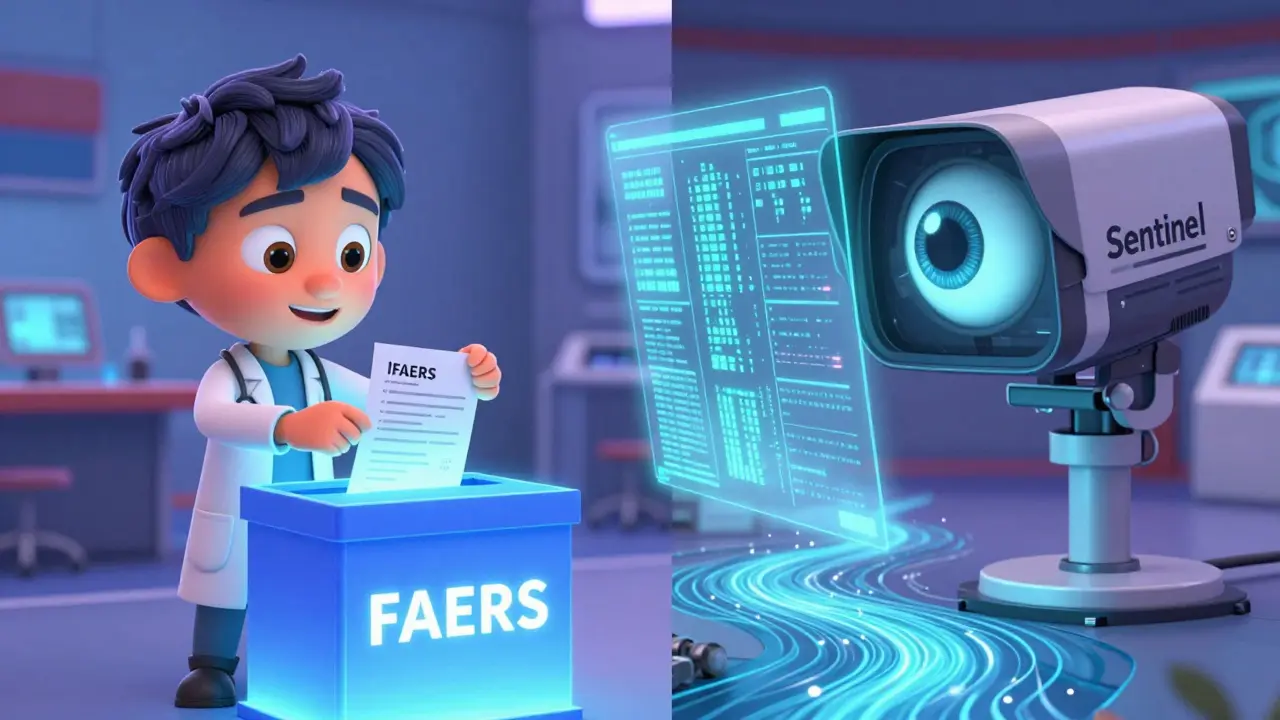
This system is built on a mix of "passive" and "active" surveillance. Passive surveillance is like a suggestion box-people report problems when they happen. Active surveillance is more like a security camera-the FDA proactively searches through massive health databases to spot trends before they become crises.
How FAERS Works: The Passive Safety Net
The primary tool for passive monitoring is the FDA Adverse Event Reporting System, or FAERS. FAERS is a central database that collects reports of adverse events, medication errors, and product quality complaints. Since 1969, it has grown to hold over 30 million reports.
Most of the data in FAERS comes from spontaneous reports. While this is helpful, it has a major flaw: underreporting. Studies show that spontaneous systems might only catch 1% to 10% of actual adverse events. Doctors are busy, and patients often don't know where to report a side effect. To fix this, the FDA uses the MedWatch platform, which aims to make reporting easier for healthcare providers and consumers.
To make sense of millions of reports, the FDA uses the Information Visualization Platform (or InfoViP), a tool that uses machine learning to help experts spot "signals"-patterns that suggest a specific drug is causing a specific side effect-much faster than a human could by scrolling through spreadsheets.
The Sentinel Initiative: Proactive Tracking
Because passive reporting is incomplete, the FDA launched the Sentinel Initiative in 2008. Unlike FAERS, which waits for a report, Sentinel proactively queries electronic health records and insurance claims data. It allows the FDA to monitor the safety of millions of patients in near real-time.
By accessing data from over 300 million patients, the FDA can ask complex questions, such as "Are patients taking Drug X more likely to develop heart failure than patients taking Drug Y?" This shift from reactive to proactive science allows the agency to identify risks in months rather than years.
| Feature | FAERS (Passive) | Sentinel (Active) |
|---|---|---|
| Data Source | Voluntary reports from users/doctors | Electronic health records, insurance claims |
| Approach | Reactive (Wait for reports) | Proactive (Query databases) |
| Speed | Slower to detect rare signals | Near real-time monitoring |
| Main Limitation | Heavy underreporting | Data privacy and access hurdles |
Mandatory Rules for Drug Manufacturers
Safety monitoring isn't just the FDA's job; it's a legal requirement for the companies that make the drugs. Under federal regulations, manufacturers must submit serious and unlabeled adverse event reports within 15 days. They also provide periodic safety update reports every 6 to 12 months.
For high-risk medications, the FDA implements Risk Evaluation and Mitigation Strategies, known as REMS. A REMS program is a strict safety strategy that might require a doctor to have special certification to prescribe the drug or require the patient to undergo regular blood tests to ensure the drug isn't causing organ damage. As of 2024, about 78 drugs are under active REMS programs, protecting millions of patients.

Challenges in the Real World
Even with these systems, there are gaps. One major issue is the "file drawer problem," where negative safety findings aren't always reported promptly. There's also a disparity in how quickly signals are found. If a drug is used by millions, the FDA might spot a problem in about two years. But for a niche drug with fewer than 100,000 users, it can take nearly five years to identify a safety signal.
Furthermore, there is a disconnect in reporting. While healthcare providers submit about 63% of reports, patients only account for about 6%. Many people simply don't realize that their experience with a medication is a piece of a larger puzzle that could save other lives.
What's Next for Drug Safety?
The future of monitoring is heavily tied to AI and Big Data. The FDA's Sentinel 2.0 initiative is now integrating genomic data from millions of people to understand why some people have severe reactions to a drug while others don't. We are also seeing a move toward blockchain-based reporting to make data more secure and transparent.
By 2030, experts predict that most safety signals will be caught through active surveillance rather than waiting for a doctor to fill out a form. This means faster warnings, quicker label changes, and ultimately, safer medicine for everyone.
What is a "safety signal" in drug monitoring?
A safety signal is a reported sign of a new potentially causal association between a drug and an adverse event. It isn't proof that the drug caused the problem, but rather a "red flag" that tells the FDA they need to investigate further using scientific analysis and data queries.
How can I report a side effect to the FDA?
The easiest way for consumers to report a side effect is through the MedWatch online portal. You can submit a report directly on the FDA website, providing details about the medication, the dosage, and the specific reaction you experienced.
What happens if the FDA finds a serious risk after a drug is approved?
Depending on the severity, the FDA can take several actions. This includes adding a "Black Box Warning" to the packaging (the most serious type of warning), requiring a REMS program to limit who can use the drug, or in extreme cases, recalling the drug and removing it from the market entirely.
Why do some drugs have REMS programs while others don't?
REMS are reserved for drugs with known, serious safety concerns where a standard label warning isn't enough. For example, if a drug can cause severe birth defects or sudden organ failure, the FDA requires a REMS program to ensure the drug is used only under strict supervision.
How does the FDA's system compare to other countries?
The FDA's Sentinel Initiative is generally considered more advanced than many international counterparts, such as the EMA's EudraVigilance in Europe, because it allows for deeper, active queries of real-world patient data across a larger population of covered lives.