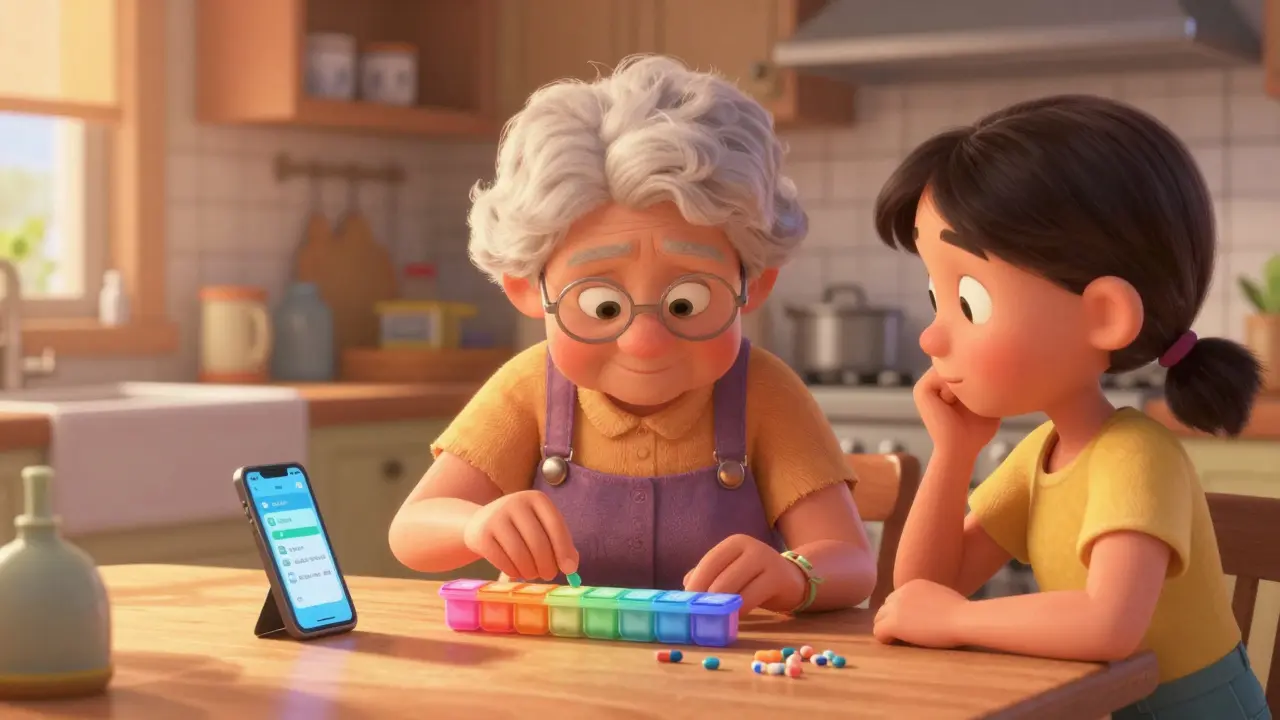
Every year, thousands of people accidentally take two doses of the same medication - not because they meant to, but because they forgot they already took it. It happens to busy parents, older adults managing multiple prescriptions, and even healthy people who grab a pill out of habit. The result? Nausea, dizziness, low blood pressure, liver damage, or worse. In Australia, the Therapeutic Goods Administration reports that medication errors at home are among the top three causes of preventable hospital admissions for people over 65. The good news? Most of these accidents are easy to stop with simple, proven steps.
Use a Pill Organizer - But Choose the Right One
A weekly pill organizer isn’t just a convenience - it’s a visual safety net. The key is picking one that matches your routine. If you take medicine once a day, a simple 7-compartment box works. But if you’re on morning, afternoon, and bedtime doses, you need a box with separate slots for each time of day. Look for ones with clear labels: AM, PM, and sometimes even “Before Meals” or “At Bedtime.” A 2023 survey of over 1,200 seniors found that 68% use weekly pill organizers, and those who did cut their risk of double-dosing by 35%. But here’s the catch: if you don’t fill it correctly, it won’t help. Make sure someone double-checks the pills before you start. Many pharmacies will fill them for you for free - ask when you pick up your prescription. For people who take liquids, like liquid antibiotics or cough syrup, a pill organizer won’t work. That’s where measuring tools come in.Never Use a Kitchen Spoon to Measure Medicine
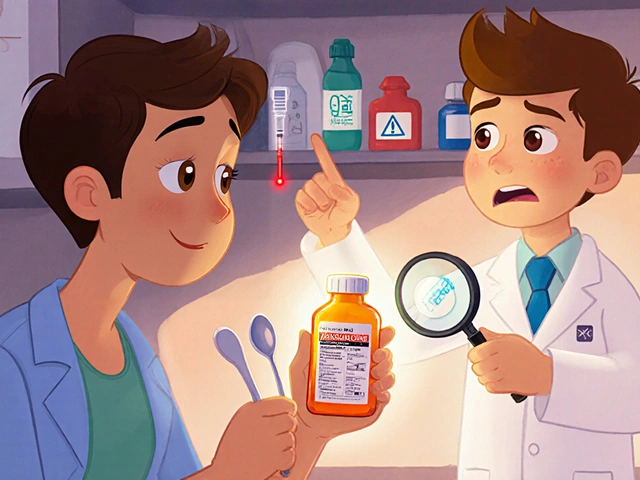
You’ve probably heard this before, but it’s still happening. A teaspoon from your kitchen can hold anywhere from 2.5mL to 7.3mL. That’s a 200% difference. For a child’s antibiotic or an elderly person’s blood thinner, that variation can mean the difference between a safe dose and a dangerous overdose. Always use the syringe, dropper, or cup that came with the medicine. If you lost it, ask your pharmacist for a new one. Most pharmacies give them out for free. If you’re giving medicine to a child, write the dose on the syringe with a permanent marker - that way, even if you’re tired or in the dark, you’ll know exactly how much to give.Set Digital Reminders - And Share Them
Smartphone apps like Medisafe, MyTherapy, or even the built-in calendar and alarm functions can be lifesavers. In a 2022 study, people who used medication reminder apps improved their adherence by 87%. But the real power comes when you share the reminders. If you’re caring for a parent or child, set up the same reminder on your phone too. That way, if you see the alert pop up and they haven’t taken it, you can check in. If they’ve already taken it, you’ll know not to give another dose. One 72-year-old woman in Adelaide avoided a dangerous interaction between her blood thinner and a new painkiller because her daughter had set up a shared reminder list. The app flagged that both medications contained acetaminophen - something she didn’t realize until the alert popped up.Keep a Written Medication List - Including Everything
Most people think their prescription list is just for doctors. But it’s also your personal safety checklist. Write down every pill, liquid, vitamin, herb, or supplement you take - even the ones you only take “once in a while.” Include the dose and why you take it. Why? Because many double-dosing cases happen when people take two different products that contain the same active ingredient. For example, Tylenol and many cold medicines both contain acetaminophen. If you take both without knowing, you can easily hit a toxic dose. A 2023 report from EssexCare Pharmacy found that 32% of double-dosing incidents involved hidden duplicate ingredients. Keep this list in your wallet, on your phone, and taped to the fridge. Update it every time your doctor changes your meds.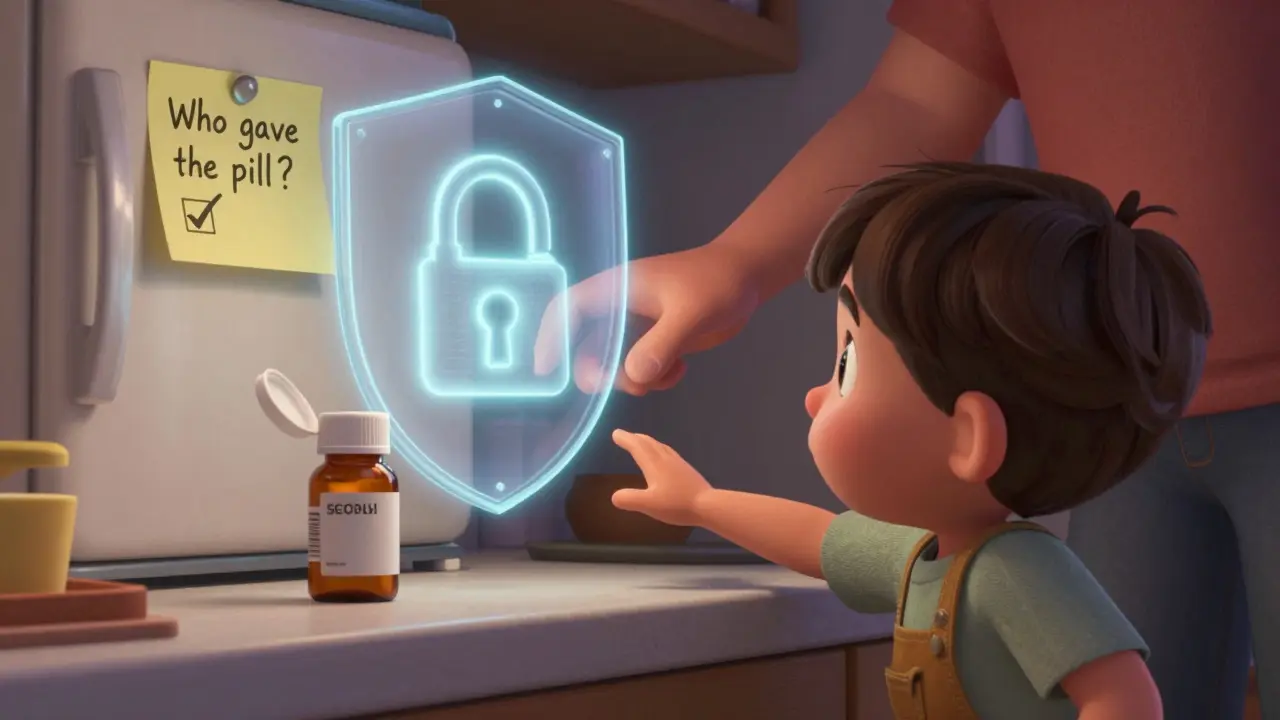
Assign One Person to Handle Medications
In homes with multiple caregivers - parents, grandparents, nannies, adult children - double-dosing spikes. Why? Because someone gives the medicine, then another person doesn’t know it was already given. St. Louis Children’s Hospital found that assigning one person to be the “medication manager” cuts double-dosing incidents by nearly 50%. It doesn’t mean that person has to do everything - just that they’re the one who confirms it’s been done. If you’re caring for an older relative, make a simple chart: “Who gave the morning pill?” with initials or a checkmark. Even a sticky note on the fridge works.Store Medicines Out of Reach - Especially for Kids
Most people think double-dosing only happens because someone forgets. But in 86% of pediatric emergency cases involving medicine, the child got into a bottle that wasn’t locked away. Keep all medicines - even vitamins - in a locked cabinet, not on the counter or in a purse. Use child-resistant caps, even if you think you’re careful. And never tell a child a medicine is “candy.” That’s how habits form.Link Medication to a Daily Routine
The easiest way to remember is to tie it to something you already do every day. Brushing your teeth? Take your pill right after. Eating breakfast? Take it with your toast. Going to bed? Take it before you turn off the light. A 2023 study showed that 78% of people who successfully avoided double-dosing tied their medication to a consistent daily habit. It turns a mental task into a physical one - something your body learns without thinking.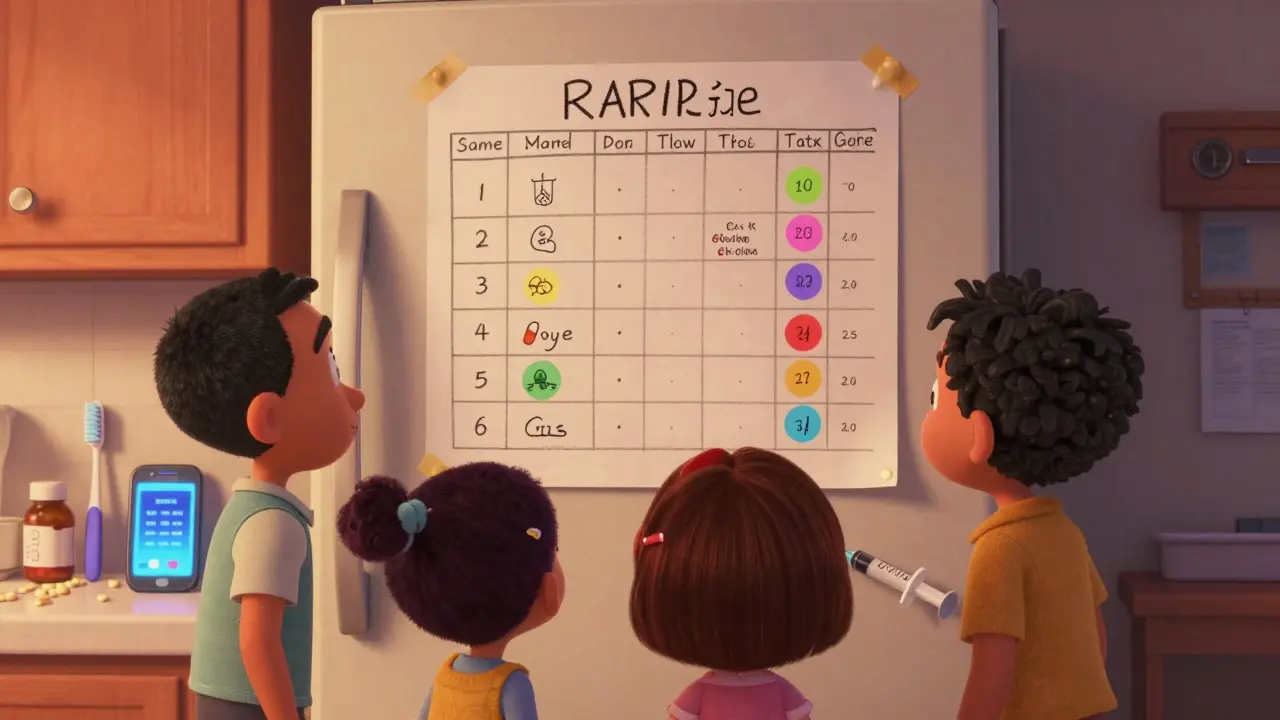
Been using a pill organizer for my mom’s meds since last year. Game changer. No more guessing if she took her blood pressure pill or not. Just look in the box. If it’s gone, she took it. If it’s still there? Yeah, we got a problem.
Also started putting all meds in a locked drawer. Kids are curious. Don’t even get me started on how many times I caught my nephew trying to ‘eat the rainbow’ from the bathroom cabinet.
so like i read this and i was like wow so many tips but honestly the real issue is people dont take responsibility for their own health anymore like why should a pharmacy fill your pills for free its not their job to babysit you i mean come on
I love how this article just says ‘do one thing’ like it’s that simple. But I’ve been trying to get my dad to use a pill organizer for 3 years. He says it’s ‘too much like a nursing home.’ So now I just set two alarms on my phone - one for him and one for me. I get the alert too. If he doesn’t answer when I call, I drive over. It’s not perfect but it’s something.
Also I write the dose on the syringe with a Sharpie. Best. Idea. Ever. I used to give him half a teaspoon of cough syrup and then panic because I wasn’t sure if I was using the right spoon. Now? No more panic.
This article reads like a public service announcement from 2008. Everyone knows not to use kitchen spoons. Everyone knows to use pill organizers. The fact that we need a 2000-word essay on this is a reflection of societal decline not a solution to medication errors.
YES. The ‘one person in charge’ thing saved my grandma’s life. My aunt and I were both trying to help - and we both gave her her blood thinner on the same day. She ended up in the ER. Now? I’m the official med manager. I update the list. I set the alarms. I check the box. She still takes her vitamins on her own - but the big stuff? I got it.
Also - sticky notes on the fridge. Don’t underestimate them. My grandma reads them better than her phone.
Smart reminders are great. But if you’re not consistent, they’re just noise. I had an app for months. Got 87% adherence? Nah. I turned it off. Now I tie my meds to brushing my teeth. No app. No alarm. Just toothpaste = pill time. Works every time.
Always use the measuring tool that comes with the medicine. Even if it’s ugly. Even if you lost it. Just call the pharmacy. They’ll give you a new one. Free. No judgment. They’ve seen it all.
Oh wow. A whole article about not using a kitchen spoon? Wow. What a revelation. Next you’ll tell us not to put our fingers in the toaster. Did you know 78% of people who avoid double-dosing tie meds to daily routines? Shocking. I guess that’s why I’ve been taking my blood pressure pill right after I fart. Works like a charm. Also, I use a soup ladle. It’s calibrated.
How quaint. You’ve all been saved by sticky notes and Sharpies. How utterly… pastoral. Meanwhile, in the real world, we have smart dispensers with Bluetooth sync, AI-powered interaction logs, and FDA-approved compliance tracking. But no - let’s all just tape a list to the fridge and call it a day. How very… American. So earnest. So inefficient.
Let’s be honest - this isn’t about medication safety. It’s about the collapse of personal responsibility in the face of a culture that infantilizes adults. We’ve turned medication management into a toddler’s bedtime routine. ‘Who gave the morning pill?’ Is this a kindergarten logbook? We’re not raising children. We’re raising adults who refuse to remember what they were told in 1997.
Did you know the government is using pill organizers to track us? The QR codes on them? They’re linked to the CDC. They’re collecting data on who takes what, when, and where. Next thing you know, they’ll deny you insurance if you miss a dose. I’ve stopped using mine. I write everything on a napkin and burn it. You’re being watched. Always.
lol i just use my phone alarm and if i forget i dont care 😎
There is something deeply moving about how many of us are trying to protect our loved ones with such quiet, humble tools - a box, a syringe, a sticky note. We don’t need drones or AI. We need presence. We need to show up. Not with gadgets. With love. And that’s the real breakthrough.
It’s interesting how we’ve reduced human memory - a biological, emotional, associative process - into a mechanical system of boxes, alarms, and checklists. We’ve outsourced cognition to plastic compartments and phone alerts. But what happens when the power goes out? When the phone dies? When the child knocks over the organizer? The real solution isn’t in the tool. It’s in the ritual. The quiet moment before bed, when you hold the pill in your palm and remember why you take it. That’s the memory that lasts. The rest? Just scaffolding.