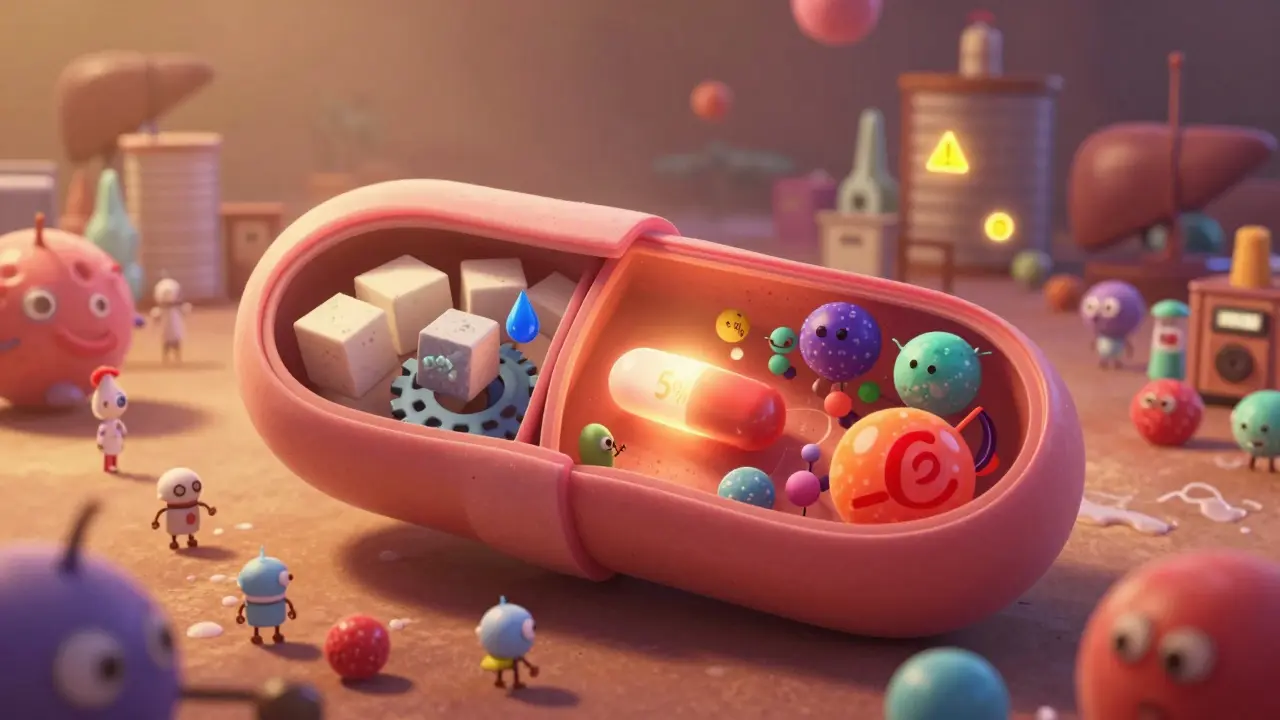
When you pick up a pill, you’re not just taking the active drug. In fact, the active ingredient might make up less than 5% of what’s in that capsule or tablet. The rest? That’s made up of excipients-the so-called "inactive" ingredients. For decades, these were thought to be harmless fillers, just there to help the pill hold its shape or taste better. But new science is turning that idea upside down. Could these "inactive" ingredients actually be changing how your medicine works-or even causing side effects you didn’t expect?
What Are Excipients, Really?
Excipients are the non-active parts of a medicine. Think of them as the scaffolding, the glue, the flavoring, and the coating that make the active drug easier to swallow, stable on the shelf, or absorbable in your body. Common ones include lactose (a milk sugar), microcrystalline cellulose (ground wood pulp), magnesium stearate (a lubricant), and even food dyes like tartrazine. In oral pills, excipients can make up 60% to 99% of the total weight. That’s not a tiny amount-it’s the bulk of what you’re consuming. The FDA lists about 1,500 approved excipients across all types of medicines, from pills to eye drops to IV fluids. Each one has a role: binders hold the pill together, disintegrants help it break down in your stomach, lubricants keep it from sticking to machinery during manufacturing, and preservatives stop it from going bad. They’re not optional. Without them, most drugs wouldn’t work reliably-or at all.Why "Inactive" Might Be a Misleading Term
The term "inactive" sounds safe. It implies nothing happens in your body. But that’s not true. A 2020 study in Science tested 314 excipients against 44 biological targets and found that 38 of them had measurable activity. That means they weren’t just sitting there-they were interacting with your cells. Take aspartame, the artificial sweetener sometimes used in chewable tablets. It showed activity against the glucagon receptor at concentrations you’d actually reach in your blood after taking a standard dose. Sodium benzoate, a preservative found in liquid meds, blocked an enzyme linked to mood regulation. Propylene glycol, used in many oral and injectable drugs, interfered with another enzyme that breaks down neurotransmitters. These aren’t lab curiosities. The study showed that for some excipients, the levels found in your bloodstream after normal use matched or came close to the levels that triggered biological effects in test tubes. That’s not theoretical-it’s happening in real people.When Excipients Change, Medicines Can Change
Generic drugs are supposed to be identical to the brand-name version. But when it comes to excipients, they don’t have to be. The FDA allows generic manufacturers to swap out inactive ingredients-as long as they can prove the medicine still works the same way and doesn’t cause harm. That sounds reasonable. But it’s where things get messy. In 2020, Aurobindo tried to launch a generic version of Entresto, a heart failure drug. They replaced magnesium stearate with sodium stearyl fumarate. Sounds harmless, right? But in vitro tests showed the new version released the active ingredients 15% slower at stomach pH levels. The FDA rejected the application. Why? Because even small changes in how fast a drug dissolves can mean the difference between it working-or not working at all. On the flip side, Teva successfully swapped out one disintegrant for another in their generic version of Jardiance. They proved through bioequivalence studies that the new formula released the drug at the exact same rate and into the same amount in the bloodstream. That’s how it’s supposed to work. The problem? Not every company does the testing. And not every change is caught.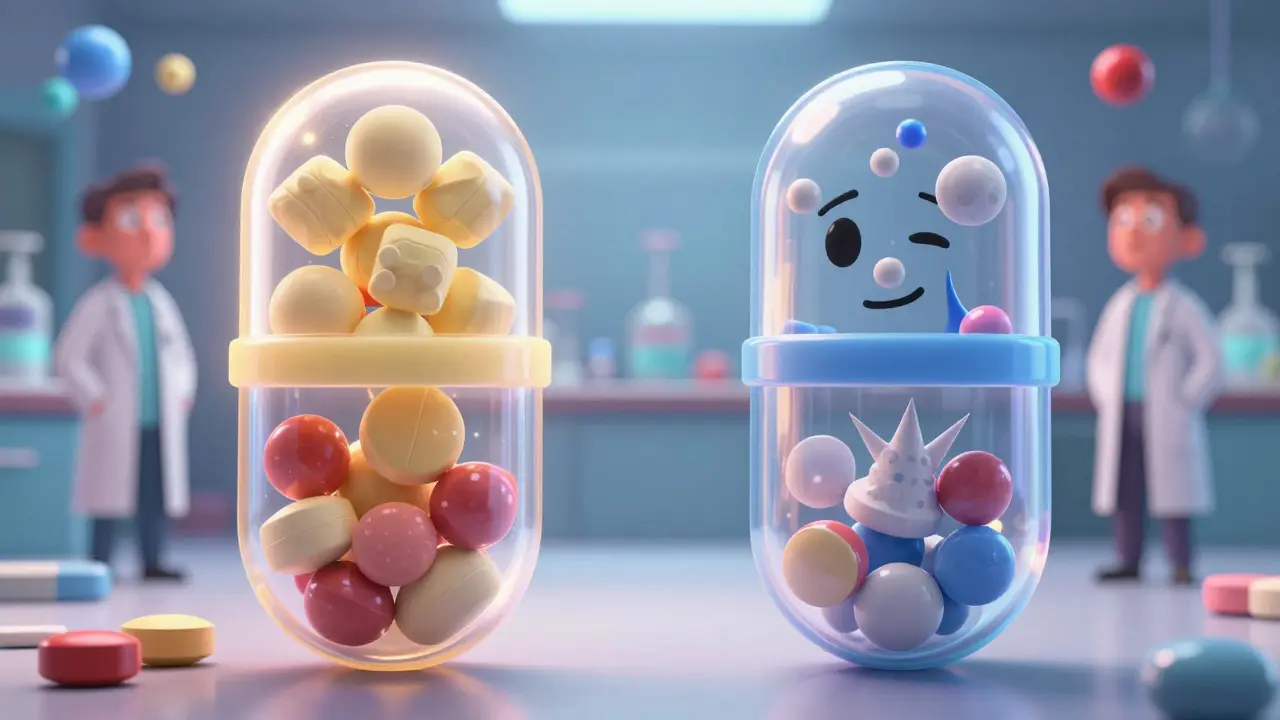
Regulations Are Out of Date
The FDA treats excipients differently depending on how the drug is given. For eye drops, IV fluids, or ear drops, the rules are strict: the generic must match the brand-name excipients exactly. But for pills and capsules? You can change almost anything. Why the difference? Because if a bad excipient gets into your bloodstream through an IV, it’s a bigger risk. But for pills? The assumption is that the gut will handle it. That assumption is being proven wrong. The European Medicines Agency (EMA) requires manufacturers to justify any excipient changes in a detailed document. The FDA doesn’t. Instead, it relies on its Inactive Ingredient Database (IID), which lists approved excipients and their safe limits. But the database doesn’t tell you if an excipient might interact with your liver enzymes, gut bacteria, or immune system. It just says, "This amount is okay." That’s not enough anymore.Real-World Consequences
In 2018, 14 generic versions of the blood thinner valsartan were recalled because of a cancer-causing contaminant-NDMA. It wasn’t the active ingredient. It was a new solvent used in the manufacturing process, a change in the excipient system. Patients had been taking the same medicine for years. Then, one small change in an "inactive" ingredient caused a public health crisis. And it’s not just contamination. Some people report allergic reactions or stomach upset with a generic version of a drug they’ve taken for years. Doctors often assume it’s "just in their head." But if the disintegrant changed from sodium starch glycolate to croscarmellose sodium, and that new ingredient irritates their gut lining? That’s not in their head. It’s in the pill. A 2023 survey of pharmacists found that 61% had patients report new side effects after switching to a generic-side effects that disappeared when they switched back. The FDA doesn’t track these reports systematically. And because excipients aren’t listed in detail on most drug labels, patients don’t even know what to look for.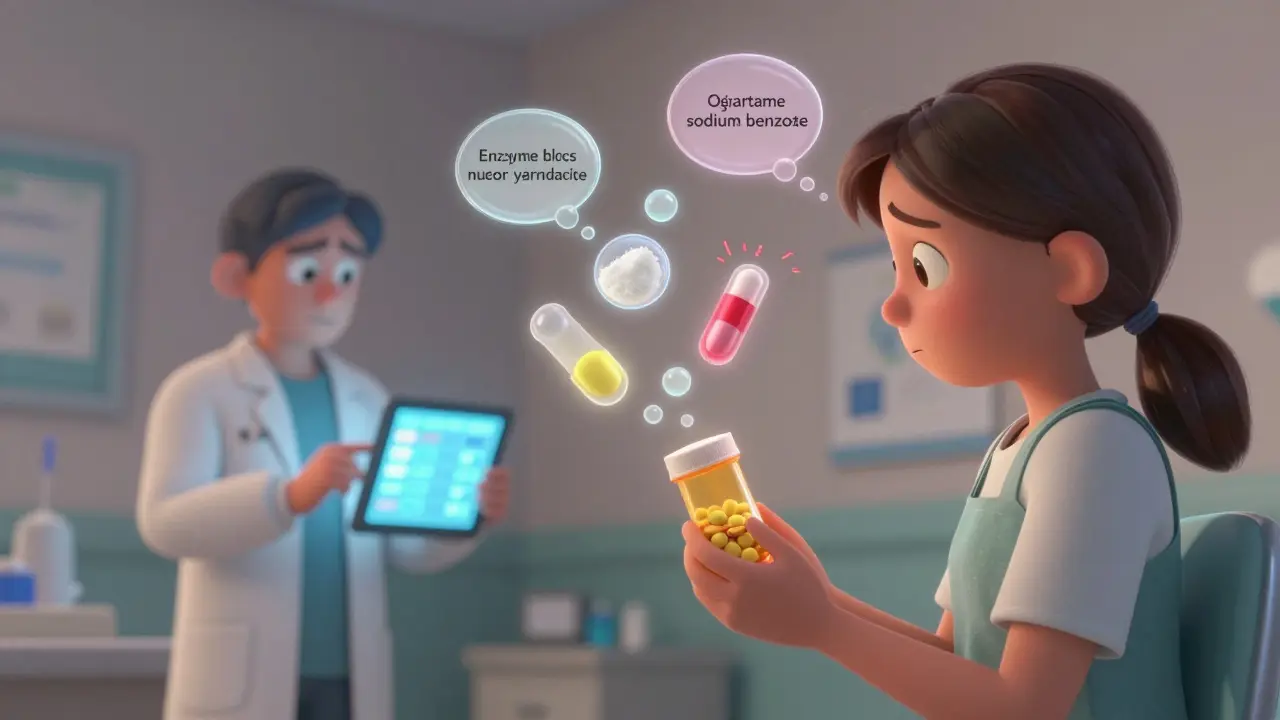
What’s Being Done?
The FDA knows the system is outdated. In December 2023, they launched a pilot program requiring extra safety data for 12 high-risk excipients used in orally disintegrating tablets-like aspartame and saccharin-after reports of rare allergic reactions. They’re also building a computer model to predict which excipients might interact with human biology, based on the 2020 Science study. The big push? A proposed update to FDA regulations that would require all new excipients to be screened against 50 high-risk biological targets before approval. That could add $500,000 to $1 million to the cost of developing a new generic drug. But it might prevent the next valsartan recall. Meanwhile, the International Pharmaceutical Excipients Council is trying to set universal safety thresholds-levels below which an excipient is considered harmless. But critics say that ignores individual differences. What’s safe for one person might trigger a reaction in another, especially if they have liver disease, a compromised immune system, or are taking multiple medications.What You Can Do
You don’t need to become a chemist. But you do need to be aware. If you’ve been taking a medication for years and suddenly start having new side effects after switching to a generic, don’t ignore it. Talk to your pharmacist. Ask: "Was the excipient formula changed?" They can check the FDA’s IID or the manufacturer’s documentation. If you have allergies, especially to dairy, soy, or artificial sweeteners, ask if your pill contains lactose, soy lecithin, or aspartame. These aren’t always listed on the box. You might need to request the full ingredient list from the manufacturer. And if you’re on multiple medications, be extra cautious. Excipients can interact with each other. A preservative in one pill might slow down the absorption of another. It’s not common-but it’s possible.The Bottom Line
Excipients aren’t just filler. They’re part of the medicine. And while most are safe, we’ve spent decades treating them like background noise. Science is now showing they’re part of the melody. Some might be harmless. Others? They could be the reason your drug isn’t working-or why you’re feeling off. The system is slowly changing. But until then, don’t assume "inactive" means "safe." Your body doesn’t know the difference. It just reacts.Are excipients always safe?
No. While most excipients have decades of safe use data, new research shows that some previously considered "inert" substances can interact with biological systems. Examples include aspartame, sodium benzoate, and propylene glycol, which have shown activity against human enzymes at concentrations reached during normal drug use. The FDA acknowledges that the assumption of inertness doesn’t hold for all excipients at all doses.
Can generic drugs have different excipients than brand-name versions?
Yes. For oral tablets and capsules, the FDA allows generic manufacturers to use different excipients as long as they prove the drug performs the same way in the body. This is called bioequivalence. But for injectables, eye drops, and ear drops, excipients must match the brand-name drug exactly. Differences in excipients can affect how quickly the drug dissolves or is absorbed, which can change its effectiveness.
Why don’t drug labels list all excipients?
Regulations only require listing active ingredients and major allergens like lactose or soy. Many excipients, such as fillers or lubricants, aren’t required to be disclosed on the label. Patients who need full ingredient lists must request them from the manufacturer or pharmacist. This lack of transparency makes it hard to identify reactions linked to excipients.
How do I know if my medicine’s excipients changed?
Check the pill’s appearance-color, shape, or markings may change. But the most reliable way is to ask your pharmacist. They can access the FDA’s Inactive Ingredient Database or contact the manufacturer to confirm if the excipient formula was updated. If you notice new side effects after switching generics, ask specifically about excipient changes.
Are there excipients I should avoid if I have allergies?
Yes. Common allergens in medications include lactose (from milk), corn starch, soy lecithin, tartrazine (yellow dye #5), and aspartame. People with celiac disease should watch for gluten-containing fillers like wheat starch. If you have known allergies, always ask your pharmacist to verify the excipient list before accepting a new generic version.
What’s being done to improve excipient safety?
The FDA is developing a computational model to predict excipient-biological interactions and has proposed requiring all new excipients to be screened against 50 high-risk biological targets. A pilot program now requires extra safety data for 12 high-risk excipients in orally disintegrating tablets. These steps aim to modernize outdated assumptions and reduce risks from untested excipient changes.

So basically, your pill is more like a science experiment than a medicine? 🤯 I just assumed the rest was just sugar and starch. Turns out it’s more like a cocktail of chemicals I didn’t sign up for.
Oh please. This is just fearmongering dressed up as science. People get mad when their generic pills look different and blame the ‘excipients’ like it’s some conspiracy. Wake up. If your body can’t handle a little magnesium stearate, maybe you should stop taking pills altogether.
Excipients are the silent conductors of pharmacokinetics. The assumption of inertness is a relic of 20th-century reductionist pharmacology. We’re now entering the era of polypharmacological systems biology - where even ‘fillers’ modulate receptor crosstalk, gut microbiome dynamics, and phase I enzyme induction. Aspartame’s glucagon receptor antagonism? Not a fluke. It’s emergent pharmacodynamics. 🔬🧬
And let’s not forget bioavailability modulation via surfactant-lipid interactions. Propylene glycol isn’t just a solvent - it’s a membrane fluidity disruptor. The FDA’s IID is a spreadsheet from the dial-up era. We need dynamic, patient-specific excipient profiling. Personalized excipient genomics? That’s the next frontier.
And don’t even get me started on the regulatory arbitrage between oral and parenteral routes. Why is IV more regulated than PO? Because we still think the gut is a ‘buffer zone.’ Spoiler: it’s not. It’s a sensory organ with 200M neurons. Your pill isn’t just dissolving - it’s conversing with your enteric nervous system.
The valsartan NDMA recall? That wasn’t contamination. That was systemic negligence. We treat excipients like additives in cereal, not as pharmacologically active co-components. The science is screaming. The regulators are asleep.
Next time you pop a pill, ask yourself: who designed the scaffolding? And more importantly - did they test it against *your* genome?
TL;DR: Your pill is a symphony. The active ingredient is the soloist. The excipients? The entire orchestra. And someone’s playing out of tune.
This made me cry. I have celiac and I’ve had so many stomach flare-ups after switching generics - and no one ever asked if the filler had gluten. My pharmacist didn’t even know to check. I had to call the manufacturer three times just to get the full list. 😭
Why isn’t this on the label? Why does it feel like we’re being treated like lab rats? I’m so glad someone finally said it: excipients aren’t ‘inactive.’ They’re invisible players in our health.
My grandma switched to a generic blood pressure med and started feeling dizzy. She thought it was just aging. Turned out the new version had a different binder - switched back to the brand, symptoms vanished. Took her 6 months to figure it out. Don’t ignore weird side effects after a switch. Pharmacists can help - just ask.
So let me get this straight - we’re told to trust generics because they’re cheaper, but the only thing that’s actually guaranteed to be the same is the active ingredient? The rest is like buying a car with the same engine but different tires, suspension, and fuel line… and hoping it doesn’t explode.
Classic capitalism: optimize for cost, not safety. And now we’re supposed to be grateful for the discount? 🤡
People who think this is overblown are the same people who thought thalidomide was fine because "it worked for nausea." Wake up. Just because something has been used for decades doesn’t mean it’s safe - it just means we haven’t had enough people die yet to notice.
If your kid has a peanut allergy, you read every label. Why wouldn’t you do the same for your prescription? You’re not paranoid. You’re responsible.
Thank you for writing this. I’ve been too scared to speak up before - I thought I was being dramatic when I said my anxiety got worse after switching generics. But now I know it’s not me. It’s the pill. I’m going to ask my pharmacist for the full ingredient list tomorrow. 💙
My cousin took a generic version of his antidepressant and started crying in the shower every day. He thought he was going crazy. Switched back to brand - boom, normal again. No one believed him. Now he’s got a folder with receipts, pill pictures, and a list of excipients. He’s basically a detective now.
As a pharmaceutical scientist from India, I must emphasize that the regulatory disparity between oral and parenteral excipients is not merely outdated - it is dangerously archaic. The human gastrointestinal tract is not a passive conduit; it is a dynamic biological interface with enzymatic, immunological, and microbial subsystems. The assumption that excipients remain inert in the GI lumen is empirically invalid. We have observed in our own bioequivalence studies that microcrystalline cellulose formulations from different vendors exhibit differential binding affinities to CYP3A4 enzymes - a finding ignored by FDA’s IID. The proposed screening of 50 biological targets is a necessary first step, but insufficient. We require real-time pharmacovigilance linked to patient genomics. Until then, patients are unwitting participants in an uncontrolled experiment.