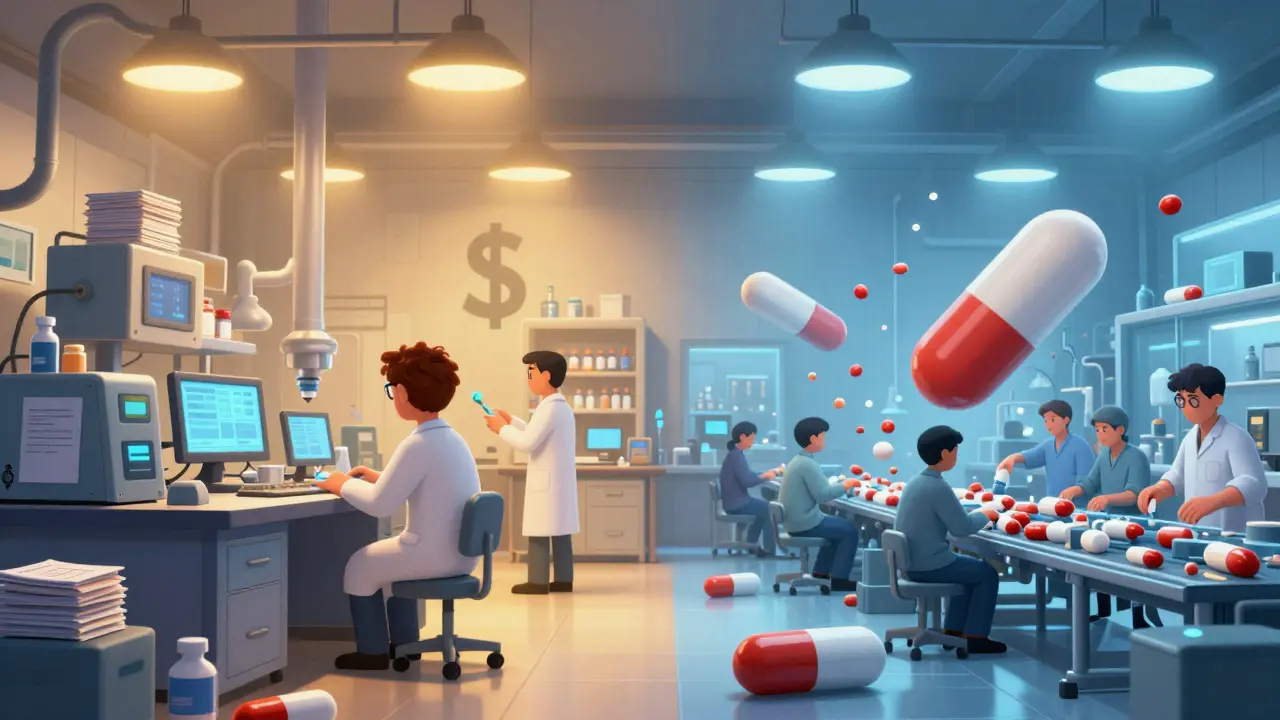
When you pick up a prescription, you might not think about who made the pill or how much it cost to produce. But behind every bottle of generic medication and every branded drug is a complex system of labor, regulation, and economics. The truth is, generic drugs and brand-name drugs don’t just differ in price-they differ in how labor is used, where it’s sourced, and why one costs so much less than the other.
Why Generic Drugs Are So Much Cheaper
Generic drugs cost 80-85% less than their brand-name counterparts, even though they contain the exact same active ingredient. That’s not magic. It’s math. And labor is a big part of that math. Brand-name drugs start with a massive investment. The FDA estimates it takes about $2.6 billion and 10 to 15 years to bring a new drug to market. That includes years of lab research, clinical trials, regulatory filings, and patent protection. All of that costs money-and that cost gets baked into the price. Labor here isn’t just about making pills. It’s about scientists, data analysts, regulatory specialists, and legal teams working for over a decade just to get approval. Generic manufacturers don’t have to do any of that. They skip the R&D. They don’t pay for clinical trials. They don’t need to market the drug. Their only job is to prove their version is bioequivalent-and that’s it. So their labor costs are focused on production, not innovation.Where the Labor Goes: Brand vs Generic
In brand-name drug production, labor makes up 30-40% of total manufacturing costs. That’s because every step is custom. Every batch is closely monitored. Every change in formula requires new testing, new documentation, new approvals. You need experienced chemists, quality assurance staff, and regulatory experts on-site full-time. Generic drug production? Labor is only 15-25% of total costs. Why? Scale. Volume. Repetition. A single generic manufacturer might produce 10 million pills of the same 10mg tablet every week. That kind of volume changes everything. The same worker who checks one batch today checks the 500th tomorrow. They get faster. They make fewer mistakes. The FDA and industry studies show that for every time production volume doubles, unit labor costs drop by 27-45%. That’s a huge efficiency gain. And here’s the kicker: quality control alone can take up over 20% of a generic drug’s total production cost. That’s not because generics are shoddy-it’s because they’re held to the same exacting standards as brand-name drugs. Every batch must be tested for purity, potency, and stability. Every label, every blister pack, every shipping box must be tracked. That’s labor-intensive. But because they’re doing it at scale, the cost per pill is tiny.The Global Labor Shift
Most generic drugs aren’t made in the U.S. About 80% of the active pharmaceutical ingredients (APIs) in U.S. generics come from India and China. Why? Labor is 42% cheaper there. That doesn’t mean workers in India are more skilled or machines are better. It means wages are lower, environmental rules are looser, and government subsidies help keep costs down. The HHS Office of the Assistant Secretary for Planning and Evaluation found that these cost advantages don’t come from efficiency-they come from structural imbalances in global markets. For U.S.-based brand-name companies, nearly all manufacturing happens domestically or in high-regulation countries like Germany or Switzerland. That means higher wages, stricter safety rules, and more oversight. Their labor costs reflect that. Generic manufacturers, on the other hand, outsource the bulk of their API production to low-cost countries. They focus their U.S. labor on packaging, distribution, and compliance. That’s a smart business move. It lets them keep prices low while still meeting FDA standards.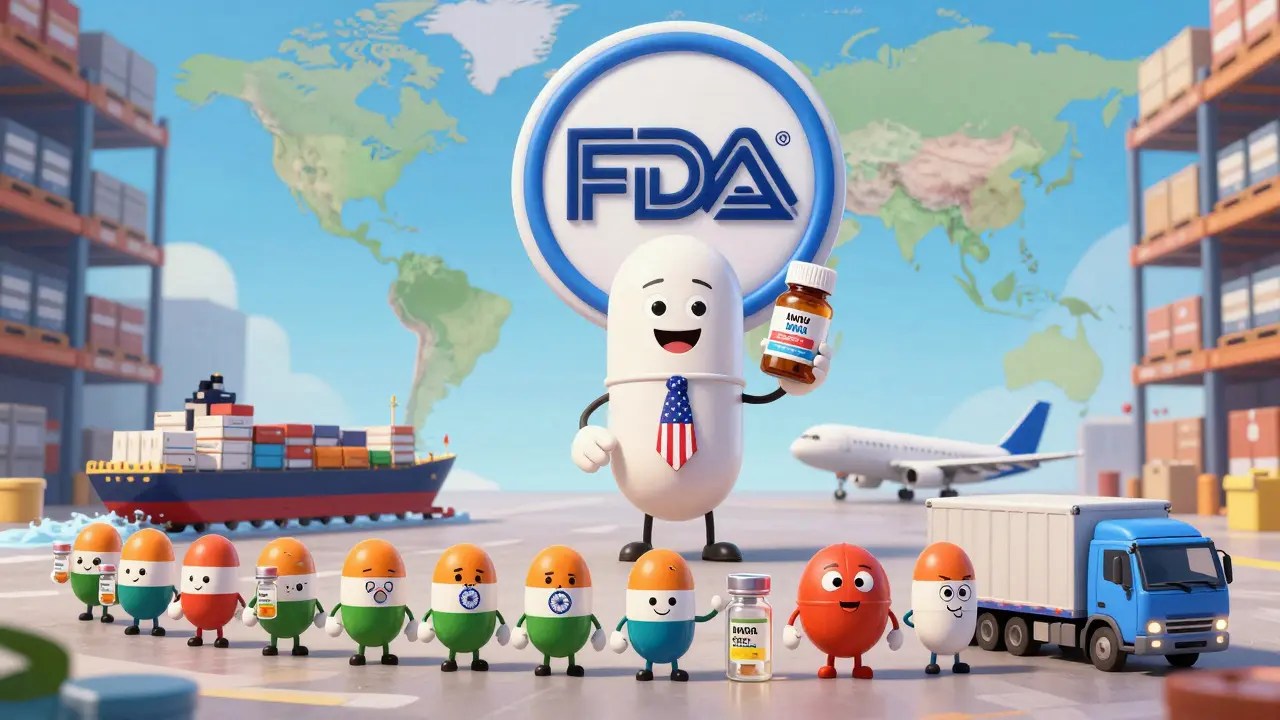
Quality Control: The Hidden Labor Cost
Here’s something most people don’t realize: the FDA requires generic drugs to meet the same quality standards as brand-name drugs. That means every batch of generic lisinopril or metformin must be tested just as rigorously as the brand version. That testing takes people. Lots of them. Quality control labs need technicians to run HPLC machines, analysts to review data, and document controllers to track every step. A medium-sized generic manufacturer spends about $184,000 a year just on compliance systems. Add in $1.9 million for program participation and $320,000 per new drug application, and you’re looking at a massive labor burden. But here’s the twist: because generics are produced in huge volumes, that cost gets spread thin. One lab tech can test 500 batches in a month. In a brand-name plant, they might test 20 batches a year-each one unique. The result? Generic manufacturers spend more total dollars on quality control-but far less per pill.Contract Manufacturing: Outsourcing Labor to Cut Costs
More and more generic companies are outsourcing production to Contract Manufacturing Organizations (CMOs). In fact, biosimilar manufacturers now spend 42% of their total production costs on CMOs. That’s up from 28% for traditional small-molecule generics. Why? It’s about flexibility. Building your own factory with a team of 200 workers is expensive. Hiring a CMO lets you scale up or down based on demand. If sales drop, you don’t lay off staff-you just order fewer batches. This shifts labor from a fixed cost to a variable one. It also lets generic companies avoid the overhead of managing labs, training staff, and maintaining equipment. The CMO absorbs those costs and passes them on at a lower rate because they serve dozens of clients. Brand-name companies rarely do this. They need control. They need secrecy. They need to protect their proprietary processes. So they keep production in-house-even if it costs more.
The Pressure Cooker: Why Generic Labor Is Under Constant Strain
There’s a dark side to low prices. As more generic competitors enter the market, prices keep falling. The FDA reports that when three or more generic makers produce the same drug, prices drop by 70-90% within a year. That’s great for consumers. But it’s brutal for manufacturers. To stay profitable, they have to cut costs. And labor is the easiest place to cut. Some companies respond by hiring less experienced staff. Others reduce training hours. Some even cut back on testing frequency-risking quality for savings. The FDA has warned that this pressure is leading to supply shortages. When a factory skimps on labor, mistakes happen. Batches get rejected. Production halts. Patients go without. The irony? The very system that makes generics affordable-intense competition-is also the thing that makes it harder to maintain high-quality labor standards.Who Benefits? Who Pays?
Nine out of ten prescriptions filled in the U.S. are for generic drugs. That’s $360 billion in annual savings for patients and insurers. But behind those savings is a hidden trade-off. The U.S. pays higher prices for brand-name drugs to fund innovation. We pay lower prices for generics because we outsource labor to countries with lower wages and fewer protections. We get cheap pills, but we also rely on a global supply chain that’s vulnerable to political shifts, trade wars, and pandemics. Brand-name manufacturers argue they need high prices to keep developing new drugs. Generic manufacturers argue they need to keep prices low to stay alive. Both are true. The real question isn’t which side is right. It’s whether we’re willing to pay for the full cost of our drug system-or just the parts we can see.What This Means for You
If you’re taking a generic drug, you’re benefiting from economies of scale, global labor arbitrage, and intense competition. You’re not getting a cheaper product-you’re getting the same product made more efficiently. If you’re paying for a brand-name drug, you’re paying for innovation, exclusivity, and control. You’re not paying for better ingredients. You’re paying for the history behind them. The next time you see a $4 generic prescription at the pharmacy, remember: it’s not just cheap. It’s the result of millions of hours of labor, optimized across continents, compressed by competition, and held to the same standards as the brand version. It’s not magic. It’s manufacturing. And it’s working-mostly.Why are generic drugs so much cheaper than brand-name drugs if they’re the same?
Generic drugs are cheaper because their manufacturers don’t have to pay for research, clinical trials, or marketing. They only need to prove they work the same way. Their labor costs are focused on high-volume production, not innovation. This lets them spread fixed costs over millions of pills, making each one far cheaper to produce.
Do generic drugs use lower-quality labor or fewer workers?
No. Generic drugs must meet the same FDA quality standards as brand-name drugs. The same testing, documentation, and inspections are required. However, to keep prices low, some manufacturers reduce training hours, hire less experienced staff, or outsource labor to countries with lower wages. This creates pressure on quality-especially when competition drives prices down further.
Where are most generic drugs made?
About 80% of the active ingredients in U.S. generic drugs come from India and China. Final packaging and labeling often happen in the U.S. or Europe. This global setup lowers labor costs significantly-by about 42% compared to U.S.-based production-but also creates supply chain risks.
Does outsourcing labor hurt the quality of generic drugs?
Not necessarily. Many contract manufacturers in India and China meet or exceed U.S. quality standards. The FDA inspects these facilities regularly. But when price pressure forces companies to cut corners-like reducing testing or skipping audits-quality can suffer. That’s why supply shortages happen: a single factory failure can disrupt the entire market.
Why do brand-name drugs still exist if generics are cheaper and just as effective?
Brand-name drugs exist because pharmaceutical companies need to recover the $2.6 billion it costs to develop a new drug. Without patent protection and high prices, there would be no incentive to invest in new treatments. Generics only enter the market after the patent expires. Until then, brands are the only option-and that’s why they command higher prices.
Are labor costs the biggest reason generics are cheaper?
Labor is a major factor, but not the biggest. The biggest savings come from skipping R&D and clinical trials. Labor costs are lower because of scale, outsourcing, and simplified processes. But without those upfront savings, even the most efficient labor system couldn’t make generics 80% cheaper.
Wow, this breakdown is actually eye-opening. I always thought generics were just ‘cheap knockoffs,’ but the sheer scale of labor optimization behind them is wild. 😮 Same standards, same FDA checks, but spread over millions of pills? That’s not laziness-that’s engineering genius.
My grandma takes 7 generics a day. She doesn’t know any of this-but I’m telling her tonight. 🙌 If she knew her $4 pill was made by someone in India who’s been testing the same batch for 12 hours straight, she’d probably cry. Or send them a care package. Probably both.
generic = cheap. brand = premium. stop overthinkin. 😴
It’s not labor arbitrage-it’s structural capital displacement. The neoliberal pharmaceutical complex externalizes labor costs to the Global South while internalizing risk via regulatory capture. The FDA’s inspections are performative compliance theater. 🤖
As someone from India, I’ve seen these factories. People work 12-hour shifts, 6 days a week, under AC that barely works. They’re not ‘cheap labor’-they’re brilliant, overworked engineers making sure your metformin doesn’t turn into chalk. 🙏 And yes, we use emojis. Deal with it. 😎
80% of APIs from China and India? Hmm. And the U.S. imports 90% of its antibiotics from there. Coincidence? Or is this a slow, silent bio-weaponization of our healthcare system? 🤔 The FDA inspections? Probably staged. I’ve seen the videos. They always show the clean rooms. Never the back alleys.
What struck me most is how the same quality standards apply across the board-yet the perception of generics remains so low. It’s not about science, it’s about branding. We’ve been conditioned to equate price with value, even when the chemical structure is identical. We’re not just paying for a pill-we’re paying for a story. And the story of the generic is ‘boring.’
But here’s the paradox: the system works. Millions get access to life-saving drugs because of this efficiency. Yet we vilify the workers who make it possible, while celebrating the CEOs who profit from the patent monopoly. We need to reconcile the ethics with the economics.
Maybe the real question isn’t ‘why are generics cheaper?’ but ‘why do we let innovation be funded by exploitation?’
And if we want truly sustainable pharma, we need to pay more-not just for R&D, but for labor dignity too.
That’s not anti-capitalist. That’s just human.
they just make the pills in a garage somewhere. no one checks. i heard a guy on reddit say his cousin's friend got sick from a generic. trust no one.
And what about the workers? The ones in Hyderabad who’ve been testing the same tablet for 18 years? Do they get healthcare? Do they get paid overtime? Do they get to see their kids? I think about them every time I fill a prescription. And I cry. I cry because they’re invisible. And we’re all complicit.
Every time you say ‘it’s just a $4 pill,’ you’re erasing a human being. And that’s not just sad-it’s evil.
Someone should make a documentary. I’d watch it. I’d cry again.
Interesting how the same people who scream about ‘Made in China’ for electronics are totally fine with ‘Made in India’ for their blood pressure meds. The cognitive dissonance here is almost poetic.
But honestly? I’m just glad I can afford my prescriptions. I don’t care where they’re made, as long as they work. And they do. The system’s flawed-but it’s not broken. Not yet.