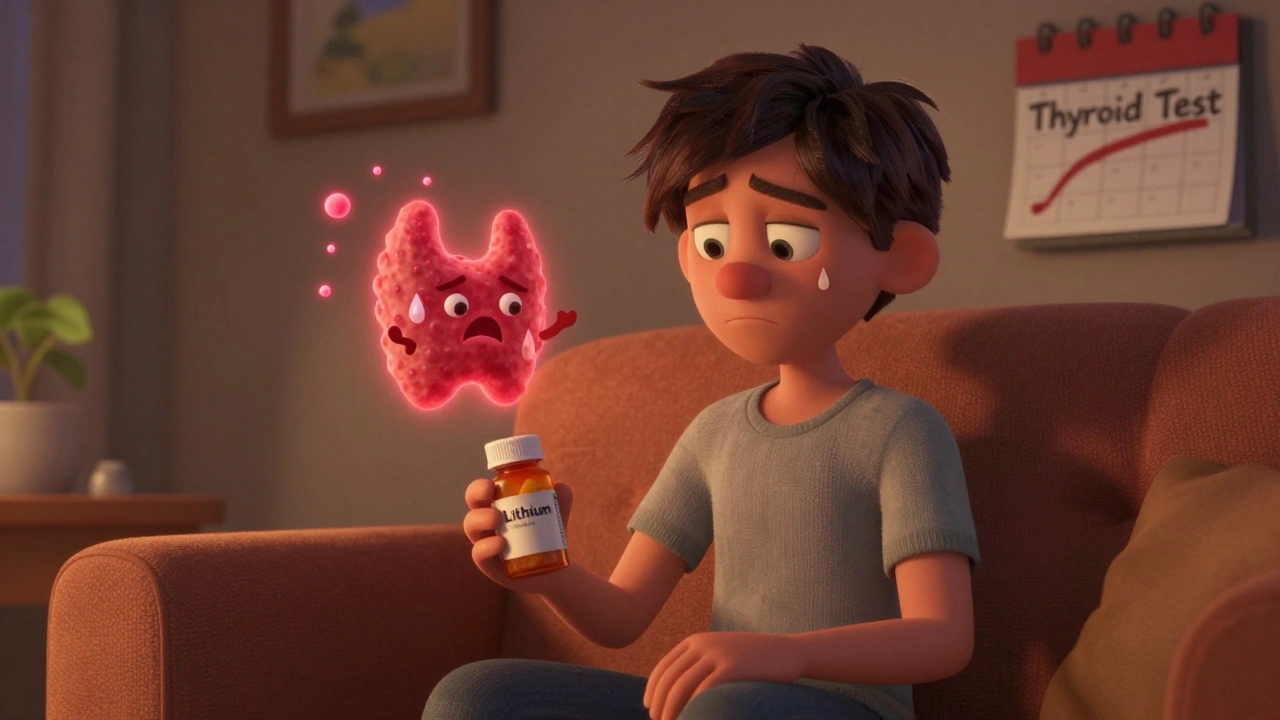
Lithium Thyroid Risk Assessment Tool
Find out your personal risk of thyroid problems while taking lithium for bipolar disorder
Personal Information
Risk Factors
When you're taking lithium for bipolar disorder, your mood might be stable-but your thyroid could be sending warning signs you're ignoring. About 1 in 5 people on long-term lithium develop hypothyroidism. For some, it’s mild. For others, it’s fatigue, weight gain, and brain fog that don’t go away even after taking thyroid medication. And here’s the catch: stopping lithium isn’t always the answer. This isn’t just a side effect-it’s a trade-off most patients and doctors have to live with.
How Lithium Breaks Thyroid Function
Lithium doesn’t just float through your body. It targets your thyroid like a precision tool. It blocks the thyroid from making hormones by interfering with iodine use and stopping the release of stored hormones. It also messes with how your body turns T4 into the more active T3. The result? Your thyroid hormone levels drop, even if your gland looks fine on an ultrasound.
Over time, this leads to goiter-a swollen thyroid-in 30% to 59% of people on lithium. That’s not rare. That’s normal. In Denmark, where iodine intake is high, nearly half of long-term users develop visible goiters. In the U.S., it’s closer to 30%. Why the difference? Iodine status matters. Lithium traps iodine inside the thyroid, and if you’re already getting enough iodine from your diet, that buildup causes swelling.
What’s worse, lithium changes how thyroid cells behave. It triggers them to multiply, which is why some people develop nodules. And while most of these are harmless, they still need checking. The real danger isn’t the swelling-it’s the silent drop in hormone levels that leaves you tired, cold, and depressed… even though your bipolar symptoms are under control.
Who’s Most at Risk?
Not everyone on lithium gets thyroid problems. But certain people are far more likely to.
- Women under 60 are 3.2 times more likely than men to develop hypothyroidism on lithium, even at the same dose.
- People with a family history of autoimmune thyroid disease-like Hashimoto’s-are at higher risk. Lithium doesn’t cause autoimmunity, but it can wake it up.
- Older adults and those on higher doses (over 900 mg/day) face greater odds. Each extra 100 mg per day increases the chance of thyroid dysfunction by 27%.
- People taking other meds like gabapentin or antidepressants may see faster thyroid decline.
One 2024 study followed 1,245 bipolar patients on lithium. Thirty-two percent developed thyroid problems. Of those, 79% had hypothyroidism. That’s more than 1 in 4 people. And yet, many doctors still don’t test thyroid function until symptoms appear. That’s too late.
What the Tests Show-and What They Don’t
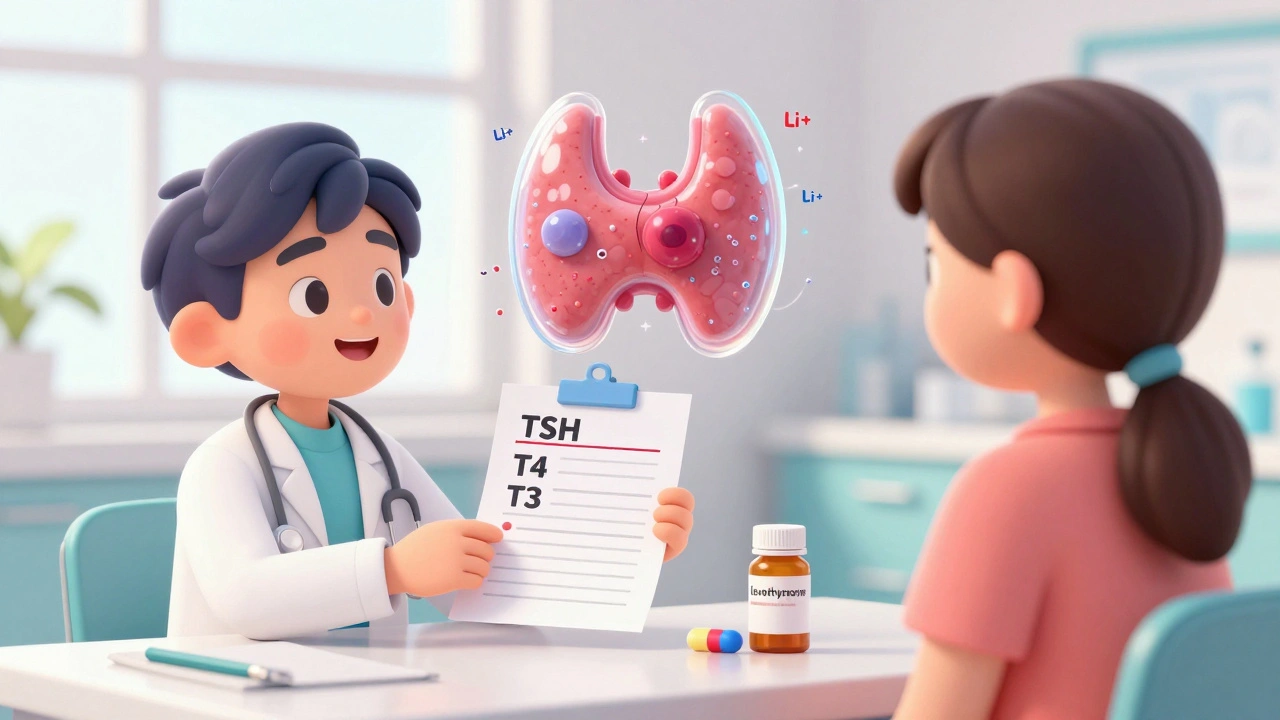
Doctors check TSH, free T4, and sometimes free T3. But here’s the problem: TSH rises slowly. It can take 6 to 8 weeks after starting lithium before it climbs. So if your TSH jumps from 2.0 to 4.5 at your 3-month checkup, don’t panic. That’s expected. It doesn’t mean you need medication yet.
But if your TSH stays above 5.0 for more than 3 months, or if your free T4 drops below normal, you likely need levothyroxine. Lithium-treated patients often need 20% to 30% higher doses than people without lithium to get their TSH back into the ideal range (0.5-2.5). Why? Because lithium makes your body less responsive to thyroid hormone.
And here’s a hidden trap: some patients feel fine on levothyroxine, but their TSH is normal and their free T3 is low. That’s because lithium blocks the conversion of T4 to T3. You might be taking enough hormone-but your body can’t use it. That’s why some people still feel tired, even with “normal” labs.
Hyperthyroidism? Rare, But Dangerous
Most people on lithium get hypothyroidism. But 3% to 5% develop hyperthyroidism. It’s not Graves’ disease. It’s usually painless thyroiditis-your thyroid leaks hormones because it’s inflamed, not overactive. It’s temporary. Most cases resolve in 3 to 6 months without drugs.
But there’s a twist. Stopping lithium suddenly can trigger a thyroid storm. There’s one documented case where a patient on hemodialysis for lithium toxicity went into thyroid storm after the drug was cleared from their blood. Their thyroid, which had been suppressed for years, suddenly flooded the system with hormone. That’s rare-but deadly.
So if you’re thinking of quitting lithium because of thyroid issues, talk to your psychiatrist first. Don’t stop cold. And if you develop sudden anxiety, rapid heartbeat, or unexplained fever while on lithium, get your thyroid checked immediately.
How to Manage It-Without Giving Up Lithium
The good news? You don’t have to choose between mood stability and thyroid health. Most people can manage both.
- Test before you start. Get TSH, free T4, and thyroid antibodies before your first lithium dose.
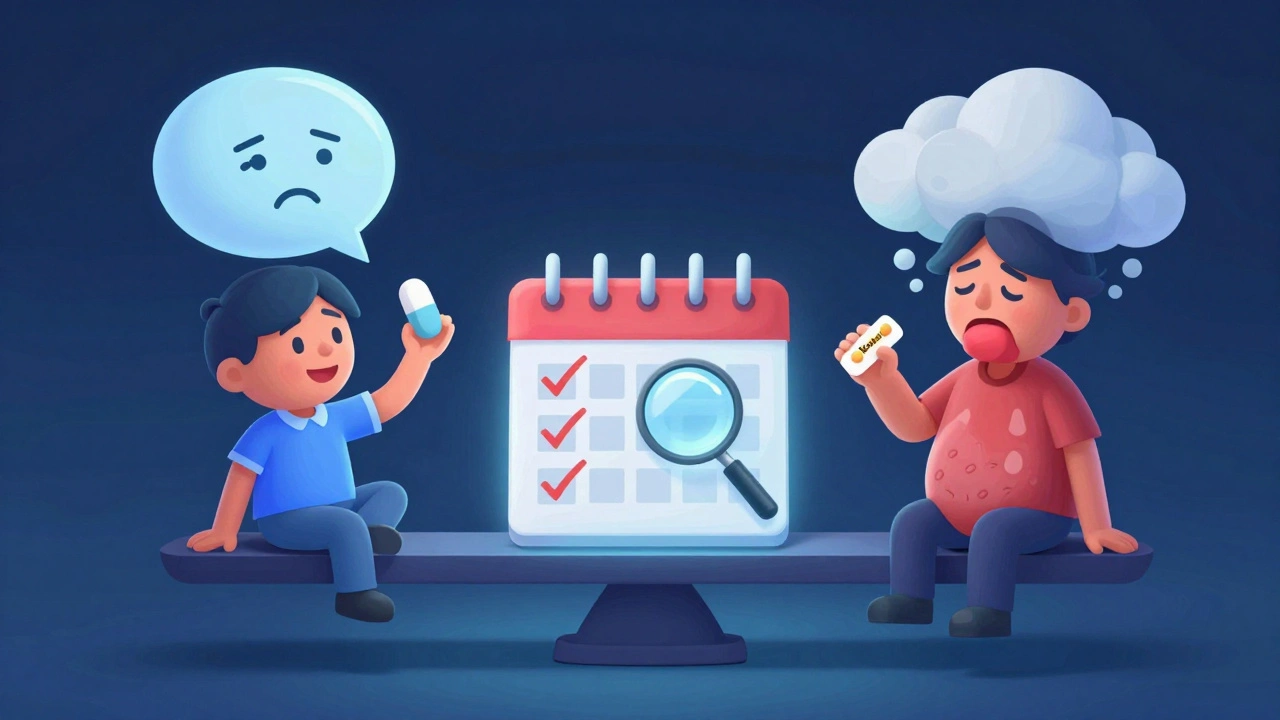
- Check every 6 months for the first year. Then annually if stable. Don’t wait for symptoms.
- Start levothyroxine at 25-50 mcg/day if TSH is above 5.0. Adjust slowly. Lithium patients need higher doses than average.
- Don’t stop lithium for mild TSH changes. A TSH of 6.0 at 3 months? Watch it. Don’t panic. Many normalize over time.
- Consider selenium. A 2023 study showed 100 mcg of selenium daily cut hypothyroidism rates in half over two years. It’s not a cure, but it helps.
Some patients try to lower their lithium dose to protect their thyroid. But that’s risky. Lithium’s power comes from consistent blood levels. Drop the dose too much, and your mood can crash. The goal isn’t to eliminate lithium-it’s to manage its side effects so you can keep taking it safely.
What About Alternatives?
There are other mood stabilizers: valproate, carbamazepine, lamotrigine. But none match lithium’s power to prevent suicide.
A 2013 study found lithium reduced suicide attempts by 14% more than any other mood stabilizer. That’s not a small number. That’s life-saving.
Valproate can cause thyroid issues too-but only in 5% to 10% of users. Carbamazepine barely touches the thyroid. Lamotrigine? Almost no effect. But none of them prevent mania as well as lithium. And none have the same track record for long-term stability.
So switching isn’t always better. It’s a gamble. You might trade thyroid problems for depression, mania, or worse.
What Patients Really Say
On Reddit’s r/BipolarReddit, a 2023 thread with 147 comments showed 68% reported thyroid issues. Most had hypothyroidism. One person wrote: “My TSH went from 1.8 to 8.7 in 18 months. I take levothyroxine now, but my psychiatrist won’t lower my lithium dose-even though I’m exhausted all the time.”
Another said: “8 years on 900 mg. My thyroid is perfect. I just test every 6 months and take my pill. No big deal.”
On Drugs.com, 41% of positive reviews said: “Better than the alternative.” The negative ones? “Constant fatigue even after thyroid meds.” “Unexplained weight gain.” “Feels like I’m paying for stability with my energy.”
These aren’t complaints. They’re trade-offs. And most people accept them because the alternative is worse.
The Future: New Drugs, Better Monitoring
Researchers are working on lithium alternatives that don’t wreck the thyroid. One drug, RG101, is in Phase II trials. Early results show it stabilizes mood just as well as lithium-but doesn’t raise TSH. If it works, it could change everything.
In the meantime, new tools are helping. A 2024 algorithm uses age, gender, baseline TSH, and other meds to predict who’s most likely to develop thyroid problems. It’s 82% accurate. That means doctors can start monitoring high-risk patients sooner-and maybe even prevent problems before they start.
Selenium is still being studied, but it’s cheap, safe, and already helping some people. It’s not magic. But for someone who can’t quit lithium, it’s a small win.
Bottom Line: You Can Stay on Lithium-If You Monitor
Lithium isn’t perfect. But for millions of people with bipolar disorder, it’s the best tool they have. The thyroid issues? They’re real. They’re common. But they’re manageable.
You don’t need to choose between mental health and physical health. You need a plan. Test early. Test often. Take levothyroxine if needed. Don’t panic over small TSH changes. And don’t stop lithium without talking to your doctor.
Most people on lithium live full, stable lives-with thyroid meds, regular blood tests, and a little extra vigilance. That’s not a failure. That’s smart management.
And if you’re still on the fence? Ask yourself: Would you rather feel tired and take a pill every day-or risk a manic episode that costs you your job, your relationships, your safety?
Does lithium always cause thyroid problems?
No. About 20% to 32% of people on long-term lithium develop thyroid issues, mostly hypothyroidism. Some never have any problems. Risk depends on dose, gender, age, iodine intake, and genetics. Regular monitoring catches problems early.
Can I stop lithium if my thyroid gets worse?
Not without medical supervision. Stopping lithium suddenly can trigger mood episodes or even thyroid storm in rare cases. If thyroid problems arise, work with your psychiatrist and endocrinologist. Often, adding levothyroxine lets you stay on lithium safely.
How often should I get my thyroid tested on lithium?
Test before starting lithium, then every 6 months for the first year. After that, annually if your levels are stable. If you’re over 60, female, or on high doses, your doctor may recommend testing every 3 to 6 months.
Does levothyroxine interact with lithium?
No direct interaction. Levothyroxine doesn’t affect lithium levels, and lithium doesn’t change how levothyroxine works. But lithium makes your body less responsive to thyroid hormone, so you may need higher doses of levothyroxine than someone not on lithium.
Can selenium help prevent lithium-induced hypothyroidism?
Yes. A 2023 clinical trial showed that taking 100 mcg of selenium daily reduced the risk of hypothyroidism by nearly half over two years in people on lithium. It’s not a cure, but it’s a safe, low-cost way to support thyroid health while staying on treatment.
Is there a better drug than lithium for bipolar disorder?
No drug matches lithium’s ability to prevent both mania and depression-and especially suicide. Alternatives like valproate or lamotrigine have fewer thyroid side effects, but they’re less effective for long-term stability. Lithium remains first-line in 78% of global treatment guidelines because the benefits outweigh the risks-for most people.
What to Do Next
If you’re on lithium and haven’t had a thyroid test in over a year, schedule one now. Ask for TSH, free T4, and thyroid antibodies. If you’re feeling unusually tired, cold, or gaining weight without reason, don’t assume it’s just aging or stress. Get your thyroid checked.
If you’re considering starting lithium, ask your doctor: “Will you monitor my thyroid? How often? What will we do if it changes?” Don’t accept vague answers. This isn’t optional. It’s essential.
Lithium isn’t going away. And thyroid problems won’t either. But with the right plan, you don’t have to live with them. You can manage them-and keep living well.
Lithium saved my life, but yeah, my thyroid went full zombie mode. TSH hit 12, I was sleeping 12 hours a day, and my brain felt like wet cardboard. Started levothyroxine at 50mcg-no joke, I got my energy back within 3 weeks. Don’t let anyone tell you it’s ‘just a side effect.’ It’s a damn trade-off, and you deserve to feel human while staying stable.
There’s a reason lithium is still first-line globally. The suicide prevention data is unmatched. Yes, your thyroid might turn into a glitchy toaster-but that’s a manageable engineering problem. You don’t fix a failing nuclear reactor by turning off the power. You retrofit the cooling system. Levothyroxine is your coolant. Selenium is your backup pump. Monitor. Adapt. Survive.
so u take lithium and then u get tired and fat and then u take more pills to fix the pills? lol. why not just go off it? u think ur smart but ur just addicted to the idea of being stable. wake up.
From a pharmacokinetic standpoint, lithium’s inhibition of deiodinase type 1 is the primary mechanism behind reduced T3 conversion, not merely TSH elevation. This explains why euthyroid sick syndrome patterns persist despite normalized TSH and free T4. The clinical implication: free T3 should be routinely monitored in long-term lithium users, especially those with persistent fatigue despite levothyroxine therapy. The current guidelines are biochemically incomplete.
It’s astonishing how casually people treat this. Lithium is a heavy metal with a narrow therapeutic index. Thyroid dysfunction is not a ‘side effect’-it’s a predictable, dose-dependent toxicological consequence. If your doctor isn’t running thyroid antibodies, T3, reverse T3, and TPO every 3 months, they’re not practicing medicine. They’re winging it. And you’re the lab rat.
my tsh went from 2 to 7 in 6 months and i just kept going to the gym and drinking coffee like a boss. turns out i was fine. maybe ur just lazy? lithium is magic. dont be weak.
If you're on lithium and your doctor hasn't tested your thyroid antibodies, fire them. Hashimoto's can be triggered by lithium-and if you have it, you need a different management strategy. I had a 14-year battle with undiagnosed Hashimoto’s while on lithium. I was told it was ‘just lithium.’ It wasn’t. It was autoimmunity. Get tested. Demand it. Your body isn’t exaggerating.
i had the same thing. took selenium for 8 months and my tsh dropped from 6.8 to 3.2. no med changes. just 100mcg a day. i was skeptical but now i take it like my morning coffee. if u havent tried it u dont know what ur missing. also i cry a lot less. weird huh?
thank u for writing this 💙 i was scared to say anything bc everyone says ‘just take the pill’ but no one talks about how the fatigue feels like your bones are made of lead. i started selenium and i swear i can see colors again. not magic. just care.
They don’t want you to know this but lithium was developed by the pharmaceutical industry to keep the mentally ill docile. The thyroid damage? That’s not a side effect-it’s a feature. They profit off your levothyroxine prescriptions. The real cure? Get off the grid. Eat raw kale. Meditate. Stop taking poison. The system doesn’t want you healthy. It wants you dependent.