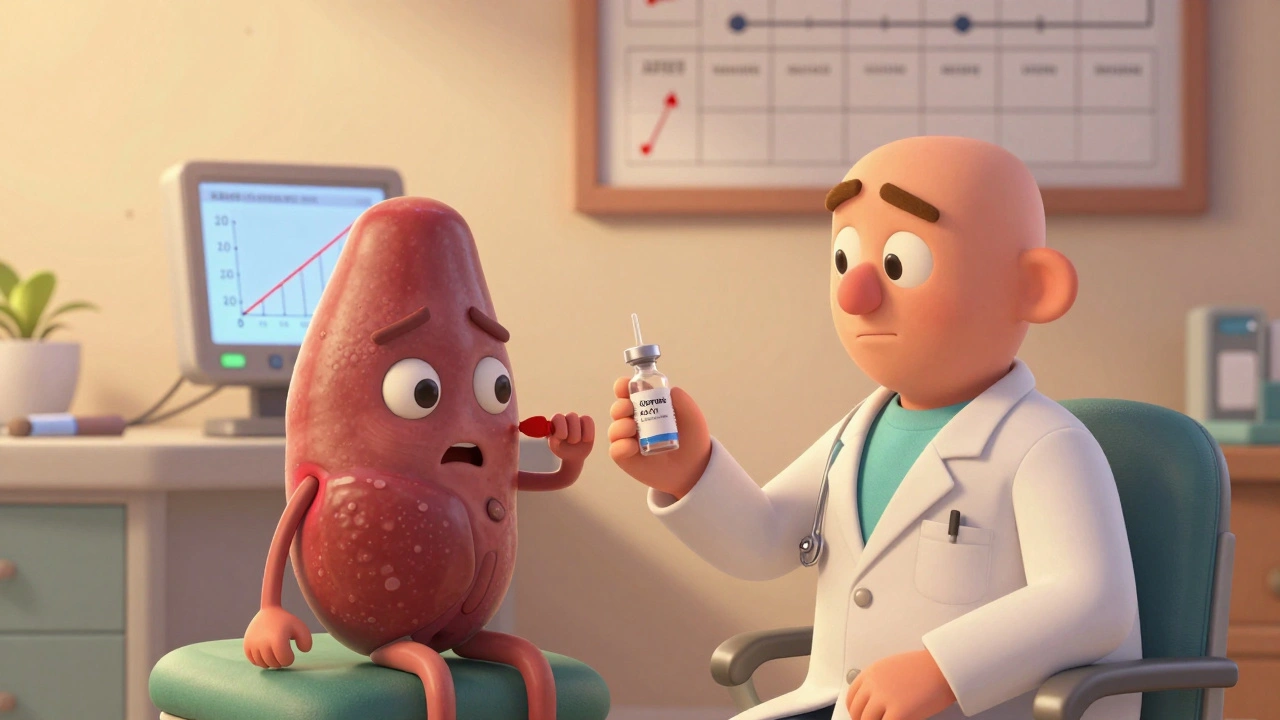
When you’ve been on steroids for months or years, stopping them isn’t as simple as just skipping a pill. Your body forgets how to make its own cortisol. If you quit too fast, you could end up in the hospital with an adrenal crisis-low blood pressure, vomiting, confusion, even collapse. That’s why steroid taper plans with ACTH stimulation testing are now the standard for anyone coming off long-term glucocorticoid therapy.
Why Your Adrenals Go Silent
When you take steroid pills like prednisone or hydrocortisone for more than a few weeks, your brain stops telling your adrenal glands to make cortisol. It’s not laziness-it’s biology. Your hypothalamus and pituitary gland think, “We’ve got plenty of cortisol from outside, no need to work.” Over time, your adrenal glands shrink and lose their ability to respond. This is called HPA axis suppression. It doesn’t matter if you’re on high doses for rheumatoid arthritis or low doses for asthma or Duchenne muscular dystrophy. If you’ve been taking steroids for more than 3-4 weeks, your body needs help waking up.What Is ACTH Stimulation Testing?
The ACTH stimulation test checks if your adrenal glands can still do their job. You get a shot of synthetic ACTH (called cosyntropin), which is the hormone your pituitary normally releases to tell your adrenals: “Make cortisol now.” Then, blood is drawn before the shot and again at 30 and 60 minutes after. If your cortisol level spikes to 18-20 mcg/dL or higher, your adrenals are recovering. If it stays below 14 mcg/dL, you’re still suppressed-and you’re not ready to stop steroids yet.This test isn’t optional for people on long-term therapy. A 2024 study from Mayo Clinic showed that using this test during tapers cut adrenal crisis rates from 8.5% down to just 1.2%. That’s an 86% drop. Without testing, doctors often guess. And guessing can kill.
When to Test and How Often
The 2024 joint guideline from the Endocrine Society and European Society of Endocrinology says testing should happen when you’ve reached a physiologic dose-about 4-6 mg of prednisone per day (or 15-25 mg of hydrocortisone split into three doses). That’s the amount your body would normally make if you weren’t sick. You don’t test at the start of your taper. You test when you’re close to the finish line.For people who’ve been on steroids for 3-12 months, a common plan is to drop the dose by 2.5-5 mg every 1-2 weeks until you hit that 10-15 mg/day mark. Then you slow down. Drop by 20-25% each week. For those on steroids longer than a year, recovery takes longer. One month of tapering for every month you were on steroids. That means if you were on them for 18 months, you might need 18 months to safely stop. Some people need up to two years.

Not All Tapers Are the Same
Different groups have different rules. The Endocrine Society says only test if you have symptoms like fatigue, dizziness, or nausea. But the Adrenal Insufficiency Coalition and the PJ Nicholoff Protocol say test everyone after three months. Why? Because symptoms are unreliable. One patient might feel fine but have cortisol levels of 8 mcg/dL. Another might feel awful at 17 mcg/dL due to withdrawal, not true adrenal failure. That’s why testing matters-it cuts through the noise.The PJ Nicholoff Protocol was built for Duchenne muscular dystrophy patients. It’s detailed, step-by-step, and includes stress dosing instructions for illness, injury, or surgery. For example, if you’re on 5 mg of prednisone and get the flu, you might need to double or triple your dose for a few days. Without this plan, muscle function can crash. Families who’ve used it report avoiding the severe decline they saw with earlier, rushed tapers.
What Happens If You Stop Too Fast?
Adrenal crisis isn’t rare. It’s life-threatening. Symptoms include sudden weakness, vomiting, abdominal pain, low blood pressure, and loss of consciousness. About 12.7% of people who stop steroids without a proper taper develop adrenal insufficiency. That’s more than one in eight. Many end up in the ER. And it’s often preventable.Even if you don’t have a crisis, you might get withdrawal symptoms: joint pain, muscle aches, brain fog, insomnia, depression. These aren’t “just in your head.” They’re real, and they’re caused by your body’s sudden lack of cortisol. The key is to slow down. If symptoms hit, you might need to go back to your last tolerated dose and try again slower.

Access Is a Big Problem
The science is clear. The guidelines are solid. But here’s the reality: many people can’t get the test. In rural areas, patients might have to drive three hours for an ACTH stimulation test. Wait times can be six weeks or longer. A 2023 survey found 23% of patients ended up in the emergency room because they couldn’t get tested on time.Primary care doctors often feel unprepared. A 2022 study showed 68% of GPs said they didn’t know how to interpret the results or when to refer. That’s why the Endocrine Society released a free 4-hour online training module in early 2024. And by Q4 2024, a new mobile app will guide clinicians through the tapering steps and testing schedule.
What You Need to Do
If you’re on long-term steroids, here’s what to ask your doctor:- Have I been on steroids longer than 3-4 weeks? If yes, we need a taper plan.
- When will we do the ACTH stimulation test? It should be when I’m at 4-6 mg of prednisone.
- Do I need stress dosing instructions for illness or surgery?
- Will I get a steroid emergency card? You need one. It tells paramedics you need steroids in an emergency.
Don’t assume your doctor knows the latest guidelines. Bring up the 2024 Endocrine Society recommendations. If your clinic doesn’t do ACTH testing, ask for a referral to an endocrinologist. It’s not a luxury-it’s a safety net.
The Future of Adrenal Recovery
Research is moving fast. The NIH is funding a point-of-care ACTH test that could be done in a doctor’s office in under an hour. Saliva cortisol tests are being studied as a less invasive alternative. And electronic health records are starting to include built-in tapering reminders and alerts.For now, the best tool we have is the combination of a slow, structured taper and ACTH stimulation testing. It’s not perfect. But it’s the only thing proven to save lives.
One patient told me: “I thought I was fine until I passed out in the grocery store. The test saved me.” That’s why this isn’t just about medicine. It’s about making sure your body gets the time it needs to heal.
How long does it take for adrenal glands to recover after stopping steroids?
Recovery time depends on how long you were on steroids. For therapy lasting 3-12 months, recovery can take 6-12 months. For therapy longer than a year, it often takes one month of recovery for every month of steroid use-so up to 9-12 months or even longer. Some people need up to two years. The key is not to rush. Testing with ACTH stimulation helps determine when recovery is complete.
Can you stop steroids cold turkey after long-term use?
No. Stopping steroids abruptly after long-term use can trigger an adrenal crisis, which is life-threatening. Symptoms include low blood pressure, vomiting, confusion, and loss of consciousness. Even if you feel fine, your adrenal glands may not be producing cortisol. Always follow a medically supervised taper plan with ACTH testing to confirm recovery.
What’s the difference between adrenal insufficiency and steroid withdrawal?
Adrenal insufficiency means your body can’t make enough cortisol due to suppressed adrenal glands. It’s a physiological problem confirmed by low cortisol levels on an ACTH test. Steroid withdrawal is a set of symptoms-fatigue, joint pain, insomnia-that happen when your body adjusts to lower steroid levels, even if your adrenals are still working. The difference matters: adrenal insufficiency needs more steroids. Withdrawal may need slower tapering or supportive care. Testing clears up the confusion.
Do I need an emergency steroid card?
Yes-if you’ve been on steroids for more than 3-4 weeks, you need a steroid emergency card. It tells medical staff you’re at risk of adrenal crisis and need immediate steroid treatment during illness, injury, or surgery. Without it, you could die in an emergency. The American Association of Clinical Endocrinology reports only 47% of community patients have one. Don’t be one of them.
What if I can’t get an ACTH test because of wait times or distance?
If testing is delayed, your doctor may need to extend your taper or keep you on a low replacement dose until you can be tested. Never stop steroids because of a long wait. Some clinics use symptom-guided tapers with close monitoring as a temporary solution, but this is riskier. Ask for a referral to a specialist or academic center. If you develop symptoms like dizziness, nausea, or weakness, go to the ER immediately. Don’t wait.
The ACTH stimulation test is the single most underutilized tool in endocrinology. I’ve seen too many patients crash because their PCP just said, ‘You feel okay, so keep going.’ No. You don’t feel okay-you’re just numb. The cortisol spike isn’t a suggestion, it’s a biological checkpoint. If your adrenals can’t hit 18 mcg/dL, you’re not ready. Period.
And yes, I’m the guy who printed out the 2024 Endocrine Society guidelines and handed them to my doctor. He didn’t know about the stress dosing protocol. I had to teach him. Don’t wait for them to catch up. Be your own advocate.
It is, indeed, a matter of considerable concern that the medical establishment continues to rely on such a rudimentary methodology for adrenal recovery assessment. The ACTH stimulation test, while statistically validated, remains a crude proxy for the complex neuroendocrine recalibration that occurs during glucocorticoid withdrawal. One might reasonably argue that salivary cortisol rhythms, circadian variability, and CRH responsiveness ought to be incorporated into a more nuanced, multivariate model-yet here we are, in 2025, still operating on binary thresholds derived from 1980s protocols.
One cannot help but wonder if this is due to institutional inertia, or simply a failure of imagination in clinical research.
so i got on prednisone for like 6 months for my lupus flare and when i tried to quit, i felt like i was dying but my doc said ‘you’re fine’ and cut me off. turned out my cortisol was at 6. i passed out in the grocery store. no joke.
the test saved me. but i had to beg for it. like, literally cried in the office. why is this not automatic? why do we have to fight for our own lives?
also i miss being able to sleep. like, actual sleep. not just passing out from exhaustion.
ACTH testing? Really? You think the pharmaceutical companies don’t profit off this? They make the steroids, they make the cosyntropin, they make the labs that bill for the tests. And now they’re pushing ‘guidelines’? Classic. They want you dependent on their system. The real cure? Natural cortisol production-through diet, fasting, and sunlight. Not some synthetic hormone shot.
And why are they pushing this now? Coincidence? Or is this part of the Great Adrenal Control Agenda? You’re being manipulated. They don’t want you healthy-they want you compliant.
Why are we letting foreigners dictate our medical standards? The Endocrine Society is full of Ivy League elites who’ve never held a job or paid taxes. Meanwhile, real Americans are getting stuck with 18-month tapers because some professor in Boston decided ‘one month per month on steroids’ is the rule. I’ve been on prednisone for 10 months and I’m fine. My dad was a Vietnam vet-he didn’t get fancy tests. He just powered through. We don’t need this weak, over-medicalized nonsense.
So now we’re supposed to trust a blood test from a lab that’s owned by the same corporation that makes the steroids? That’s not science-that’s corporate collusion. And why are we letting bureaucrats decide how fast we taper? I’ve been on these pills for 3 years and I’m not some lab rat. I know my body better than some 27-year-old endocrinologist who’s never had a real job.
They’re trying to control us. And this ‘emergency card’? That’s just a way to keep you on their radar. I’m done playing.
Okay, so I’ve been on hydrocortisone for 14 months for my Addison’s mimic condition, and I followed the PJ Nicholoff Protocol religiously. I did the ACTH tests every 4 weeks once I hit 10 mg. Took me 15 months to get off. There were weeks I couldn’t get out of bed. My joints felt like they were grinding glass. My brain was foggy for months.
But here’s the thing-I didn’t crash. I didn’t end up in the ER. I didn’t lose my job. And now? I can run 5K without my legs giving out. The test wasn’t just a formality-it was my lifeline. I wish every person on long-term steroids had access to this. The system is broken, but the science? It’s solid. Don’t let bureaucracy rob you of your recovery. Push. Push harder than you think you can. Your future self will thank you.
They say ‘trust the science’ but they never tell you the science is expensive. My insurance denied the ACTH test twice. Said it was ‘not medically necessary’ because I ‘didn’t have symptoms.’ Guess what? I had symptoms. I just thought they were ‘normal.’
Also, the ‘emergency card’? My doctor said I didn’t need it because I ‘don’t do risky stuff.’ I’m a single mom who drives a 2008 Camry. That’s not risky? I’m the one who gets into car accidents. I’m the one who gets sick. I’m the one who needs to live.
They treat us like we’re drama queens. But when you’re shaking in the ER because your body forgot how to breathe, no one’s laughing.
Let me tell you something from Nigeria-here, if you’re on steroids for more than a week, you’re considered a walking dead man. No tests. No tapers. No follow-up. You get a prescription, you take it, you die when you stop. No one cares. No one even knows what ACTH is.
So yes, I’m glad this exists in the US. But don’t act like this is some miracle of modern medicine. It’s just the bare minimum. In my country, we pray. Here, you test. One is more effective than the other. Which one do you think I’d choose?
I just want to say-this post saved my life. My daughter was on high-dose prednisone for Duchenne for 2 years. We were told to cut by 2.5mg every 2 weeks. She was crying every night, couldn’t walk, her muscles were wasting. We didn’t test. We just trusted the ‘standard.’
Then I found the PJ Nicholoff Protocol. We slowed down. We tested. We did stress dosing when she got the flu. She didn’t crash. She didn’t lose function. She’s walking again. Not perfectly-but walking.
To every parent out there: don’t let anyone rush you. Your child’s body isn’t a machine. It’s a living thing that remembers. And it needs time. You’re not being ‘overprotective.’ You’re being a parent. And that’s enough.
Why is everyone so obsessed with tests? Why not just let the body heal naturally? I mean, we used to live without labs and doctors. We had herbs, sunlight, and willpower. Now we’re all just chemical zombies waiting for a blood draw to tell us if we’re alive enough to stop pills. It’s pathetic. I stopped cold turkey after 8 months and I’m fine. I didn’t need no fancy test. I just had faith. And my body listened.
I’ve been on steroids for 5 years. I tapered over 22 months. Did 6 ACTH tests. Had two setbacks. Went back up a dose. Felt like a failure each time.
But here’s what I learned: recovery isn’t linear. Some days you feel like you’re healing. Other days you feel like you’re falling apart. The test didn’t give me a yes/no answer-it gave me a compass. It told me when to push, when to rest, when to cry.
You’re not broken because you need time. You’re human. And that’s okay.