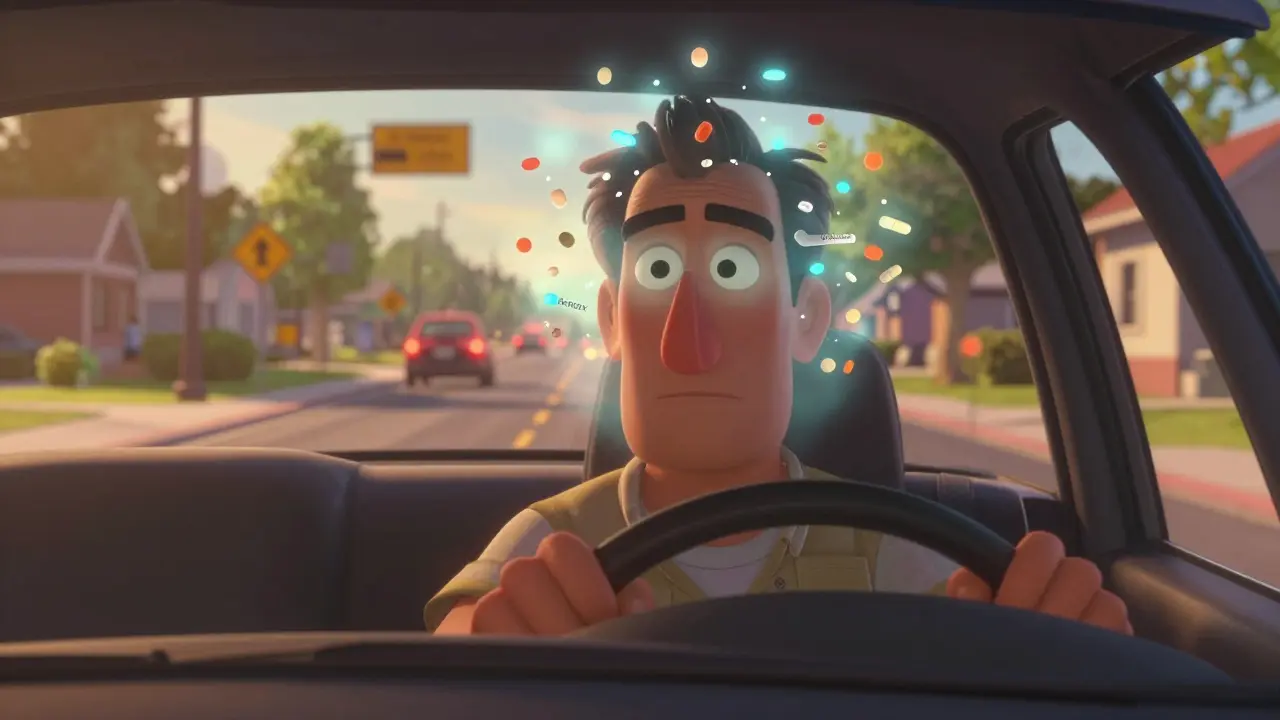
Medication Driving Risk Calculator
Assess how your medications may affect your ability to drive safely based on the latest research.
Enter Your Medications
Medication Safety Guide
First-generation antihistamines
Diphenhydramine (Benadryl, Tylenol PM) can impair driving as much as 0.10% BAC (above legal limit).
Wait at least 8-12 hours before driving.
Benzodiazepines
Reduce brain processing speed by 25-40%.
Users are 40-60% more likely to be in a crash.
Opioids
Can delay reaction time by up to 300 milliseconds.
Avoid driving for at least 8-12 hours after taking.
Many people assume that if a medication is prescribed by a doctor or sold over the counter, it’s safe to take before getting behind the wheel. But that’s not true. In fact, medications are now the second most common cause of drug-related traffic deaths in the U.S., right after alcohol. You might be surprised to learn that your morning pill, nighttime sleep aid, or allergy medicine could be putting you-and others-at risk.
What Medications Really Do to Your Driving Skills
Driving isn’t just about turning the steering wheel. It’s about quick reactions, clear thinking, steady hands, and good judgment. Many common medications slow down your brain’s ability to process information, blur your vision, make you drowsy, or even cause sudden lapses in attention. The effects aren’t always obvious. You might feel fine, but your reaction time could be as slow as someone with a 0.08% blood alcohol level-the legal limit in every U.S. state. Take benzodiazepines, like Xanax or Valium. These are often prescribed for anxiety or insomnia. Research from the Canadian Centre on Substance Abuse shows they can reduce brain processing speed by 25% to 40%. That means if a car suddenly brakes in front of you, you might not react in time. Studies show users of these drugs are 40% to 60% more likely to be in a crash than those who don’t take them. Opioids like oxycodone or fentanyl are another major concern. They cause droopy eyelids, narrowed pupils, and can delay reaction time by up to 300 milliseconds. That’s longer than the blink of an eye-and long enough to cause a serious collision. Even if you’re taking them as prescribed, your body doesn’t always handle them the same way over time, especially as you age. And then there are the ones you wouldn’t expect. Nonsteroidal anti-inflammatory drugs (NSAIDs) like ibuprofen and naproxen? They’re linked to a 58% higher risk of crashes, according to research from LeRoy and Morse. Why? Because they can cause dizziness, blurred vision, or sudden fatigue, especially when taken long-term or in higher doses. Antidepressants, particularly older ones like amitriptyline (a tricyclic), increase the chance of a motor vehicle accident by 40%. Even newer ones like mirtazapine can make you feel foggy in the morning. A 2014 review in the PMC journal found a Standardized Incidence Ratio (SIR) of 1.4-meaning users were 40% more likely to be involved in a crash.Over-the-Counter Drugs Are Just as Dangerous
You don’t need a prescription to be at risk. Many OTC meds are just as risky as prescription ones. Take diphenhydramine-the active ingredient in Benadryl, Tylenol PM, and other sleep aids or allergy pills. A single dose can impair your driving as much as a 0.10% blood alcohol level. That’s above the legal limit in every U.S. state. People think, “I took it last night, I’m fine now.” But diphenhydramine can linger in your system for 8 to 12 hours. One Reddit user, u/SafeDriver2023, shared their story: they took Tylenol PM at night, woke up at 7 a.m., felt “fine,” and drove to work at 9 a.m. They failed a field sobriety test. The diphenhydramine was still in their system. Cold and flu remedies often contain this same ingredient. So do motion sickness pills and some nighttime pain relievers. Labels say “may cause drowsiness.” But they don’t say how long. That’s the problem. Most people don’t realize how long the drug stays active in their body.Age Makes a Big Difference
As we get older, our bodies change. By age 65, the way we absorb, process, and eliminate drugs shifts dramatically. The liver and kidneys don’t work as efficiently. That means medications stay in your system longer. Kimberly Zammit from Mount Sinai Health System explains: “Changes in the body’s responsiveness to a medication, as well as a decline in the amount the body removes,” make older adults far more vulnerable. The Beers Criteria, updated in 2019 by the American Geriatrics Society, lists over 30 medications that should be avoided in adults over 65 because of their impact on driving. These include anticholinergics, sedatives, and certain antidepressants. Yet, only 41% of physicians routinely talk to their older patients about driving risks when prescribing these drugs.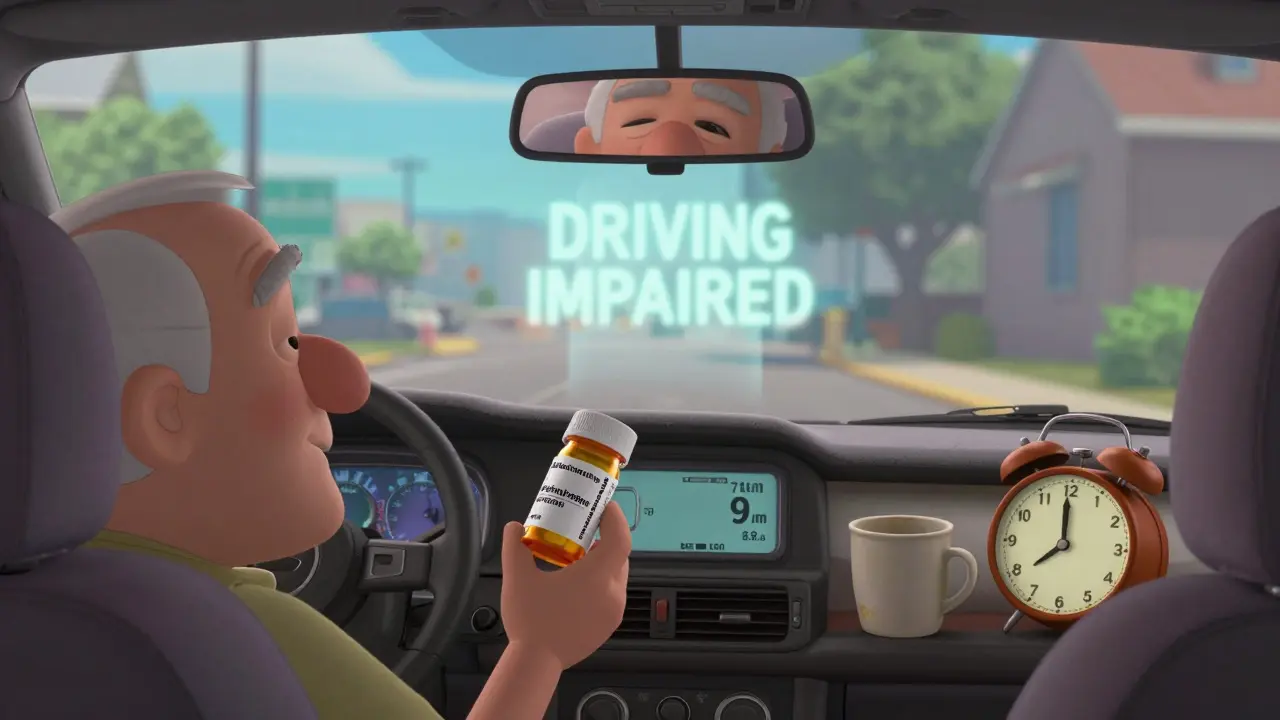
Combining Drugs Is the Worst Risk
The biggest danger isn’t one drug-it’s the mix. Taking alcohol with a sleep aid. Combining an opioid with a benzodiazepine. Mixing an antidepressant with an NSAID. These combinations don’t just add up-they multiply. Dr. Robert Voas from the Pacific Institute for Research and Evaluation found that 22% of drivers tested at trauma centers had multiple drugs in their system. The effects weren’t just additive. They were synergistic. One study showed that combining alcohol with a benzodiazepine increased crash risk by more than 150% compared to either alone. And here’s the scary part: most people don’t know they’re doing it. A 2021 AAA survey found that 70% of drivers who took three or more potentially impairing medications still drove within two hours of taking them. They thought they were fine. They weren’t.Why Labels Don’t Help Enough
You’d think the warning labels would be clear. But they’re not. A 2021 FDA review of 500 medication package inserts found that only 32% gave specific timeframes for driving restrictions. Most just say “may cause drowsiness” or “avoid operating heavy machinery.” And what does “heavy machinery” even mean? Does it include your car? The 2021 AAA study found 63% of patients didn’t realize driving was included in those warnings. Even worse, 68% of patients in an NHTSA study said their doctor never mentioned driving risks when prescribing a new medication. Pharmacists are better-89% now include driving warnings during dispensing, according to the 2023 National Community Pharmacists Association report. But not everyone sees a pharmacist when they pick up a prescription.What You Can Do to Stay Safe
You don’t have to stop taking your meds. But you do need to take control.- Ask your doctor: “Could this medication affect my ability to drive?” Don’t assume they’ll bring it up.
- Read the label carefully: Look for words like “drowsiness,” “dizziness,” “blurred vision,” or “may impair alertness.”
- Wait before driving: For first-generation antihistamines like diphenhydramine, wait at least 6 hours. For sleep aids like zolpidem (Ambien), wait 8 to 12 hours. Don’t guess-wait longer than you think you need to.
- Test yourself: Try a simple self-assessment. Can you touch your nose with your eyes closed? Can you walk a straight line without swaying? If you struggle, don’t drive.
- Use a driving simulator: The University of Iowa developed a test that requires completing 15 driving maneuvers with less than 1.5 lane deviations. If you can’t pass it after taking a new med, skip the drive.
- Track your meds: Keep a list of everything you take, including supplements. Bring it to every appointment.
Been driving for 15 years in Chennai with daily doses of ibuprofen and antihistamines. Never had an issue. Maybe it's just how our bodies adapt. Western studies don't always translate.
Also, why is everyone so scared of pills? We used to take aspirin and go to work. Now we need a psychologist to tell us if we can drive.
Stop driving if you’re on anything that says ‘may cause drowsiness.’ Simple.
This is an incredibly important and well-researched piece. The data on synergistic drug interactions is alarming, particularly when combined with aging physiology. I’ve seen elderly patients on five or more CNS-acting medications-no one ever connected the dots to their near-misses on the highway.
It’s not just about awareness-it’s about systemic change. Prescribers need mandatory driving-risk counseling. Pharmacies need standardized visual alerts on bottles. And yes, car manufacturers need to integrate real-time impairment detection. This isn’t fearmongering. It’s public health infrastructure.
OMG this is so real 🙌
My grandma took Ambien + Zoloft + naproxen + melatonin. She swerved into a mailbox last winter. No alcohol. Just polypharmacy. 😭
Also-why isn’t there a ‘Driving Risk Score’ sticker on every OTC bottle like energy drinks? We need this in red neon. 🚨
It’s obvious the FDA and pharmaceutical industry are complicit. They profit from prescribing these drugs, then quietly bury the driving risk data. The ‘Driving Risk Score’? A PR stunt. They don’t want you to know that 70% of antidepressants impair psychomotor function. They want you to drive while medicated-so you’ll keep buying refills.
And don’t get me started on how DREs are trained by the same labs that fund drug studies. It’s all a pyramid scheme. Wake up.
WAIT. WAIT. WAIT.
So you’re telling me… that my morning coffee + NyQuil + Xanax combo… is more dangerous than drunk driving??
And the government knows this… and does NOTHING??
AND THEY’RE PLANNING TO INSTALL DRIVING SENSORS IN CARS??
THIS IS THE BEGINNING OF THE SURVEILLANCE STATE!!! THEY’RE GOING TO TRACK OUR MEDS, OUR SLEEP PATTERNS, OUR EYEBALL MOVEMENTS!!
WHO’S PAYING THEM?? WHO’S BEHIND THIS??
THEY’RE GOING TO TAKE OUR CARS NEXT!!
🚨🚨🚨🚨🚨
Thanks for writing this. I’ve been a paramedic for 12 years and I’ve seen too many crashes where the driver said, ‘I didn’t think it would affect me.’
Just because you feel fine doesn’t mean your brain is working fine. I always tell people: if you’re unsure, don’t drive. Call an Uber. Sleep in the garage. It’s not worth it.
And yes-talk to your pharmacist. They’re the real heroes here.
Typical Western overreaction. In India, we take 3-4 medications daily and drive 80km to work. You think your body is fragile? It’s not. You’re just weak. Modern medicine is not a crutch-it’s a tool. If you can’t handle a little drowsiness, maybe you shouldn’t be driving at all.
Also, why are we letting Big Pharma dictate our lifestyles? The real issue is lack of discipline. Stop blaming pills. Take responsibility.
Great breakdown. I’d add one more tip: if you’re on a new med, take a day off driving-even if you feel fine. Your body needs to adjust.
And if you’re over 65? Talk to your pharmacist before your doctor. They’ll tell you what the label doesn’t. I’ve had patients who didn’t realize their ‘sleep aid’ was the same as Benadryl.
You’re not being paranoid. You’re being smart.