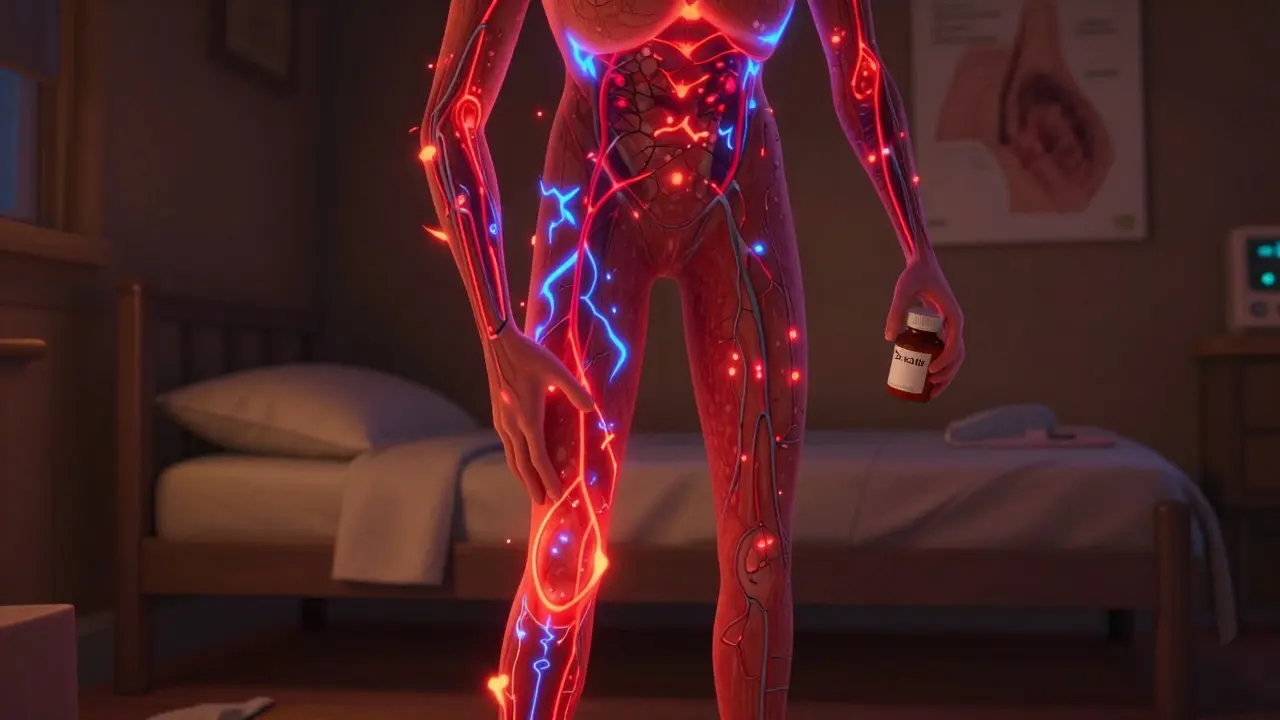
When nerves get damaged, they don’t just stop working-they start screaming. That’s what neuropathic pain feels like: burning, electric shocks, or pins and needles that don’t go away, even when there’s no obvious injury. It’s not the kind of pain you get from a cut or a sprain. This is pain from broken wiring inside your body. About 7-10% of people live with it, often because of diabetes, surgery, shingles, or trauma. For many, the go-to solutions are gabapentin and pregabalin. Both are old drugs, but they work differently, and choosing between them can make a big difference in how you feel-and how you live.
How Nerve Damage Turns Into Pain
Nerves aren’t just wires. They’re complex systems that send signals to your brain about touch, temperature, and pain. When they’re damaged-whether from high blood sugar in diabetes, a pinched nerve after surgery, or a viral infection like shingles-they start sending false alarms. Your brain gets signals saying “pain!” even when nothing’s wrong. That’s neuropathic pain. It can feel like a constant fire, or like someone’s zapping you with static electricity. Sometimes, even a light touch, like sheets against your skin, becomes unbearable. That’s called allodynia. Other times, a small pinch feels like a knife. That’s hyperalgesia.
This isn’t just discomfort. It can ruin sleep, make you anxious, and stop you from moving normally. Studies show up to 30% of diabetic patients develop this kind of nerve pain. And it doesn’t always respond to regular painkillers like ibuprofen or even opioids. That’s why doctors turn to gabapentin and pregabalin-not because they’re magic, but because they target the broken nerve signals directly.
Gabapentin: The Original, But Complicated
Gabapentin was first approved for epilepsy in 1993, but its real breakthrough came when doctors noticed it calmed nerve pain too. It works by latching onto a specific part of nerve cells called the alpha-2-delta subunit. This stops calcium from rushing into the cells, which in turn reduces the release of pain signals. Simple in theory, messy in practice.
The problem? Gabapentin doesn’t play nice with your body. It’s absorbed unevenly. If you take it on a full stomach, your body might absorb half as much as if you took it on an empty one. Its half-life is only 5-7 hours, which means you need to take it three times a day-morning, afternoon, and night. Missing a dose? The pain can come roaring back. Dosing starts low-usually 100-300mg at bedtime-and climbs slowly, often over weeks. The maximum dose is 3,600mg daily, split into three doses. That’s a lot of pills.
Side effects are common: dizziness in nearly 26% of users, sleepiness in almost 19%, and swelling in the ankles in about 10%. Some people feel clumsy or unsteady. A 2023 Cochrane review found that about 30% of people with postherpetic neuralgia got at least half their pain relief from gabapentin, compared to 16% on placebo. Not amazing, but better than nothing.
And here’s the kicker: gabapentin costs about $15.75 for 90 capsules of 300mg. That’s why it’s still the default choice in rural clinics and safety-net hospitals. If you’re on Medicare or have no insurance, it’s often the only option.
Pregabalin: Faster, Stronger, But Costlier
Pregabalin came along in 2004 as the “improved” version of gabapentin. It’s chemically similar but works better. It binds to the same target-alpha-2-delta-but six times more tightly. That means it’s more predictable. It doesn’t care if you eat before taking it. Its half-life is slightly longer, so you only need to take it twice a day. And because it’s absorbed more efficiently, you don’t need to climb up to 3,600mg to get results.
Typical starting dose? 75mg daily. Within a few days, many doctors bump it to 150-300mg. Some go as high as 600mg. Studies show 34.5% of diabetic neuropathy patients got at least half their pain relief on pregabalin, versus 17.6% on placebo. That’s a better response rate than gabapentin. In head-to-head trials, 300mg of pregabalin gave the same relief as 3,600mg of gabapentin. That’s a big deal. Less pills. Less confusion.
But it comes with trade-offs. Side effects are stronger. Dizziness? 32%. Sleepiness? 23%. Weight gain? 12.4%. That’s not a small number. People report gaining 5 to 15 pounds in the first month. One Reddit user wrote: “Pregabalin killed my pain in 48 hours-but I gained 12 lbs in six weeks.” For someone already struggling with mobility or diabetes, that’s a serious concern.
Cost? About $28.50 for 60 capsules of 75mg. That’s nearly double gabapentin’s price. And while generic versions exist, they still cost more. That’s why pregabalin is more common in urban clinics and academic hospitals where insurance covers it. But even then, some patients abandon it because of the cost.

Head-to-Head: What the Data Really Says
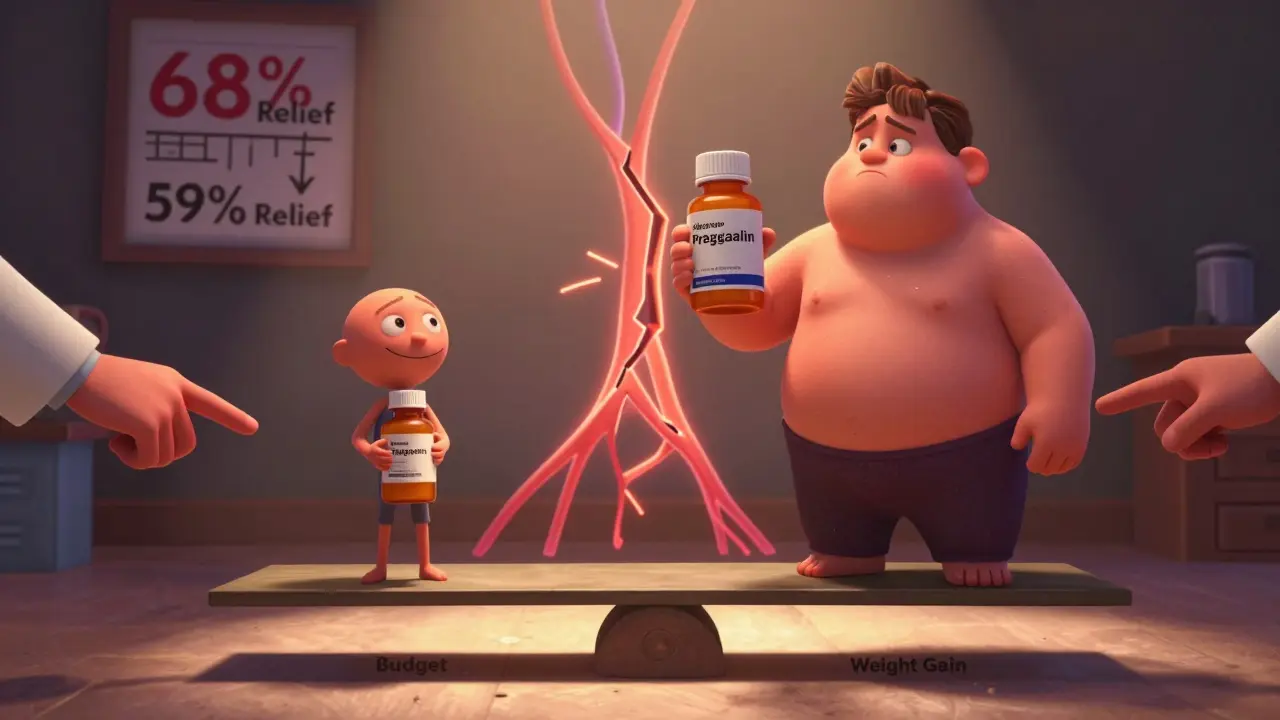
The 2021 meta-analysis of over 4,000 patients found pregabalin worked faster and more consistently. In the DIRECT-NEUROPATHY trial, patients reached their target dose in 8.2 days on pregabalin versus 14.7 days on gabapentin. At 12 weeks, 68.3% of pregabalin users had at least 50% pain relief, compared to 59.1% on gabapentin. That difference might not sound huge, but for someone in constant pain, it’s life-changing.
But here’s what the data doesn’t tell you: how you feel in real life. A 2024 analysis of over 3,800 patients on PatientsLikeMe showed pregabalin scored 6.2/10 for effectiveness, but only 4.8/10 for tolerability. Gabapentin? 5.7/10 for effectiveness and 5.9/10 for tolerability. In other words, gabapentin might be a little less effective, but it’s easier to live with. Pregabalin knocks out the pain faster-but it brings baggage.
And then there’s the weight gain. The 2022 NEUROCOMPARISON study found only 3.2% of gabapentin users gained weight, while 12.4% of pregabalin users did. That’s a four-fold difference. For someone with diabetes, that’s not just inconvenient-it’s dangerous.
Who Gets Which Drug?
There’s no one-size-fits-all answer. The American Diabetes Association recommends pregabalin as first-line for diabetic nerve pain, mainly because it’s more predictable. But the Neuropathic Pain Special Interest Group (NeuPSIG) says both are first-line, and choice depends on the patient.
If you’re:
- On a tight budget → Gabapentin. It’s cheaper, and Medicare covers it almost universally.
- Struggling with dosing → Pregabalin. Twice-daily is easier than three times. No food restrictions. Simpler titration.
- Already overweight or have diabetes → Gabapentin. Weight gain is a real risk with pregabalin.
- Need fast relief → Pregabalin. Many feel better within days.
- Had bad side effects from gabapentin (dizziness, imbalance) → Pregabalin. You might get the same relief at half the dose.
There’s also the issue of access. In rural areas, gabapentin is the default. In big hospitals, pregabalin is more common. And now, with the newer extended-release version of pregabalin (Lyrica CR), you can even take it once a day. That’s a game-changer for adherence.
What No One Tells You
Both drugs have black box warnings for suicidal thoughts and rare but serious swelling (angioedema). Both can cause withdrawal seizures if stopped suddenly. You can’t just quit either one cold turkey. Tapering over weeks is essential.
And here’s something surprising: gabapentin has no recorded overdose deaths. Pregabalin? The CDC reports 12.3 deaths per year linked to misuse. That’s why pregabalin got Schedule V status in 2019-meaning it’s controlled, and some pharmacies now require special paperwork or limits on refills. Some patients say this has made it harder to get the drug they need.
Also, neither drug works for everyone. About 1 in 3 people get decent relief. The rest may need to try duloxetine, amitriptyline, or newer options like cenobamate. But for now, gabapentin and pregabalin remain the most prescribed because they’re safer than opioids and more targeted than NSAIDs.
What’s Next?
The market is shifting. Generic gabapentin will stay cheap and available through 2030. Pregabalin’s sales are expected to drop as newer drugs enter the market. But neither is going away anytime soon. The 2025 NeuPSIG guidelines might downgrade them to second-line for some conditions-but many experts are pushing back. For now, they’re still the backbone of treatment.
Bottom line: Gabapentin is the workhorse-cheap, reliable, but a hassle to dose. Pregabalin is the precision tool-faster, stronger, but heavier on the wallet and the waistline. Your choice isn’t just about pain. It’s about your life: your budget, your weight, your schedule, and how much you can tolerate.
If you’re starting either one, be patient. It takes weeks to find the right dose. Track your pain, your side effects, and your mood. Talk to your doctor. And don’t give up if the first one doesn’t work. Sometimes, it’s not about which drug is better. It’s about which one works for you.
Can gabapentin and pregabalin be taken together?
No, they are not usually prescribed together. Both drugs work on the same target in the nervous system, so combining them doesn’t improve pain relief significantly but increases the risk of side effects like dizziness, drowsiness, and swelling. Doctors avoid stacking them unless under very specific supervision, such as in a pain clinic for refractory cases.
How long does it take for pregabalin to work for nerve pain?
Many people notice improvement within 3 to 7 days, especially at higher doses. Some report feeling relief as early as 48 hours. Full effects usually take 2 to 4 weeks. This is faster than gabapentin, which often takes 2 to 3 weeks to reach its full effect due to slower titration.
Why does pregabalin cause weight gain?
The exact mechanism isn’t fully understood, but pregabalin increases appetite and may slow metabolism slightly. It also causes fluid retention, contributing to swelling and weight gain. Studies show about 12% of users gain 5% or more of their body weight in the first few months. This is one reason it’s avoided in patients with obesity or uncontrolled diabetes.
Is gabapentin safe for long-term use?
Yes, gabapentin is generally safe for long-term use when monitored. It doesn’t damage organs, and tolerance doesn’t develop the same way as with opioids. However, long-term use can lead to dizziness, fatigue, or balance issues, especially in older adults. Regular check-ups and kidney function tests are recommended since it’s cleared through the kidneys.
Can I drink alcohol while taking pregabalin or gabapentin?
No. Alcohol makes both drugs more sedating. It can cause extreme drowsiness, dizziness, or even trouble breathing. Many patients report passing out or falling after mixing alcohol with these medications. Doctors strongly advise avoiding alcohol completely while on either drug.
What happens if I stop pregabalin suddenly?
Stopping pregabalin abruptly can trigger seizures, even in people without a history of epilepsy. Withdrawal symptoms can include anxiety, insomnia, nausea, and sweating. The risk is about 0.8% in taper studies, but it’s serious enough that doctors require a gradual taper over 1 to 2 weeks. Never stop without medical supervision.
Been on gabapentin for 3 years. It’s like my nerves finally shut up, but I’m always half-asleep and my legs feel like wet noodles. I don’t care if it’s cheap-I’d pay triple for something that doesn’t make me feel like a zombie who forgot how to walk. Pregabalin? Tried it once. Woke up weighing 7 lbs heavier. No thanks.
The data presented is methodologically flawed. The 2021 meta-analysis fails to account for heterogeneity in neuropathic pain etiologies-diabetic, postherpetic, and traumatic neuropathies exhibit distinct neurophysiological profiles. Moreover, the PatientsLikeMe dataset is self-selected and lacks validation against clinical pain scales (e.g., NPSI, VAS). The conclusion that pregabalin is ‘more effective’ is statistically insignificant at p > 0.05 in subgroup analyses. Cost-effectiveness models are also omitted, rendering the economic comparison speculative.
You Americans are so dramatic. In India, we use gabapentin because it’s the only thing we can afford. Pregabalin? That’s a luxury for rich people in New York. We don’t care about weight gain-we care about not screaming at night. Also, alcohol? Never. We know better. Your doctors overprescribe. We just take what works. Simple. No drama.
I was skeptical at first, but gabapentin literally saved my life. I had shingles nerve pain so bad I couldn’t sleep or hug my kids. Took 3 weeks, but then-boom. Peace. I didn’t gain weight, didn’t get dizzy. Just quiet. If you’re scared to try it, start low. One capsule at night. Give it time. Your body isn’t broken-it’s just misfiring. These meds don’t fix the wire. They just turn down the volume. You’ve got this.
Who funded this article? 😏 I’ve seen this exact same post on 3 different forums. The stats are copied from Lyrica’s marketing materials. Gabapentin’s black box warning? Never mentioned. Pregabalin’s Schedule V status? Only in the footnote. And why no mention of the 2023 FDA warning about gabapentin being used as a recreational drug in prisons? This feels… curated. 🤔
So… gabapentin: cheap, slow, and makes you feel like a sloth with a headache. Pregabalin: fast, fancy, and turns you into a human marshmallow? And we’re surprised people are confused? 🤦♂️ Also, ‘don’t quit cold turkey’? Bro, that’s like saying ‘don’t jump off a cliff’-why is this even a thing we have to say? Someone please just make a pain pill that doesn’t come with a side effect manual written in Comic Sans.
As a physician practicing in rural Ohio, I can attest that the disparity in access is not merely economic-it is structural. Patients on Medicaid are routinely denied pregabalin due to prior authorization hurdles, while gabapentin is dispensed without question. The clinical superiority of pregabalin is undeniable, yet systemic barriers render it inaccessible to those who need it most. This is not a pharmacological dilemma-it is a moral one. We must advocate for equitable prescribing policies, not merely document them.
I’ve been on both. Gabapentin gave me relief but made me forget where I put my keys. Pregabalin made my pain vanish in 72 hours… and my jeans vanish too. I switched back to gabapentin because I miss walking without wobbling. But here’s the thing: neither fixed my anxiety. I started therapy. That helped more than either pill. If you’re struggling, don’t just chase the next dose-ask your doctor about CBT or mindfulness. It’s not just about the nerves. It’s about the whole you.