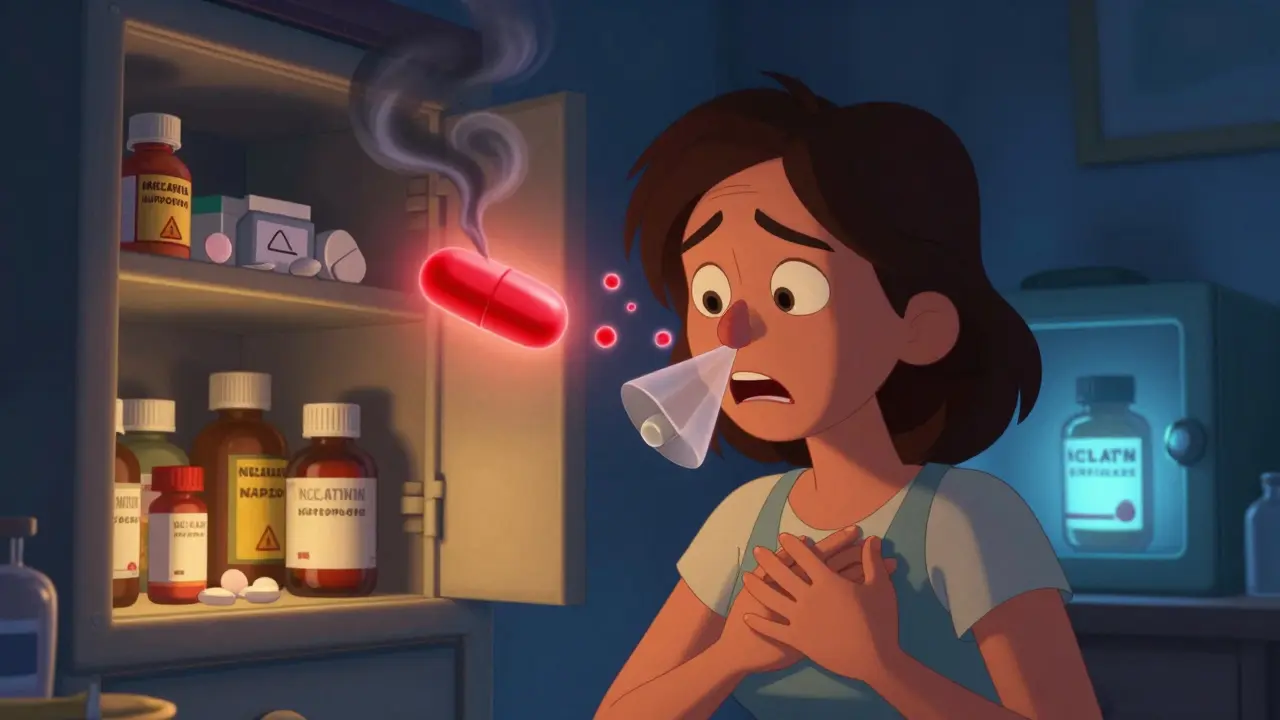
If you have asthma and reach for ibuprofen or aspirin for a headache, you could be risking a serious reaction-without even knowing it. This isn’t rare. About 7% of people with asthma experience a dangerous response to common painkillers called NSAIDs. It’s called NSAID-Exacerbated Respiratory Disease, or NERD. And it’s not just a bad cold or allergy flare. It’s a sudden, life-threatening tightening of the airways, severe nasal congestion, and a spike in asthma symptoms-all within minutes to hours after taking a pill.
What Happens in Your Body When You Take NSAIDs
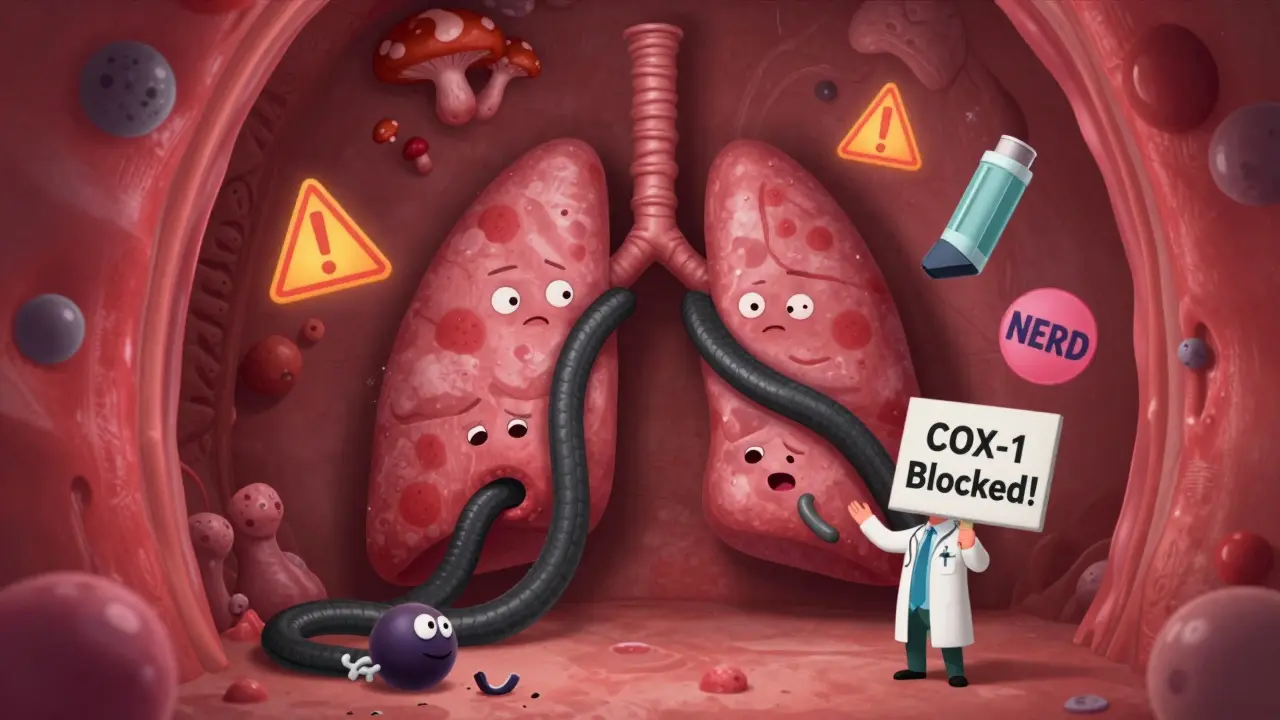
NSAIDs like aspirin, ibuprofen, and naproxen work by blocking an enzyme called COX-1. That’s how they reduce pain and inflammation. But for people with NERD, this blockage triggers a chain reaction. Instead of making protective anti-inflammatory compounds, your body starts producing too much of something called cysteinyl leukotrienes. These are powerful chemicals that cause your airways to swell, your nose to run, and your lungs to constrict.This isn’t an allergy in the traditional sense. There’s no IgE antibody involved. It’s a biochemical glitch. People with NERD already have lower levels of a natural anti-inflammatory called prostaglandin E2. When NSAIDs knock out what little remains, the imbalance explodes. The result? Bronchospasm, wheezing, and sometimes full-blown asthma attacks that land people in the ER.
Who’s Most at Risk?
Not everyone with asthma gets this reaction. But certain patterns are clear. Most people with NERD are diagnosed between ages 30 and 40. Women make up about 70% of cases. Many are overweight. And nearly half of those with chronic sinusitis and nasal polyps-those persistent growths in the nose-also have NERD.Here’s the catch: upper airway symptoms often show up years before asthma. You might have had constant nasal congestion, loss of smell, or frequent sinus infections for 1-5 years before your asthma got worse. That’s a red flag. If you’ve been told you have “chronic rhinosinusitis with nasal polyps,” you should be tested for NSAID sensitivity-even if you’ve never had a reaction yet.
What Does a Reaction Feel Like?
It doesn’t start slowly. Within 30 minutes to 3 hours after taking an NSAID, symptoms hit hard:- Sudden, severe nasal congestion
- Runny nose with clear fluid (not like a cold)
- Wheezing or chest tightness
- Shortness of breath, even at rest
- Coughing fits that won’t stop
- In worst cases, full asthma attack requiring emergency treatment
Many patients think it’s a cold, allergies, or even anxiety. One woman described it as “feeling like someone was sitting on my chest.” Another said she thought her nose was just stuffed up-until she couldn’t breathe at all. By then, it was too late to wait it out.
Which Pain Relievers Are Safe?
Not all painkillers are dangerous. Acetaminophen (Tylenol) is usually safe for most people with NERD-at doses under 1,000 mg per dose. About 5-10% may still react to higher doses, so stick to the lowest effective amount.COX-2 inhibitors like celecoxib (Celebrex) are another option. Unlike aspirin or ibuprofen, they don’t strongly block COX-1. Studies show they rarely trigger reactions in NERD patients. But they’re prescription-only and not for long-term use without monitoring.
Here’s what to avoid:
- Aspirin (even low-dose 75mg)
- Ibuprofen (Advil, Motrin)
- Naproxen (Aleve)
- Diclofenac (Voltaren)
- Ketoprofen, indomethacin, meloxicam
And here’s the tricky part: NSAIDs hide in dozens of over-the-counter products. Cold and flu remedies, menstrual pain tablets, arthritis gels, and even some sleep aids contain them. Always read the “Active Ingredients” list. If you see any of the names above-skip it.
What About Aspirin Desensitization?
There’s a treatment that sounds counterintuitive: giving patients daily aspirin under medical supervision to reduce their sensitivity. It’s called aspirin desensitization. It’s not for everyone. But for those with severe nasal polyps and uncontrolled asthma, it can be life-changing.After weeks of gradually increasing doses in a controlled clinic setting, many patients see:
- Improved asthma control
- Smaller or fewer nasal polyps
- Less need for steroid sprays or surgery
- Ability to safely take NSAIDs again
This only works if done by an allergy specialist. It’s not something to try at home. But for those who qualify, it’s one of the few treatments that actually changes the disease course-not just masks symptoms.

How to Protect Yourself
If you have asthma, especially with nasal polyps or chronic sinus issues, here’s what to do:- Ask your doctor if you should be tested for NSAID sensitivity. A supervised challenge test can confirm it.
- Carry a medical alert card or app listing your NSAID allergies.
- Keep a list of safe alternatives: acetaminophen, celecoxib (if prescribed).
- Check every medication label-OTC and prescription. Look for “NSAID” or the drug names above.
- Inform every pharmacist, ER doctor, and dentist you see. Many don’t know about NERD.
- If you’ve ever had a reaction, avoid all NSAIDs-even if it was mild. The next one could be worse.
Why This Isn’t Common Knowledge
Most people don’t know NSAIDs can trigger asthma because doctors don’t always ask. Patients don’t connect their breathing trouble to a painkiller they took hours earlier. And many OTC labels don’t warn about asthma risks.But the data is clear: in children, even short-term use of ibuprofen or aspirin increases asthma flare risk by nearly 50%. In adults with nasal polyps, the chance of NERD is 1 in 2. This isn’t a fringe condition. It’s a hidden danger in medicine cabinets across the country.
What’s Next for Treatment
Researchers are looking at ways to replace the missing prostaglandins or block the overactive leukotrienes. One promising area involves LXA4 and its derivatives-natural molecules that calm inflammation. Early studies suggest they could one day be used as inhalers or pills to treat NERD directly.For now, awareness and avoidance are your best tools. If you’ve ever had a bad reaction after taking a painkiller, don’t brush it off. Talk to your doctor. Get tested. Know your triggers. And never assume a pill labeled “safe for most people” is safe for you.
Can I take Tylenol if I have NSAID-sensitive asthma?
Yes, acetaminophen (Tylenol) is generally safe for most people with NSAID-sensitive asthma at doses up to 1,000 mg per dose. However, about 5-10% of patients may still react to higher doses or frequent use. Stick to the lowest effective dose and avoid combining it with other medications that contain acetaminophen to prevent overdose.
Are all NSAIDs equally dangerous for asthma patients?
No, but most are. All traditional NSAIDs that strongly inhibit COX-1-like aspirin, ibuprofen, naproxen, and diclofenac-can trigger reactions. COX-2 selective inhibitors like celecoxib are usually safe because they don’t block COX-1 significantly. However, you should never assume safety without checking with your doctor. Even celecoxib can cause reactions in rare cases.
Can children develop NSAID-sensitive asthma?
Yes, though it’s less common than in adults. Studies show short-term use of NSAIDs like ibuprofen or aspirin increases asthma flare risk in children by nearly 50%. While NERD is typically diagnosed in adults aged 30-40, children with severe asthma or nasal polyps should be monitored closely. Avoid giving aspirin to children under any circumstances due to Reye’s syndrome risk, regardless of asthma status.
How do I know if I have NERD or just a regular allergy?
NERD isn’t a typical allergy. It doesn’t cause hives, swelling, or itching. Instead, it causes sudden breathing trouble, nasal congestion, and asthma worsening-usually within hours of taking an NSAID. If you’ve had these reactions after multiple NSAID doses and no other triggers, you likely have NERD. A specialist can confirm it with a controlled aspirin challenge test.
Is aspirin desensitization a cure?
No, it’s not a cure, but it’s a highly effective long-term management strategy. After successful desensitization, most patients can take daily aspirin without reactions. This often leads to better asthma control, fewer nasal polyps, and reduced need for surgery or steroids. You must continue daily aspirin to maintain the benefit-stopping can cause symptoms to return within weeks.
What should I do if I accidentally take an NSAID?
If you have a known sensitivity and accidentally take an NSAID, monitor yourself closely for 3-4 hours. If you feel any nasal congestion, wheezing, or chest tightness, use your rescue inhaler immediately. If symptoms worsen or don’t improve, call emergency services. Do not wait. Early intervention can prevent a life-threatening attack.
Can I use topical NSAIDs like gels or creams?
Topical NSAIDs like diclofenac gel or ibuprofen cream are generally safer than oral forms because less of the drug enters your bloodstream. But they’re not risk-free. Some patients with extreme sensitivity still react to topical use. If you’ve had a severe reaction before, avoid them unless your doctor approves. Always patch-test a small area first and watch for respiratory symptoms.
Should I avoid NSAIDs if I only have mild asthma?
If you have mild asthma but no nasal polyps or chronic sinus issues, your risk is low-but not zero. Still, if you’ve ever had a reaction after taking an NSAID-even once-you should avoid them forever. If you’ve never had a reaction, you don’t need to avoid NSAIDs unless your doctor recommends it. But if you develop nasal congestion or worsening asthma later, reconsider NSAID use and get tested.

I took ibuprofen for my headache last week and nearly died. No joke. My throat closed up, I couldn't breathe, and I had to be rushed to the ER. No one ever told me this could happen. Now I carry an EpiPen just in case. Why isn't this on every bottle?
tylenol is fine for me but i always check the back of the bottle. last time i bought a cold med i thought it was just sinus stuff but it had naproxen in it. my lungs felt like they were wrapped in barbed wire. learned the hard way. always read the tiny print.
There’s something deeply human about how medicine keeps hiding dangers in plain sight. We trust pills like they’re harmless snacks, but our bodies are complex ecosystems, not vending machines. NERD isn’t rare-it’s ignored. And the fact that it hits women and people with nasal polyps hardest? That’s not coincidence. It’s systemic neglect wrapped in OTC packaging. We need better labeling, better education, and doctors who actually listen when patients say, ‘This always happens after I take that.’
As someone who has lived with asthma since childhood and was diagnosed with NERD at 34, I appreciate the thoroughness of this post. I now keep a printed list of safe and unsafe medications in my wallet. I also carry a card that says ‘NSAID SENSITIVE – RISK OF ANAPHYLACTOID REACTION.’ It’s saved me more than once in emergency rooms where staff assumed I was just having an asthma flare. Knowledge is power-but documentation is protection.
Let’s be real: the pharmaceutical industry doesn’t want you to know this. Why? Because if people stopped buying ibuprofen, they’d lose billions. They bury the risks in fine print, market NSAIDs as ‘safe for most,’ and let the collateral damage pile up in ERs. This isn’t medical negligence-it’s profit-driven deception. And don’t get me started on how the FDA approves these drugs without mandatory asthma warnings. We’re being treated like lab rats with credit cards.
Interesting how this post mentions aspirin desensitization as a ‘life-changing’ treatment, yet fails to mention the 30% failure rate, the 15% risk of severe reaction during the procedure, and the fact that it requires weekly clinic visits for 6–12 weeks. It’s not a magic bullet-it’s a high-stakes gamble with your respiratory system. Also, celecoxib isn’t ‘safe’-it’s just statistically less likely to trigger a reaction. That’s not the same as safe. And acetaminophen? Overdose kills more people than NSAID reactions. Are we just swapping one risk for another?
My sister in India had this and no one knew. She was misdiagnosed for 5 years. Doctors said it was pollution. Then she went to a specialist in Mumbai and they tested her-turns out she had polyps and NERD. She’s on daily aspirin now after desensitization and her breathing is better than ever. If you’re from a country with limited access to specialists, please find a way. This is not something to ignore.
Wow. So we’re supposed to believe that a pill that costs $2 at CVS is quietly murdering people with asthma? And the solution is… read the label? How about we sue the manufacturers for not putting ‘WARNING: MAY KILL ASTHMATICS’ in bold red letters on the front? Or better yet-ban NSAIDs from OTC shelves entirely. Let’s not pretend this is a ‘personal responsibility’ issue. This is corporate malpractice with a side of ignorance.
Actually, you're all missing the point. The real issue isn't NSAIDs-it's the underlying inflammation. If your asthma is bad enough that a COX-1 inhibitor triggers bronchospasm, your prostaglandin E2 levels are probably chronically low due to obesity, chronic sinusitis, or poor gut health. Fix the root cause, not the symptom. Also, celecoxib is still a COX-2 inhibitor-long-term use increases cardiovascular risk. So you're trading one problem for another. The real solution? Lifestyle. Diet. Sleep. Stop relying on pills to fix everything.
Let me ask you this: if a pill can kill you, why is it sold next to gum and candy? Why do pharmacies have entire aisles of these things? Why isn't the government forcing a black box warning on every bottle? Why do we accept that ‘most people’ are fine, while the rest of us are collateral damage? This isn’t science-it’s capitalism with a stethoscope. And if you’re still taking ibuprofen after reading this, you’re not just ignorant-you’re complicit.