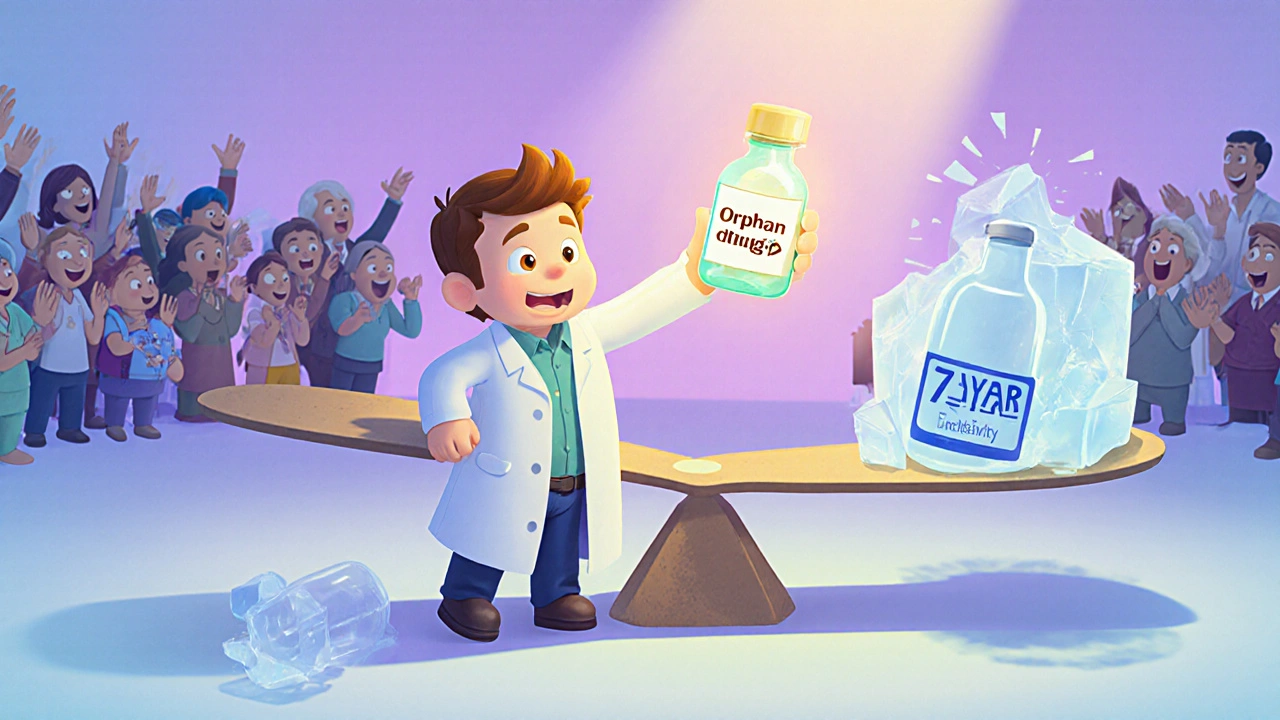
Before 1983, fewer than 10 treatments existed for rare diseases in the U.S. Today, over 1,000 are approved. The shift didn’t happen by accident. It was built on a single rule: orphan drug exclusivity.
What orphan drug exclusivity actually means
Orphan drug exclusivity isn’t a patent. It’s a legal shield granted by the FDA that stops other companies from selling the same drug for the same rare disease for seven years after approval. It doesn’t protect the chemical itself-it protects the drug for that specific condition. If a drug treats both a rare disease and a common one, generics can still come out for the common use. But for the rare use? No competition. Not even if they make the exact same pill. This rule came from the Orphan Drug Act of 1983. Back then, pharmaceutical companies had no reason to invest in drugs for diseases affecting fewer than 200,000 Americans. The market was too small. The FDA had approved only 38 rare disease drugs in the 10 years before the law. By 2018, that number had jumped to 503. The law didn’t just help patients-it created a new industry.How the system works in practice
Companies apply for orphan designation early-often during Phase 1 clinical trials. The FDA reviews the application in about 90 days. Approval is almost guaranteed if the disease affects fewer than 200,000 people in the U.S. or if the company can prove it won’t make enough money to cover costs. Once approved, the clock starts ticking on the seven-year exclusivity period. It begins on the day the FDA approves the drug for marketing, not when the patent is filed. That’s important. Many orphan drugs have patents that expire long before the exclusivity period ends. In fact, IQVIA found that for only 60 of the 503 approved orphan drugs did exclusivity outlast patent protection. Here’s the twist: multiple companies can apply for orphan designation for the same drug and disease. But only the first one to get FDA approval wins. It’s a race. The others can keep trying, but if they’re too late, they can’t enter the market unless they prove their version is clinically superior-meaning it works better, has fewer side effects, or helps patients who didn’t respond to the original. That bar is extremely high. Since 1983, only three cases have met it.Why it’s not just about patents
Patents protect inventions: a new molecule, a new way to make it, a new use. But orphan exclusivity protects the market for a specific patient group. Even if a competitor develops the same drug independently-without copying the original-they still can’t sell it for that rare disease until the seven years are up. This is why companies like Jacobus Pharmaceutical could get approval for Ruzurgi (amifampridine) for Lambert-Eaton myasthenic syndrome in 2019, even though the same drug had been used for other conditions for decades. The orphan exclusivity locked in the new use. The old uses remained open to generics. The protection was narrow, but powerful.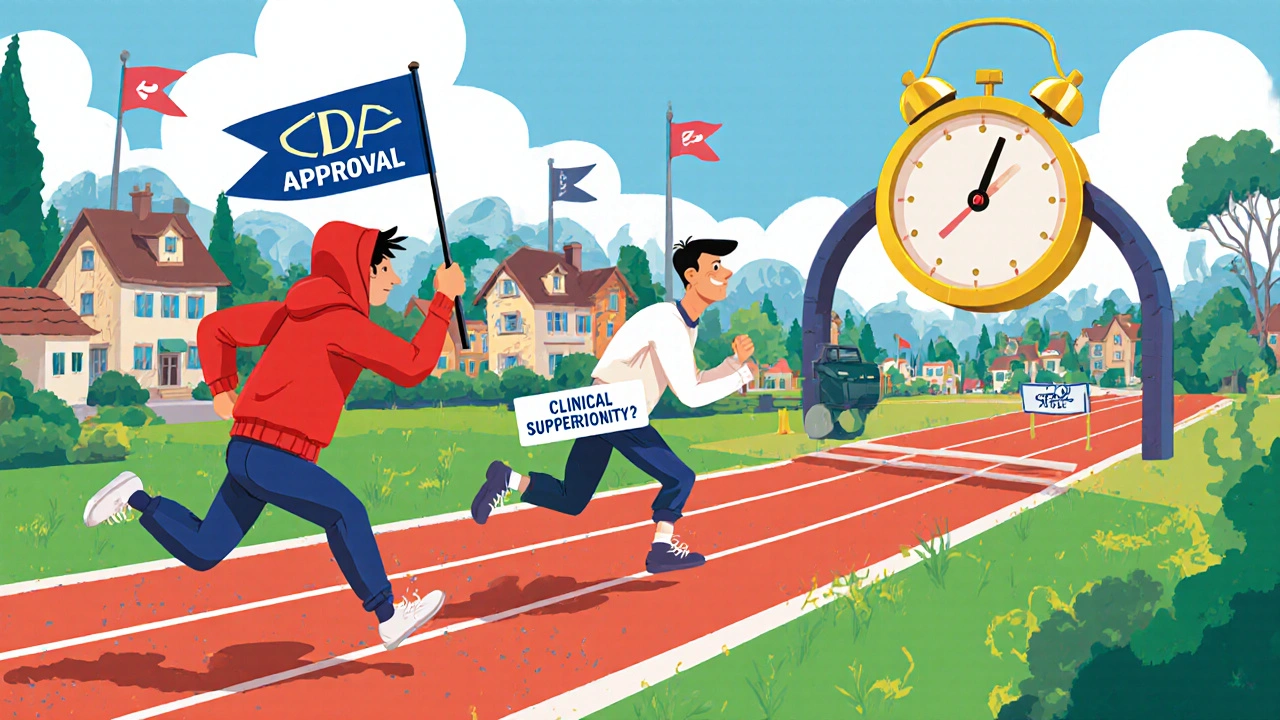
How it compares to other countries
The U.S. gives seven years. The European Union gives ten. The EU also offers a two-year extension if the company does pediatric studies. But the EU can reduce the period to six years if a drug turns out to be wildly profitable-something the U.S. system doesn’t allow. That difference matters. Companies often launch in the U.S. first because the timeline is shorter and the rules are clearer. But if a drug looks like it’ll make billions, European regulators can step in and shorten the exclusivity. In the U.S., once it’s granted, it’s locked in.Who benefits-and who doesn’t
Patient groups overwhelmingly support the system. A 2022 survey by the National Organization for Rare Disorders found 78% of advocacy organizations called orphan exclusivity “essential.” Without it, they say, treatments for diseases like Duchenne muscular dystrophy, spinal muscular atrophy, or certain rare cancers simply wouldn’t exist. But there’s pushback. Generic drug makers argue that some companies game the system. Take Humira. It’s one of the best-selling drugs in the world, with over $20 billion in annual sales. It received multiple orphan designations for rare offshoots of autoimmune conditions-even though its main market is huge. Critics say that’s not helping rare disease patients. It’s just extending monopoly profits. Regulatory professionals at mid-sized biotech firms say the system is their lifeline. One manager told a forum in 2022 that without the seven-year exclusivity, their $150 million drug for a disease affecting only 8,000 people would never have been developed. The math didn’t add up otherwise.
What’s changing now
The number of orphan designations has skyrocketed-from 127 in 2010 to 434 in 2022. More than half of all new drugs approved by the FDA today have orphan status. Experts predict that by 2027, 72% of new molecular entities will be designated as orphan drugs. That’s led to scrutiny. In 2023, the FDA released draft guidance to tighten the definition of “same drug,” especially after cases like Ruzurgi sparked confusion. Some lawmakers are pushing for a new requirement: companies must prove there’s an “unmet medical need,” not just a small patient population. Meanwhile, the EU is considering reducing its exclusivity period from ten to eight years for drugs that sell far beyond expectations. The U.S. hasn’t moved yet. But the pressure is building.What this means for patients and the future
Orphan drug exclusivity is a double-edged sword. It’s the reason children with rare genetic disorders now have treatments that didn’t exist a decade ago. It’s also the reason some of those treatments cost hundreds of thousands of dollars a year. The system works because it turns an economic impossibility into a viable business. For rare diseases, the market is too small for traditional drug development. Exclusivity fills that gap. It doesn’t guarantee affordability, but it guarantees availability. As more drugs enter the pipeline-and as prices keep rising-the debate will grow louder. But for now, the rule remains: if you’re the first to bring a treatment to a rare disease, you get seven years to make it count.How long does orphan drug exclusivity last in the U.S.?
In the United States, orphan drug exclusivity lasts for seven years from the date the FDA approves the drug for marketing. This period is separate from patent protection and applies only to the specific rare disease indication for which the drug received orphan designation.
Can a generic version of an orphan drug be approved during the exclusivity period?
No, not for the same rare disease indication. The FDA cannot approve another company’s version of the same drug for the same condition during the seven-year exclusivity window-unless that new version demonstrates clinical superiority, meaning it offers a meaningful improvement in safety or effectiveness. This has only happened three times since the program began in 1983.
Does orphan exclusivity protect the drug for all uses, or just the rare disease?
Only for the specific rare disease indication listed in the orphan designation. If the same drug is later approved for a common condition-like using a rare cancer drug for a more widespread cancer-generics can enter the market for that broader use. The exclusivity is tied to the indication, not the molecule.
Why do so many companies apply for orphan designation if only one wins?
Because the first to get FDA approval gets the seven-year market protection. Even if multiple companies are developing the same drug for the same disease, only the first to finish clinical trials and submit a successful application wins. This creates a race to market, which speeds up development. Many companies apply early to secure their place in line, even if they’re not ready to file for approval yet.
Is orphan drug exclusivity the main reason these drugs are developed?
It’s one of the top three incentives, but not always the biggest. Tax credits for clinical trial costs and waivers of FDA application fees (worth about $3.1 million) often matter more financially. But exclusivity is unique because it blocks competition directly. For many small biotech firms, the promise of seven years without generic rivals is what makes the investment possible.
This orphan drug exclusivity thing is like giving a VIP pass to a club where only one person gets in-and then they charge $500,000 for a glass of water. I mean, sure, kids with spinal muscular atrophy are alive because of it, but why does the same pill cost less in Canada than a damn Tesla? The system’s broken, but it’s broken in a way that saves lives. That’s the tragic irony.
It is imperative to note that the Orphan Drug Act constitutes a foundational pillar of American pharmaceutical innovation. The assertion that corporate profiteering is the primary driver is not only reductive but emblematic of a broader cultural disdain for market-based solutions. The seven-year exclusivity period is not a subsidy-it is a contractual incentive structure designed to rectify market failure. To undermine it is to endanger the very architecture of biomedical progress in the United States.
Let’s be real for a second. Back in the 80s, if you had a rare disease, you were basically out of luck. No meds, no hope, just a doctor shrugging and saying ‘we’ll keep you comfortable.’ Then this law came along and suddenly, people weren’t just surviving-they were going to school, getting jobs, falling in love. Yeah, some companies stretched the definition of ‘rare’ to include stuff that could’ve been treated with a placebo, but let’s not throw the baby out with the bathwater. The fact that we’re talking about 500+ approved orphan drugs today? That’s a miracle. I’ve met families who owe their kid’s life to this. And honestly? I’d rather have a few greedy pharma execs making bank than a generation of kids dying because nobody wanted to risk the R&D.
It’s wild how something so niche became the backbone of modern biotech. I used to think these drugs were just overpriced band-aids, but then I watched my cousin’s daughter get her first dose of Zolgensma. She was 8 months old, barely able to hold her head up. Two years later? She’s crawling, babbling, laughing. The price tag? A million bucks. But here’s the thing-I’d pay ten times that if I could. The system’s flawed, sure. But when you’re holding your kid’s hand during their first treatment, you don’t care about the profit margins. You just care that they’re alive.
Exclusivity ≠ innovation. It’s monopoly rent-seeking dressed up as charity.
The FDA’s orphan designation process is rigorously structured to ensure that the therapeutic need is both scientifically valid and clinically distinct. The requirement that a drug must target a condition affecting fewer than 200,000 individuals in the United States is not arbitrary-it is grounded in epidemiological data and public health priorities. Furthermore, the distinction between orphan exclusivity and patent protection is critical: the former safeguards market access for a specific indication, while the latter protects intellectual property. These are complementary, not overlapping, mechanisms. The recent FDA draft guidance on ‘same drug’ clarifies ambiguities that have emerged as the pipeline expands, and this evolution reflects regulatory maturity, not failure.
Of course the rich love this. It’s a license to print money while calling it ‘saving lives.’
So… we’re just gonna ignore the fact that Humira got orphan status like 12 times? That’s not a loophole. That’s a glitch in the matrix.
They call it ‘orphan’ drug exclusivity but it’s really just corporate welfare with a heart-shaped sticker on it. And don’t get me started on the ‘clinical superiority’ loophole-only three cases ever met it? That’s not a high bar, that’s a puddle.
It is essential to recognize that orphan drug exclusivity operates within a complex regulatory ecosystem that includes tax credits, fee waivers, and protocol assistance. The seven-year exclusivity period is not the sole incentive, nor is it the most financially significant for many sponsors. However, its non-economic value lies in its certainty: it provides a predictable market environment in which small biotech firms can secure venture capital and partner with larger manufacturers. Without this assurance, the risk-adjusted return on investment for rare disease therapeutics would remain prohibitively low, and innovation would stagnate.
Western pharmaceutical hegemony masked as humanitarianism. The Global South pays the price while the West patents cures for diseases they don't even have.
While the U.S. model incentivizes development for rare diseases, the absence of price regulation raises concerns regarding equitable access. In jurisdictions where public healthcare systems bear the burden of reimbursement, the financial strain is substantial. A comparative analysis with the EU’s flexibility in reducing exclusivity for highly profitable drugs suggests a potential model for balancing innovation with affordability. The U.S. may benefit from incorporating similar mechanisms to prevent market distortion.
Ever wonder why Big Pharma suddenly cares about diseases that affect 12,000 people? Coincidence? Or did someone in the FDA get a ‘consulting fee’ from a biotech CEO? I’ve seen the emails. I’ve seen the ‘orphan’ designations for drugs that are already on the market for arthritis. This isn’t medicine-it’s a legal shell game. And the FDA? They’re either asleep or in on it.
THIS IS WHY WE NEED TO PROTECT THIS SYSTEM 🙏💖 Kids are alive BECAUSE of this. Don’t let the haters ruin it. #OrphanDrugHero #SaveTheRareDiseaseTreatments