
Imagine trying to walk to the mailbox, but your legs feel like lead and your breath vanishes before you've even left the porch. For many people living with Chronic Obstructive Pulmonary Disease a chronic inflammatory lung disease that causes obstructed airflow from the lungs (COPD), this isn't just a lack of fitness-it's a medical condition called sarcopenia. While most people think COPD is only about the lungs, it actually attacks the muscles throughout the entire body. When you lose skeletal muscle mass and strength, your quality of life plummets, and the risk of ending up back in the hospital spikes.
The good news is that you aren't stuck with this. By combining specific nutritional shifts with a tailored approach to strength work, you can actually push back against muscle wasting. This isn't about running marathons; it's about strategic, small wins that help you carry your own groceries and breathe easier.
What Exactly is Sarcopenia in COPD?
In simple terms, Sarcopenia the progressive loss of skeletal muscle mass, strength, and physical performance is the body's way of breaking down muscle faster than it can build it. In COPD patients, this is much more aggressive than the natural muscle loss we see with aging. While a healthy adult might lose 1-2% of their muscle mass annually, those with COPD can see a decline of over 3% per year.
It's not just about the legs, either. A striking 68% of COPD patients experience significant atrophy in the pectoralis major (the chest muscles), which are vital for supporting breathing. This creates a vicious cycle: your lungs struggle, so you move less; because you move less, your muscles wither; and because your muscles are weak, breathing becomes even harder.
Doctors typically diagnose this using a few key markers. They look for low handgrip strength (usually under 27 kg for men and 16 kg for women) and measure muscle quantity using a DEXA scan or CT scan. Some specialists now use the Pectoralis Muscle Index (PMI) as a more accurate biomarker specifically for lung patients, as standard BMI calculations often miss the real story of muscle loss in this group.
The "Perfect Storm": Why Muscles Waste Away
Muscle loss in COPD isn't caused by just one thing; it's a combination of factors that create a "perfect storm." First, there is systemic inflammation. High levels of proteins like TNF-α and IL-6 circulate in the blood, which actively tells the body to break down muscle tissue. These inflammatory markers correlate directly with weaker grip strength and lower muscle mass.
Then there's the oxygen issue. Nocturnal hypoxemia-where your oxygen levels drop below 88% for a significant part of the night-is a major driver of muscle wasting. If your muscles aren't getting enough oxygen while you sleep, they can't repair themselves, which increases the risk of severe sarcopenia by nearly 50%.
Finally, there is the nutritional gap. Many people with advanced COPD suffer from anorexia (loss of appetite) or a high metabolic cost of breathing, meaning they burn calories just trying to inhale. If you aren't eating enough protein to compensate for this, your body starts "eating" its own muscle to survive.

Nutrition Strategies to Build Muscle
If you want to stop muscle loss, you have to provide the raw materials for repair. Most standard diets provide about 0.8 to 1.0 grams of protein per kilogram of body weight, but for a sarcopenic COPD patient, that's simply not enough. You need to aim for 1.2 to 1.5 g/kg/day.
The trick isn't just the total amount, but how you time it. Your body can only process so much protein at once. To maximize muscle protein synthesis, distribute your protein evenly across four meals, aiming for roughly 0.3 to 0.4 g/kg per meal. For example, if you weigh 70kg, you should aim for about 21-28g of protein at each of your four main eating windows.
You should also look for Leucine, an amino acid that acts as a "trigger" for muscle growth. Adding 2.5 to 3.0 grams of leucine per meal-often found in whey protein supplements-can improve the anabolic response by up to 37%. If you struggle with appetite, high-calorie protein shakes are a much more manageable way to hit these targets than trying to eat large portions of meat.
Resistance Training: The Safe Way to Get Strong
You cannot eat your way to muscle growth alone; you have to give the muscles a reason to grow. This is where resistance training comes in. However, standard gym routines can be dangerous for someone with COPD because of exercise-induced dyspnea (shortness of breath). About 42% of patients actually need supplemental oxygen during their workouts to avoid crashing.
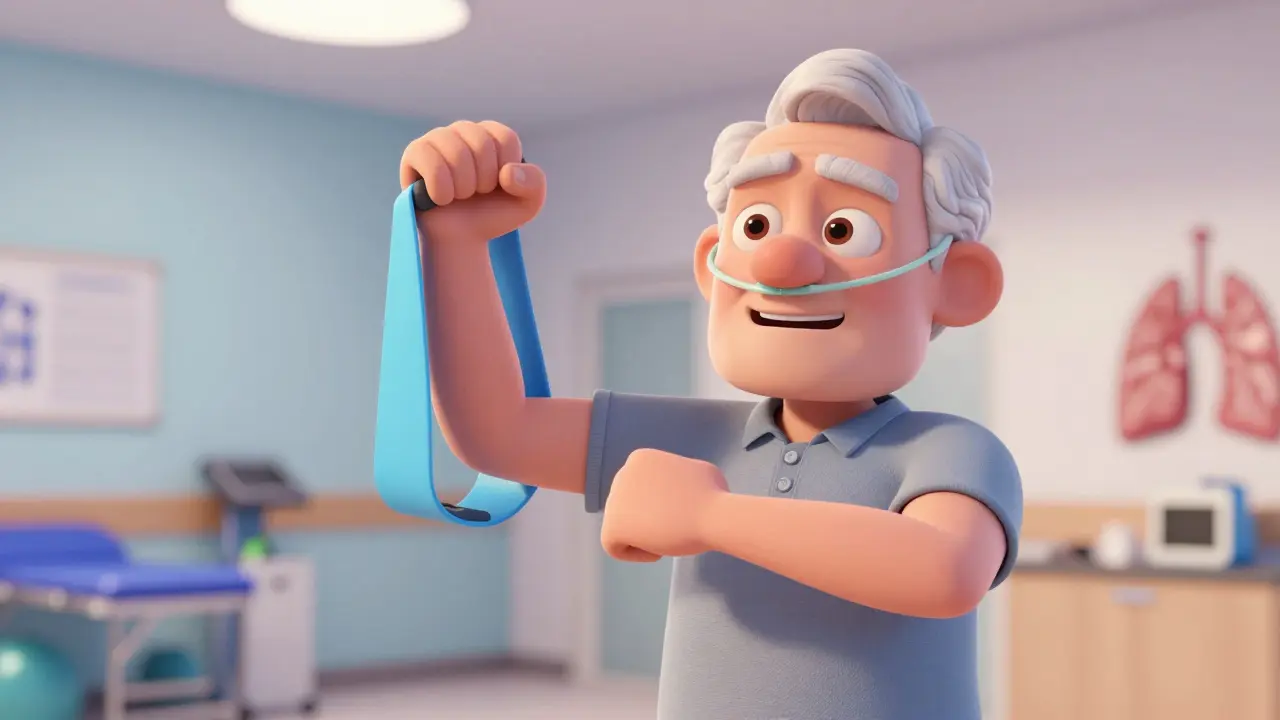
The key is to start very low and progress slowly. Expert recommendations suggest starting at 30% to 40% of your one-repetition maximum (1-RM). For most, this means starting with light resistance bands or 1-2 pound weights. As your tolerance improves over 8 to 12 weeks, you can gradually increase the load to 60-80% of your 1-RM.
To avoid extreme breathlessness, follow these practical rules of thumb:
- Prioritize Rest: Take 2-3 minute breaks between sets to let your oxygen levels stabilize.
- Use a Paced Approach: Focus on slow, controlled movements rather than fast repetitions.
- Monitor Oxygen: If you have prescribed oxygen, use it during the workout even if you don't feel short of breath yet.
- Focus on Major Groups: Target the large muscles of the legs and arms to get the most functional bang for your buck.
| Feature | Age-Related Sarcopenia | COPD-Associated Sarcopenia |
|---|---|---|
| Annual Muscle Loss Rate | 1-2% | ~3.2% |
| Primary Area Affected | Lower extremities | Respiratory & Upper limb muscles |
| Key Driver | Cellular senescence | Inflammation & Hypoxemia |
| Impact on Breathing | Minimal | Severe (Pectoralis atrophy) |
Real-World Results and Pitfalls
Does this actually work? The data says yes. In a supervised program at the Cleveland Clinic, patients with moderate to severe COPD who combined resistance training with a protein intake of 1.2 g/kg/day saw a 23% improvement in their 6-minute walk distance after 16 weeks. This translates to real-life wins: being able to walk from the car to the store without needing to stop for air.
However, the biggest hurdle is consistency. Over 50% of patients abandon their exercise programs during a symptom flare-up or exacerbation. The secret is to have a "maintenance plan" for bad days. When you're too sick for weights, focus entirely on your protein intake and very gentle stretching to prevent the muscle from wasting further while you recover.
Can I just take protein supplements instead of exercising?
While protein supplements help prevent further loss, they aren't enough to build new muscle. Without the mechanical stress of resistance training, the body won't utilize the extra protein for muscle growth. The combination of both is what drives the 32% reduction in hospitalization rates seen in clinical studies.
Is it safe to lift weights if I use supplemental oxygen?
Yes, and for many, it is actually necessary. Using supplemental oxygen during exercise prevents desaturation, which allows you to work out longer and harder without feeling like you're suffocating. Always coordinate your oxygen flow with your doctor's recommendations for physical activity.
How long does it take to see a difference in my strength?
Most patients begin to notice meaningful changes in their physical function and strength after about 8 to 12 weeks of consistent resistance training and high-protein nutrition. Some see smaller wins, like easier grooming or dressing, even sooner.
What are the best protein sources for COPD?
Lean meats, fish, eggs, and Greek yogurt are excellent. However, because of the need for leucine and the struggle with appetite, whey protein isolates are often the most practical choice. They are easy to digest and provide the high concentration of amino acids needed for muscle repair.
Can sarcopenia be completely reversed in COPD?
While it may not be possible to return to the muscle mass of your 20s, you can significantly improve muscle quality and strength. Improving your muscle mass and strength can increase 5-year survival probability from 45% to 68% in severe cases, which is a massive win for longevity and quality of life.
Next Steps for Recovery
If you suspect you're losing muscle, start by asking your doctor for a handgrip strength test or an SPPB assessment. These are quick, non-invasive ways to see where you stand. If you are diagnosed with sarcopenia, don't try to tackle a gym routine alone; look for a pulmonary rehabilitation center. These specialists can provide the supervised environment and supplemental oxygen you need to train safely.
Start small: add a scoop of whey protein to your morning routine and try using a light resistance band while watching TV. The goal isn't perfection-it's progress. Every pound of muscle you preserve is a step toward more independence and better breathing.