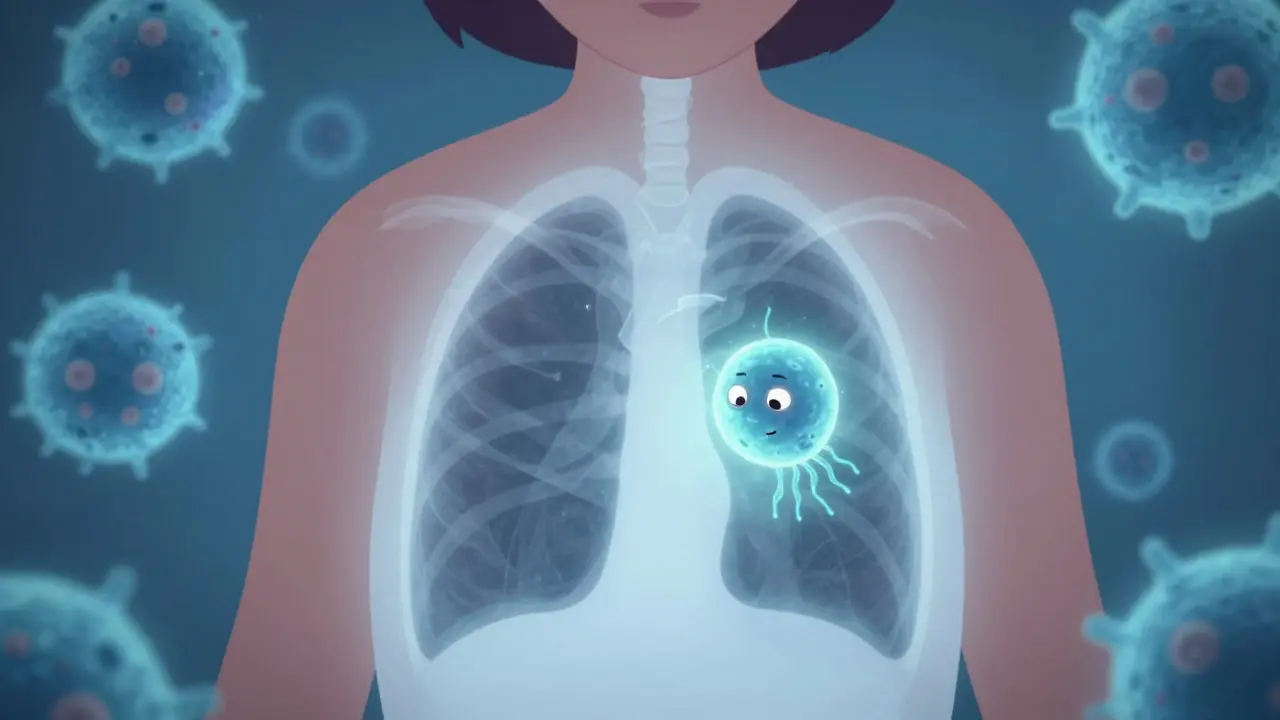
Most people don’t realize they’ve been exposed to tuberculosis until a routine test comes back positive. That’s because tuberculosis doesn’t always make you sick right away. In fact, about one-quarter of the world’s population carries the bacteria without knowing it. The difference between having a silent infection and being actively ill comes down to whether the bacteria are sleeping-or multiplying.
What’s the difference between latent and active TB?
Latent TB infection means the bacteria are alive but completely shut down inside your body. You feel fine. You don’t cough. You can’t spread it to anyone. Your chest X-ray looks normal. All that shows up is a positive skin test or blood test (called an IGRA) that tells your immune system has seen the bacteria before.
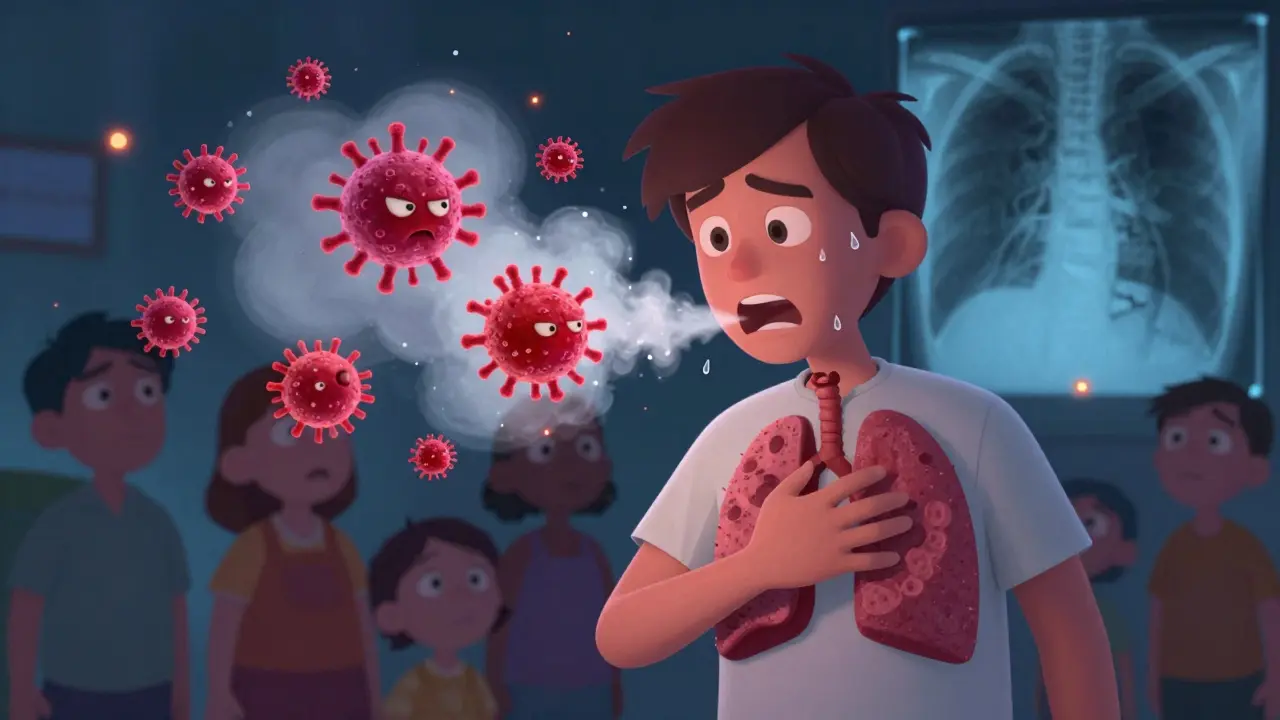
Active TB is the opposite. The bacteria have woken up, started multiplying, and are now attacking your lungs-or sometimes your spine, kidneys, or brain. You’ll likely have a cough that lasts more than three weeks, lose weight without trying, wake up drenched in sweat at night, and feel constantly tired. Some people cough up blood. Fever and chills are common. If left untreated, active TB can be fatal.
The key distinction? Latent TB = no symptoms, no spread. Active TB = symptoms, contagious, dangerous.
Who’s at risk of developing active TB?
Only 5 to 10% of people with latent TB will ever develop active disease. But that risk jumps dramatically if your immune system is weakened. People with untreated HIV are 20 to 30 times more likely to develop active TB. The same goes for those on immunosuppressant drugs for conditions like rheumatoid arthritis or after an organ transplant.
Other high-risk groups include people who were recently infected (within the last two years), those with diabetes, smokers, and people who are undernourished. In the U.S., most active TB cases happen in people born in countries where TB is common-like India, Indonesia, the Philippines, Nigeria, and Pakistan.
Even if you’ve had TB before, you can get it again. Past infection doesn’t give you full immunity.
How is TB diagnosed?
Latent TB is found with one of two tests: the tuberculin skin test (TST) or the interferon-gamma release assay (IGRA). Both check for your body’s immune response to TB bacteria. A positive result doesn’t mean you have active disease-it just means you’ve been exposed.
For active TB, doctors need proof the bacteria are multiplying. That means testing your sputum. A lab will look for TB bacteria under a microscope, grow them in a culture (which takes weeks), or use a rapid molecular test like the Xpert MTB/RIF assay that detects both TB DNA and resistance to rifampin in under two hours.
A chest X-ray is also essential. In active TB, you’ll usually see dark spots, cavities, or patchy shadows in the lungs. In latent TB, the X-ray is normal.
What does TB treatment look like?
Latent TB doesn’t need emergency treatment-but it should be treated to stop it from becoming active. The standard is nine months of daily isoniazid. But that’s a long time. Many people stop taking it because they feel fine. That’s why shorter regimens are now preferred.
Today, the CDC and WHO recommend one of two faster options:
- Three months of once-weekly isoniazid and rifapentine (taken under direct observation)
- Four months of daily rifampin
Both are just as effective as nine months of isoniazid-and far easier to finish.
Active TB is a whole different ballgame. You need four drugs at once for the first two months: isoniazid, rifampin, pyrazinamide, and ethambutol. After that, you drop pyrazinamide and ethambutol and continue with isoniazid and rifampin for another four to seven months. That’s six to nine months total.
Why so many drugs? TB bacteria are sneaky. If you only take one or two, the ones that survive become resistant. That’s how drug-resistant TB forms-and that’s deadly.
Why is treatment adherence so critical?
Missing doses, even just a few, can turn treatable TB into multidrug-resistant TB (MDR-TB). MDR-TB doesn’t respond to the two most powerful drugs-isoniazid and rifampin. Treating it takes 9 to 20 months, with harsher side effects, more injections, and a success rate that’s only about 60%.
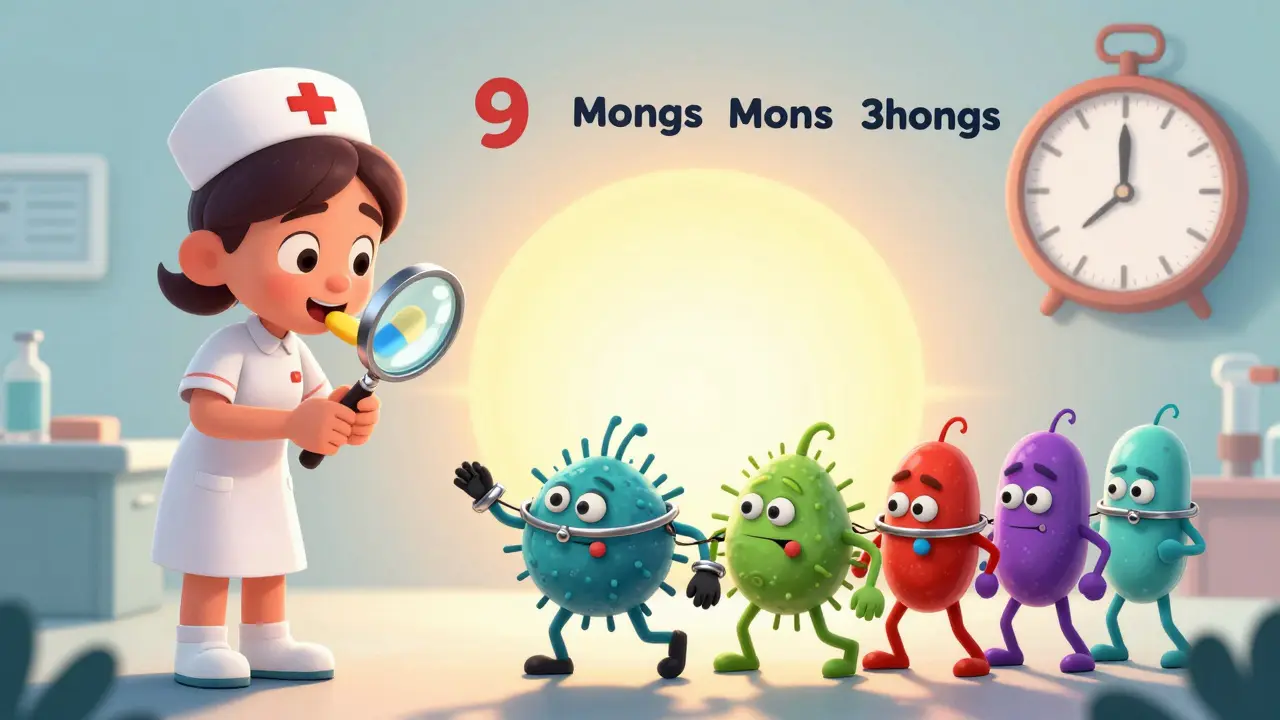
That’s why directly observed therapy (DOT) is standard. A nurse or community health worker watches you swallow every pill. It’s not about control-it’s about saving lives. Studies show DOT cuts treatment failure and drug resistance by half.
Side effects are real. Isoniazid and rifampin can damage your liver. You’ll need blood tests every few weeks. You might feel nauseous, get a rash, or notice your urine turning orange (that’s rifampin-harmless but startling). If you develop yellow eyes, dark urine, or severe nausea, call your doctor immediately.
Can you still spread TB during treatment?
Yes-until you’ve been on the right drugs for at least two weeks. After that, most people stop being contagious. But you still need to finish the full course. Stopping early is the #1 reason TB comes back.
If you have active TB, you’ll be told to stay home, avoid public places, and cover your mouth when you cough. Hospitals often put you in an isolation room with special air filters. Once your sputum tests come back negative for bacteria (usually after 2-3 weeks), you can go back to normal life.
What’s new in TB care?
Research is moving fast. New blood tests are being developed to tell the difference between latent infection that will stay quiet and latent infection that’s about to flare up. Right now, we can’t predict who will get sick-but we’re getting closer.
Shorter treatment regimens are becoming standard. The 3-month isoniazid-rifapentine combo for latent TB is now recommended worldwide. For active TB, trials are testing 4-month regimens instead of 6. Early results look promising.
And there’s hope for a better vaccine. The old BCG vaccine, used since the 1920s, only protects babies from severe forms of TB-it doesn’t stop lung infection in adults. New candidates are in late-stage trials, with some showing over 50% effectiveness in preventing disease.
Why does TB still matter today?
TB killed 1.3 million people in 2022. It’s one of the top 10 causes of death globally. Even in the U.S., where cases are low, it’s not gone. In 2023, there were over 8,300 cases reported-mostly in people born abroad, but also in homeless populations, prison inmates, and those with HIV.
Every person with latent TB is a ticking clock. Treating them is the most effective way to stop TB from spreading. Public health programs that screen high-risk groups-immigrants, healthcare workers, people in shelters-are saving lives.
And here’s the thing: TB doesn’t care where you live. It doesn’t care about your income. It only cares if your immune system is strong enough to keep it asleep. That’s why knowing the difference between latent and active TB isn’t just medical knowledge-it’s a tool for survival.
Latent TB is basically nature’s way of saying, "I’m not done with you yet." Nine months of isoniazid? No thanks. I’ll take my chances. Also, why is rifampin turning my pee orange? That’s not a side effect-that’s a warning from the universe.
They’re hiding the truth. TB isn’t just a disease-it’s a bioweapon test run by the WHO to justify mandatory vaccines and surveillance. They want you to take pills so they can track you. Look at the ‘DOT’ program-Direct Observation Therapy? More like Direct Observation of YOU. 😈💊 #BigPharmaLies
India has 27% of global TB cases. But you Americans act like it’s some foreign problem? LOL. My uncle had TB in 1998. Took 18 months. No fancy pills. Just roti, chai, and stubbornness. Now you want 3-month magic? 😂
If you don’t finish your meds, you deserve to die.
Okay, so let me get this straight… you’re telling me that 1/4 of the planet is walking around with a silent, ticking bomb… and the only way to stop it is to take pills for months… while being watched… while your pee turns orange… and you still might get it again? 😅 I mean… wow. Just… wow. TB doesn’t care about borders, income, or even your Spotify playlist… it just… waits. And waits. And waits.
While the clinical efficacy of the 3-month isoniazid-rifapentine regimen has been demonstrated in randomized controlled trials, the ethical implications of directly observed therapy as a public health mandate warrant further scrutiny regarding individual autonomy and state overreach. The normalization of medical surveillance, even when well-intentioned, establishes precedent for coercive health governance.
Thank you for this clear, compassionate breakdown 🙏 I had no idea latent TB was so common-or that treatment had gotten so much simpler. My cousin just finished the 3-month combo and said it was a breeze compared to her mom’s 9-month ordeal. So glad we’re moving forward! 💪❤️
Think about it… if 25% of the world has TB bacteria and nobody’s dying immediately… then maybe… it’s not a disease… it’s an evolutionary upgrade? 🤔 The bacteria are syncing with our immune systems. The ‘treatment’ isn’t curing you-it’s removing a symbiotic relationship that’s been quietly optimizing human resilience. They call it ‘infection’… but what if it’s adaptation? And what if the drugs… are the real threat? 🧬💀