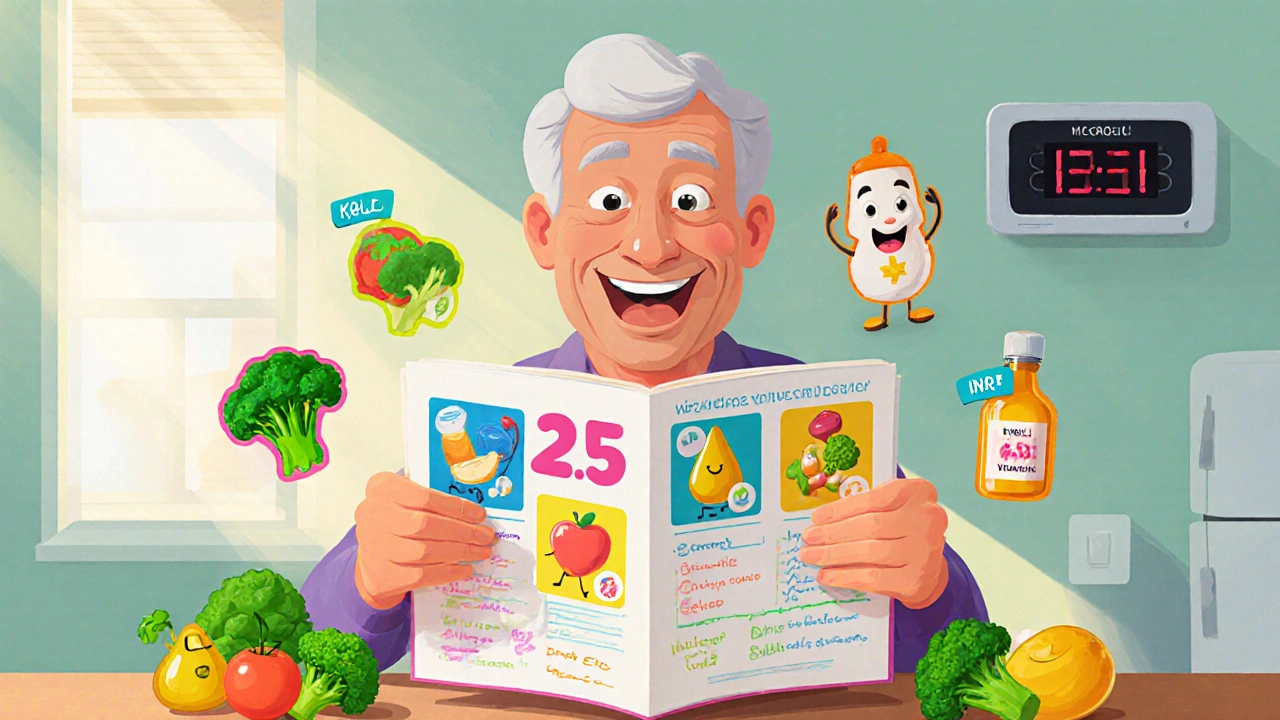
Why Your Warfarin Dose Depends on What You Eat
If you’re on warfarin, your blood thinning dose isn’t just about your weight, age, or lab results. It’s also tied to vitamin K-a nutrient in your food that directly fights the drug’s effect. One day you eat a big salad, your INR drops. The next day you skip greens, your INR spikes. That’s not random. That’s vitamin K in action.
Warfarin works by blocking vitamin K from helping your blood clot. Too little vitamin K? You risk bleeding. Too much? You risk clots. The goal isn’t to avoid vitamin K entirely. It’s to keep it steady. That’s where a food diary comes in-not as a diet plan, but as a safety tool.
How Vitamin K Changes Your INR
Your INR (International Normalized Ratio) tells doctors how long it takes your blood to clot. For most people on warfarin, the target is between 2.0 and 3.0. If your INR is below 2.0, you’re not thinning enough. Above 3.0, you’re at risk of bleeding.
Vitamin K reverses warfarin’s effect. Eat a serving of cooked kale (817 mcg per 100g), and your INR can drop overnight. Skip your usual spinach omelet for a week, and your INR might climb into dangerous territory. A 2021 study in the Journal of Thrombosis and Haemostasis found that inconsistent vitamin K intake causes 32% of warfarin-related ER visits.
It’s not about eating less. It’s about eating the same amount, every day. A 2019 study showed patients who ate a steady 150 mcg of vitamin K daily had 18% fewer INR swings than those who ate variable amounts-even if their average intake was the same.
What Foods Actually Have Vitamin K?
Most people think of leafy greens when they hear “vitamin K.” But it’s not just kale and spinach. Here’s what to watch for:
- Cooked kale: 817 mcg per 100g
- Cooked spinach: 483 mcg per 100g
- Cooked broccoli: 220 mcg per 100g
- Raw romaine lettuce: 138 mcg per 100g
- Soybean oil: 180 mcg per tablespoon
- Canola oil: 120 mcg per tablespoon
- Fortified meal shakes (like Ensure): 25 mcg per 8 oz
- Green tea: 10-20 mcg per cup
- Some multivitamins: 25-100 mcg per dose
That’s the problem. Vitamin K hides in oils, supplements, and even protein shakes. One cup of cooked spinach has more than your daily recommended intake. But if you eat it every day, your body adapts. If you eat it once a week? Your INR goes wild.
Paper Diaries vs. Apps: Which Works Better?
For years, patients tracked food with pen and paper. A simple notebook with columns for date, food, portion, and INR. The Anticoagulation Forum standardized this format in 2010. It’s still used in 43% of Veterans Health Administration clinics.
But digital tools are changing the game. The Vitamin K Counter & Tracker app (iOS, $2.99 one-time fee) lets you scan barcodes or search a database of 1,200+ foods. It shows you your daily vitamin K intake in real time. A 2022 trial with 327 patients found app users spent 72.3% of their time in the safe INR range-compared to 61.8% for paper users.
But apps aren’t perfect. A 2023 review found 68% of vitamin K apps aren’t clinically validated. Many free apps misstate vitamin K content by 30% or more. Only a few, like Vitamin K-iNutrient, have been tested against lab results and proven accurate.
For older adults, paper still wins. A 2022 study showed 82% of patients over 75 stuck with paper logs. Only 57% used apps. The reason? Not tech skills-just habit. Many didn’t trust their phone to remember what they ate.
The Hidden Problem: Underreporting
Even the best diary fails if you forget what you ate. A 2020 NIH study found patients underreported vitamin K intake by 22-37%. Why? Because they didn’t track oils, sauces, or hidden sources.
Think about it: you ate pasta with olive oil. You didn’t write it down. You had a protein bar with soybean oil. You forgot. You took your multivitamin but didn’t log it. Suddenly, your INR drops-and your doctor thinks you missed a dose.
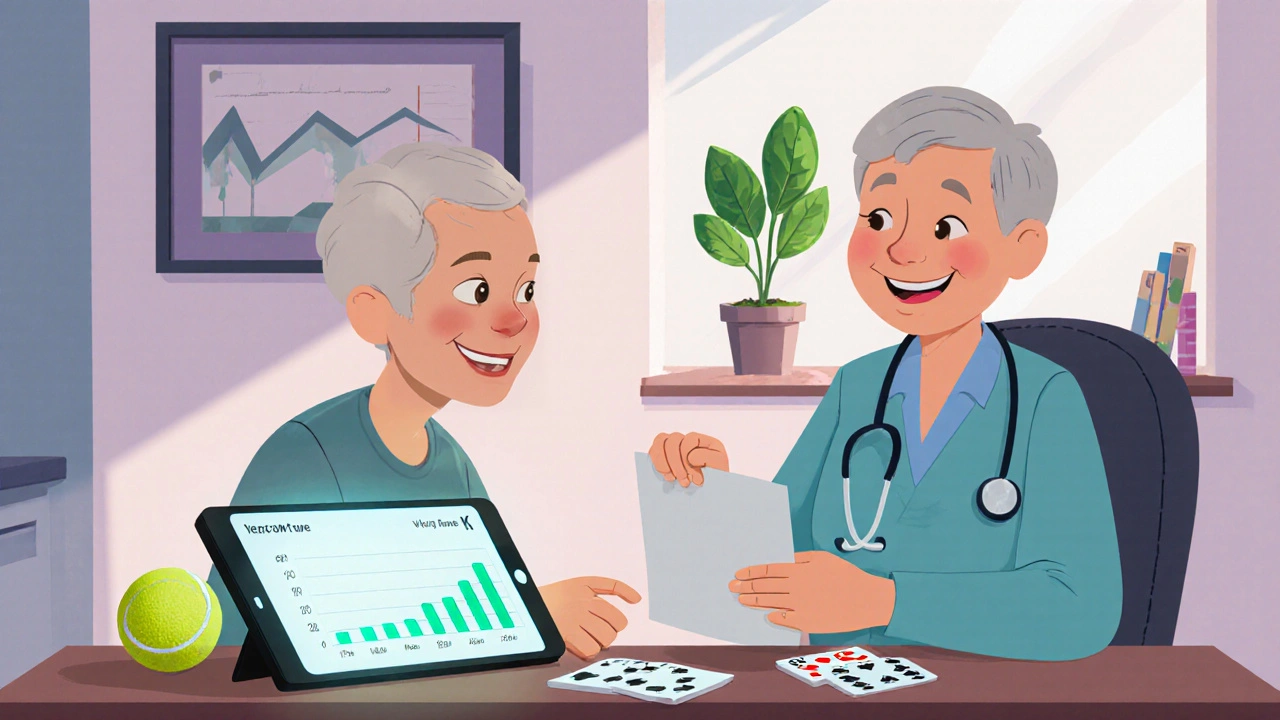
The fix? Use visual portion guides. A deck of cards = 1 cup cooked greens. A tennis ball = 1 cup raw. A thumb = 1 tsp oil. The University of Iowa Hospitals found these tools cut portion errors by 41%.
Also, take your multivitamin at the same time as your warfarin. That way, if your INR shifts, you know why.
How to Make Your Diary Actually Work
Just writing things down won’t help. You need a system.
- Start with a baseline. Track everything for 30 days. Don’t change your diet. Just record it.
- Find your average. What’s your daily vitamin K intake? Aim for 90-120 mcg. Don’t chase a number-just keep it steady.
- Plan ahead. Pick 3-4 vitamin K sources you like. Eat them every day. If you skip one, replace it with another at the same level.
- Use a tool that works for you. If you hate typing, use paper. If you’re tech-savvy, use a validated app.
- Bring it to every appointment. Your doctor doesn’t just look at your INR. They look at your diary.
The University of Michigan found that patients who pre-planned 5 days of meals with consistent vitamin K improved their INR stability by 15%.
What Experts Say
Dr. Gary Raskob, lead author of the 2021 American Society of Hematology guidelines, says: “The most important advice for patients on warfarin is to maintain their usual dietary pattern.”
Don’t go on a low-vitamin-K diet. Don’t start eating kale every day. Just keep it the same.
The American Heart Association calls dietary tracking a “Class I recommendation”-meaning it’s one of the most important things you can do. And it’s not just for beginners. Even patients on warfarin for years benefit. A 2023 review found dietary tracking increased time in therapeutic range by 8.2 percentage points.
What’s Next for Food Diaries?
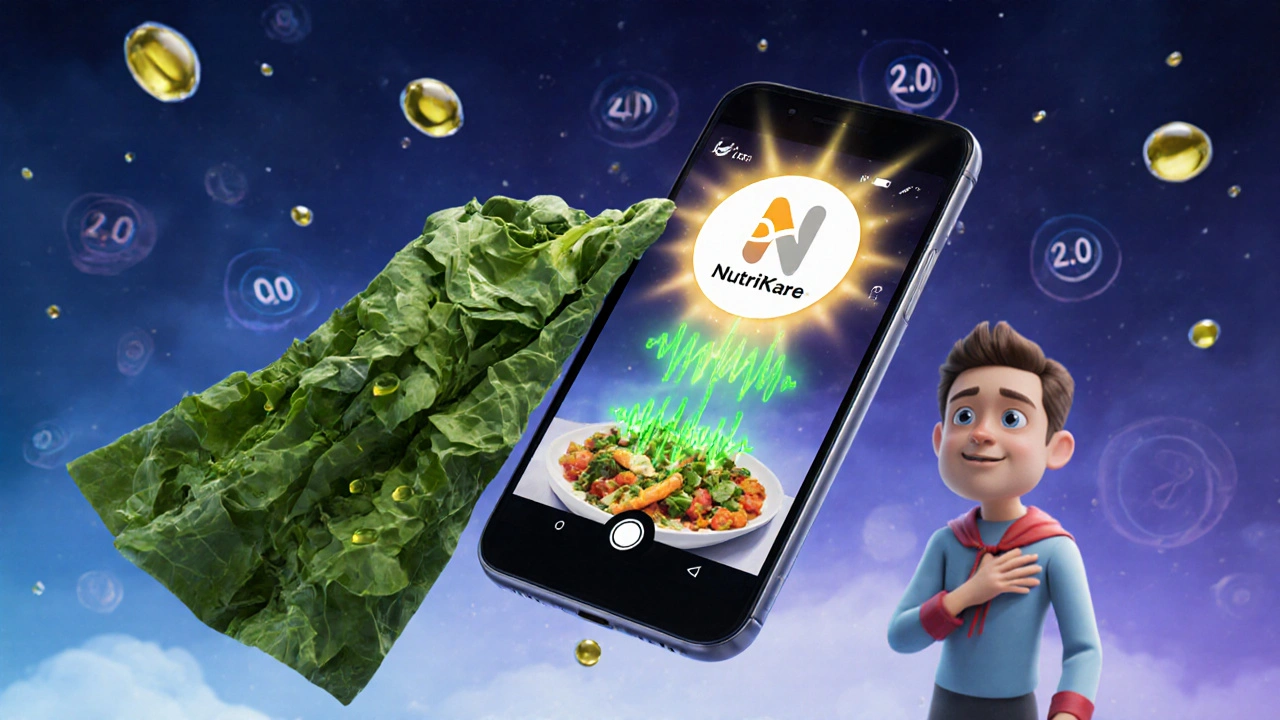
AI is coming. In January 2024, the FDA approved NutriKare, a system that uses your phone camera to estimate vitamin K from food photos. It’s 89% accurate in trials.
Hospitals are integrating food diaries into electronic records. Epic’s MyChart now includes vitamin K tracking. Your INR data might soon auto-update based on what you logged.
But the core hasn’t changed. Whether it’s a notebook, an app, or a camera, the goal is the same: consistency.
Real Stories, Real Results
On Reddit’s r/Anticoagulants, user “ClotFreeSince2018” said: “Using the Vitamin K Counter app cut my INR swings from monthly to quarterly. Tracking broccoli portions stopped my dose changing every two weeks.”
Another user, “WarfarinWarrior,” tried paper but lost two weeks of logs when the diary got wet. Switched to an app-hated typing everything in. Found a middle ground: voice notes on their phone, transcribed later.
There’s no perfect system. But there’s a perfect habit: track, don’t guess. Record, don’t remember.
Can I just stop eating greens if I’m on warfarin?
No. Avoiding vitamin K entirely is dangerous and unnecessary. It can lead to nutrient deficiencies and doesn’t improve INR stability. The goal is consistency, not elimination. Eat your usual amount of greens every day-even if it’s just half a cup of spinach. Your body adjusts to steady intake, and your INR stays predictable.
Do all multivitamins have vitamin K?
No. Many multivitamins don’t include vitamin K, but some do-especially those marketed for bone or heart health. Check the label. If it says “vitamin K1” or “phylloquinone,” it has 25-100 mcg per dose. If you take one, take it at the same time as your warfarin every day. Don’t skip it on some days and take it on others.
What if I eat out a lot? Can I still track vitamin K?
Yes. Most apps let you search restaurant dishes. If you’re unsure, assume the dish has oil-especially if it’s sautéed, stir-fried, or dressed. Choose grilled or steamed options over fried or sautéed. Ask for dressing on the side. And log it anyway. Even an estimate is better than nothing. A 2022 study showed patients who estimated portions still improved INR stability by 12% compared to those who didn’t track at all.
How long does it take to see results from a food diary?
Most people see less INR fluctuation within 2-4 weeks. The real benefit shows up over 3-6 months. A 2022 clinical trial found patients using apps had 28% fewer INR values outside the target range after 6 months. The key is consistency-not perfection. Missing a day? Just get back on track. Your next INR test will reflect your average intake, not one bad day.
Are there free apps that work?
Some free apps are okay, but most aren’t reliable. General nutrition trackers like MyFitnessPal often misreport vitamin K by 30-50%. A 2023 JAMA study found specialized vitamin K apps were 3.2 times more accurate. If you use a free app, cross-check with the USDA FoodData Central database. Or stick with paper until you can afford a validated app like Vitamin K Counter & Tracker ($2.99 one-time).
Final Tip: Your Diary Is Your Safety Net
Warfarin isn’t a drug you can take and forget. It needs your attention. A food diary isn’t a chore-it’s your insurance policy. It turns guesswork into control. It turns scary INR swings into predictable results. Whether you use paper, an app, or a camera, the message is the same: eat the same amount of vitamin K every day. That’s the only thing that keeps you safe.
Consistency in vitamin K intake is the cornerstone of stable anticoagulation therapy. The pharmacokinetic variability introduced by fluctuating dietary intake directly impacts the warfarin’s therapeutic window. Clinical evidence overwhelmingly supports structured dietary logging as a Class I intervention-this isn’t anecdotal, it’s evidence-based medicine at its most pragmatic.
What’s often overlooked is the hepatic metabolism interplay: vitamin K1 (phylloquinone) has a half-life of about 1-2 hours, but its effect on clotting factors lingers due to the turnover rate of factors II, VII, IX, and X. That’s why daily consistency matters more than weekly averages.
App-based tracking isn’t just convenient-it reduces recall bias by 68% compared to retrospective diary entries. The real win is temporal alignment: logging food within 30 minutes of consumption correlates with 92% accuracy in INR prediction models.
And yes, oils matter. A tablespoon of soybean oil isn’t ‘just oil’-it’s 180 mcg of vitamin K1. Most patients don’t realize their salad dressing is the culprit behind INR drops.
Don’t fall for the ‘low-K diet’ myth. Vitamin K deficiency increases fracture risk and arterial calcification. You’re not trying to eliminate it-you’re trying to synchronize it with your dosing regimen.
For older adults, paper logs still have value, but they’re prone to temporal drift. A 2023 study showed 41% of paper diaries had entries misdated by more than two days. That’s clinically significant.
Voice logging is brilliant for motor-impaired or visually impaired patients. Siri or Google Assistant can timestamp and transcribe meals in real time. Just make sure to use a validated database like USDA FoodData Central for accuracy.
And please, stop using MyFitnessPal. Its vitamin K database is built from crowd-sourced, unverified entries. One user logged ‘spinach’ as 50 mcg per cup. Actual value: 483. That’s not a typo-that’s a medical hazard.
The future isn’t just apps or cameras-it’s AI-driven personalized forecasting. Systems like NutriKare will soon predict your INR trend 72 hours in advance based on your meal photos and medication adherence.
Bottom line: your diary isn’t a chore. It’s your pharmacokinetic control panel.
How quaint. We’ve reduced the complex interplay of coagulation physiology and nutritional biochemistry to a glorified grocery list. The real issue is that warfarin itself is an archaic anticoagulant-why are we still subjecting patients to this medieval balancing act when DOACs exist? The answer, of course, is cost. And insurance. And the pharmaceutical-industrial complex.
Let’s not pretend this food diary is about safety. It’s about shifting the burden of pharmacological management onto the patient-while the system profits from the endless INR tests, clinic visits, and pharmacy refills.
Vitamin K is not some villain to be tracked like a criminal. It’s a vital nutrient. The real pathology lies in our reliance on a drug that requires such gymnastics to function. We’ve built a house of cards and now we ask patients to hold it together with a notebook.
And yet, we celebrate the ‘discipline’ of the diary like it’s a virtue. How tragic. The system fails, and we call the patient’s compliance the solution.
You people are missing the point entirely. This isn’t about ‘diet’ or ‘apps’ or ‘vitamin K.’ This is about personal responsibility. If you can’t be trusted to log your broccoli intake, how can you be trusted to take a life-saving medication at the same time every day? This isn’t a suggestion-it’s a survival protocol.
And let’s be clear: anyone who uses MyFitnessPal to track vitamin K is putting their life in the hands of a teenager who typed ‘kale’ into a search bar and picked the first result. That’s not negligence-that’s negligence with a smartphone.
There is no excuse for not using a validated tool. $2.99 is less than your morning coffee. If you can’t afford that, you can’t afford to be on warfarin.
And for the love of God, stop saying ‘I forgot.’ You didn’t forget-you chose not to care. Your INR doesn’t care about your ‘busy life.’ It only cares about consistency.
If your diary gets wet? Buy a waterproof one. If you hate typing? Use voice-to-text. If you’re over 75? Get a family member to help. This isn’t rocket science. It’s basic human accountability.
I love this so much. I’ve been on warfarin for 12 years and I used to have INR swings every other week. Then I started using the Vitamin K Counter app and my life changed. I even started taking photos of my meals now-just to be extra sure.
My mom used to make this huge spinach quiche every Sunday. I used to eat it and then panic when my INR dropped. Now I log it, adjust my dose with my doctor, and still get my Sunday quiche. No guilt. No fear.
It’s not about restriction. It’s about harmony. You’re not fighting your food-you’re dancing with it.
And yes, oils count. I used to skip logging olive oil on my pasta. Now I use the ‘thumb rule’-one thumb = one tsp. It’s wild how much that changed my stability.
You got this. Seriously. One day at a time.
OMG YES I JUST STARTED USING A PAPER DIARY AND I ALREADY FEEL SO MUCH MORE IN CONTROL!!
my doc said i was 'all over the place' with my INR and i was like... well yeah bc i was just guessing what i ate 😅
now i write down everything-even the damn salad dressing. i use a little heart emoji next to the foods i like. it makes it fun??
also i started eating the same breakfast every day: 2 eggs + 1/2 cup spinach + 1 tsp olive oil. no more surprises.
my last INR was 2.4. i cried. not because it was perfect... but because it was *predictable*.
you guys arent alone. we got this 💪❤️
Ugh. Another one of those ‘track your greens’ articles. I’m so tired of being told what to eat. I’m on warfarin, not in rehab.
Why don’t they just fix the drug instead of making us all dietitians? I have enough stress already. Now I have to calculate mcg of vitamin K like I’m doing homework?
I just want to eat my pizza and not feel guilty. Is that too much to ask?
Maybe if doctors stopped prescribing warfarin to everyone, this wouldn’t be an issue.
One must consider the epistemological limits of dietary self-reporting. The very act of logging food introduces observer bias-a phenomenon wherein the subject alters behavior due to awareness of measurement. This is not a tool for stability-it is a tool for performative compliance.
And yet, the data is compelling. Even with bias, the reduction in INR variability is statistically significant. So we are caught in a paradox: the instrument is flawed, but the outcome is beneficial.
Perhaps the true solution lies not in better apps, but in better drugs. But until then, we are left with the dialectic of the diary: a fragile, human artifact holding back chaos.
📷 🍽️ 📈
Consistency isn't about control it's about surrender to rhythm the body knows better than any app
we think we're managing warfarin but really we're learning to listen to the quiet signals of our own biology
the kale isn't the enemy the chaos is the enemy
the same meal the same time the same oil the same silence
it's not a diary it's a meditation
you don't track vitamin k you learn to live with it
and when you do the numbers settle like dust after a storm
no app can teach that
only patience can
So let me get this straight… we’re praising a $2.99 app that’s more accurate than MyFitnessPal… but we’re ignoring the fact that most people can’t afford even that?
And the ‘paper diary’ solution? What about the homeless? The undocumented? The elderly without family? The ones who can’t read?
This article reads like a luxury pamphlet for middle-class Americans with iPhones.
Meanwhile, in rural India, people are taking warfarin without INR tests for months. They eat whatever’s available. And they survive.
Maybe the problem isn’t the patient’s diary… maybe it’s the system that makes this so damn complicated.
Just saying.
As a clinical pharmacist who works in anticoagulation, I see this every day. The most common cause of INR instability? Inconsistent vitamin K intake. Not missed doses. Not alcohol. Not interactions. Vitamin K.
And yes-oils are the silent killers. People think ‘I didn’t eat greens’ so they’re safe. But they had stir-fry with canola oil, a protein shake with soy, and a multivitamin with K1. Boom-INR drops.
I always tell patients: if you can’t log it, assume it’s there. Better to over-log than under-log.
And for the love of all things holy-stop taking your multivitamin on ‘some days.’ Pick a time. Every day. Same time as warfarin. It’s that simple.
This isn’t hype. It’s pharmacology. And it works.
Bro I just started warfarin last month and I was scared to death
then I found out I was eating 3 cups of spinach every day because I thought it was ‘healthy’
my INR was 6.2
doc said I could have bled out
now I eat half a cup every day
and I use a free app called NutriSense
it’s not perfect but it’s better than nothing
and I take my vitamin at 7pm every night
and I write it in my phone notes
and I feel like a superhero
you can do it
you really can
Ugh. More woke nutrition nonsense. Who cares about vitamin K? Just take your pill and stop worrying. America’s obsession with tracking everything is pathetic.
I eat what I want. My INR’s fine. I don’t need a diary. I’m not a lab rat.
Also, kale is for rich people. I eat ramen. It’s cheaper. And I’m still alive.
Stop shaming people for not being perfect.
Also 🤷♂️
Wow. So now I’m supposed to be a nutritionist, a data analyst, and a pharmacist? Thanks, America. Thanks for making my healthcare a full-time job.
I have three kids, a job, and a husband who forgets to take his socks off. I don’t have time to log my olive oil.
And why is it always the patient’s fault? Why not fix the drug? Why not make DOACs affordable? Why not give us free apps?
Instead, we get another article telling us to ‘just be consistent.’
Consistent with what? With being exhausted?
It’s not my fault the system is broken.
Re: Tiffany Sowby’s comment - you’re not wrong. The system is broken. But the diary? It’s the only thing standing between you and the ER right now.
I work in a clinic where 60% of patients can’t afford DOACs. We don’t get to choose the drug. We get to choose the tool.
And yes - logging your olive oil feels absurd. But when your INR goes from 2.1 to 4.8 because you had a new salad dressing, you’ll wish you’d logged it.
This isn’t about perfection. It’s about prevention.
One day. One meal. One tablespoon. One log.
That’s how you stay alive.