
For decades, doctors told us: take more vitamin D to protect your bones. But the science has shifted - and what worked for your parents might not work for you. The truth? Vitamin D matters for bone health, but vitamin D isn’t a magic pill. Too little hurts. Too much might, too.
Why Vitamin D Even Matters for Your Bones
Vitamin D doesn’t build bone directly. It’s the gatekeeper for calcium. Without enough vitamin D, your body absorbs just 10-15% of the calcium you eat. With enough? That jumps to 60-80%. That’s the difference between bones that stay strong and bones that start to crumble. It also helps your muscles work better. Weak muscles mean more falls - and falls are the main reason older adults break hips. Vitamin D keeps your balance and reflexes sharp. That’s why it’s not just about density - it’s about safety.What’s the Right Level? It’s Not What You Think
For years, the standard was clear: your blood level of 25(OH)D should be at least 30 ng/mL (75 nmol/L). That’s what the Endocrine Society said. But here’s the twist: the biggest study ever done on this - the VITAL trial - found no extra protection for bones at that level. In fact, people taking 2,000 IU daily for five years had no fewer fractures than those taking a placebo. That’s not a typo. Thousands of healthy adults, mostly over 50, got tested, tracked, and monitored. No benefit. No harm. Just… nothing. So what’s the real target? For most people, 20 ng/mL (50 nmol/L) is enough. That’s the cutoff the Institute of Medicine uses. Below that? You’re deficient. Between 20 and 30? You’re borderline. Above 30? You’re not necessarily safer - you might just be wasting money.Not All Vitamin D Is Created Equal
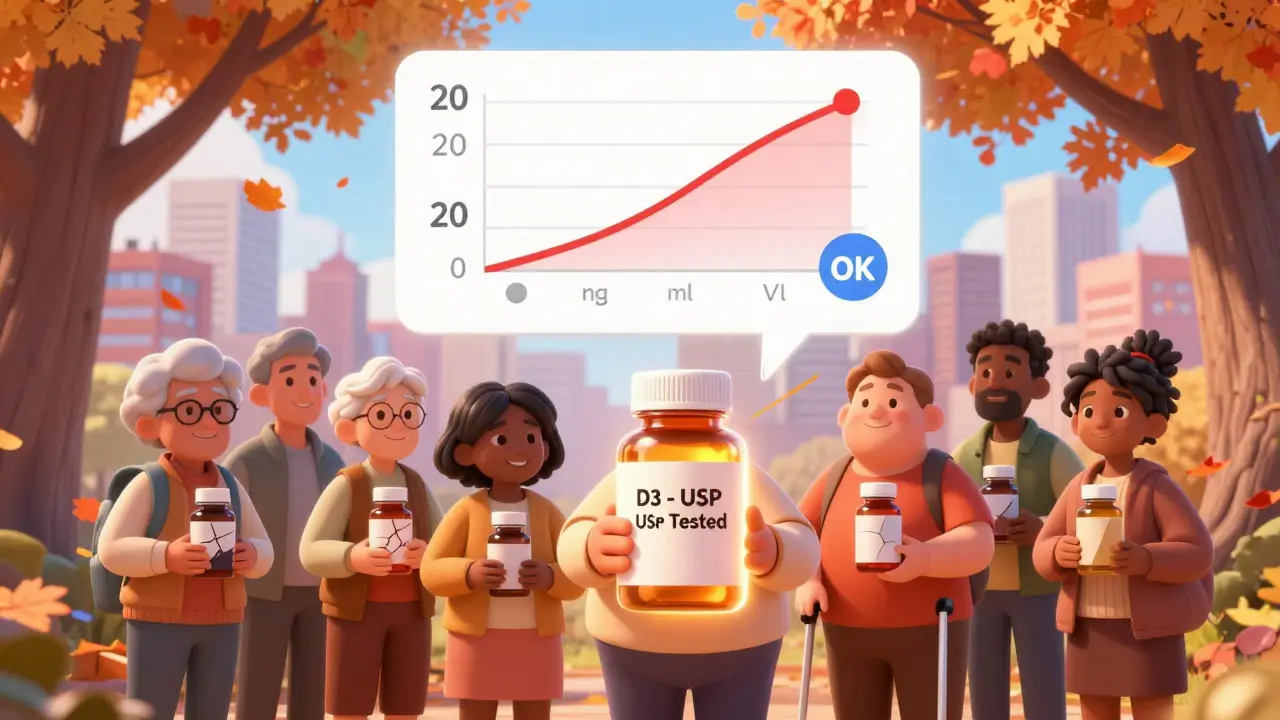
There are two forms: D2 (from plants) and D3 (from animals and your skin). D3 is the one your body actually uses best. It’s 87% more effective at raising blood levels than D2. If you’re buying a supplement, check the label. Make sure it says cholecalciferol - that’s D3. Even then, quality varies. ConsumerLab tested 20 popular brands in 2022. One brand had only 72% of the D3 it claimed. Another had 128%. You’re not just guessing at dosage - you’re guessing at safety. Stick to brands that are third-party tested. Look for USP, NSF, or ConsumerLab verification. It’s not glamorous, but it’s the only way to know you’re getting what you paid for.More Isn’t Better - It Can Be Worse
Here’s the shocker: taking too much vitamin D can weaken your bones. A 2020 JAMA study gave people 400 IU, 4,000 IU, or 10,000 IU daily for three years. Those on 4,000 IU lost 3.9 mg of bone mineral per cm³ in their radius. Those on 10,000 IU lost 7.5 mg. That’s measurable, real bone loss. Not theoretical. Not statistical noise. Actual thinning. Why? High doses may overstimulate bone turnover. Your body starts breaking down old bone faster than it builds new bone. The result? Less density, not more. And it’s not just bone. High doses can raise calcium levels in your blood, leading to kidney stones, nausea, or even heart rhythm issues. The body doesn’t handle excess vitamin D well. It’s not water-soluble. It stores up. And it doesn’t let go easily.Who Actually Needs Supplements?
Not everyone. If you’re healthy, eat fatty fish a couple times a week, get regular sun, and drink fortified milk or cereal - you probably don’t need a pill. But some people do:- People over 65, especially if they live indoors or wear sunscreen daily
- Those with dark skin - melanin blocks UVB rays needed to make vitamin D
- People with obesity - fat traps vitamin D, so your blood levels stay low even if you take the same dose as someone lean
- Anyone with Crohn’s, celiac, or other gut conditions that affect fat absorption
- People who’ve had gastric bypass surgery
Calcium + Vitamin D: A Team That Only Works Together
Vitamin D without calcium? Useless for bones. Calcium without vitamin D? Mostly wasted. A 2023 meta-analysis found that when taken together, calcium and vitamin D reduced hip fracture risk by 30%. But here’s the catch: that benefit only showed up when vitamin D was under 400 IU per day. At higher doses, the effect vanished. That means: if you’re taking 1,000 IU of vitamin D, you’re probably not getting any extra fracture protection - even with calcium. The sweet spot? 800 IU vitamin D + 1,000-1,200 mg calcium daily. That’s the combination backed by the most consistent data.Timing and Absorption: When You Take It Matters
You wouldn’t take a fat-soluble vitamin on an empty stomach. So why do so many people? Vitamin D needs fat to be absorbed. A 2015 study showed taking it with your largest meal - usually dinner - boosted absorption by 57%. That’s not a small tweak. That’s the difference between getting 500 IU and 800 IU from a 1,000 IU pill. Take it with eggs, avocado, nuts, or a spoonful of olive oil. Don’t just swallow it with your morning coffee.What About Sunlight?
Your skin makes vitamin D when hit by UVB rays. But in the UK, that’s only possible from late March to September. Even then, you need 10-30 minutes of midday sun on arms and legs - without sunscreen - several times a week. If you’re pale, you’ll make more. If you’re darker, you’ll need longer. If you’re over 65, your skin’s ability to make vitamin D drops by 75%. And sunscreen with SPF 30 blocks 97% of UVB rays. So while sun is the original source, it’s not reliable for most adults in northern latitudes. That’s why supplements exist.What the Experts Really Say
Dr. Meryl LeBoff, lead researcher on the VITAL trial, put it plainly: “Most healthy older adults already get enough vitamin D.” The U.S. Preventive Services Task Force says: don’t take vitamin D to prevent fractures if you’re not at high risk. Grade D recommendation. That’s the lowest possible endorsement. Meanwhile, the International Osteoporosis Foundation still recommends supplementation for high-risk groups - but they’re clear: “Optimal status promotes skeletal health.” Not “more is better.” The real takeaway? Vitamin D is essential. But it’s not a supplement for everyone. It’s a targeted tool for those who need it.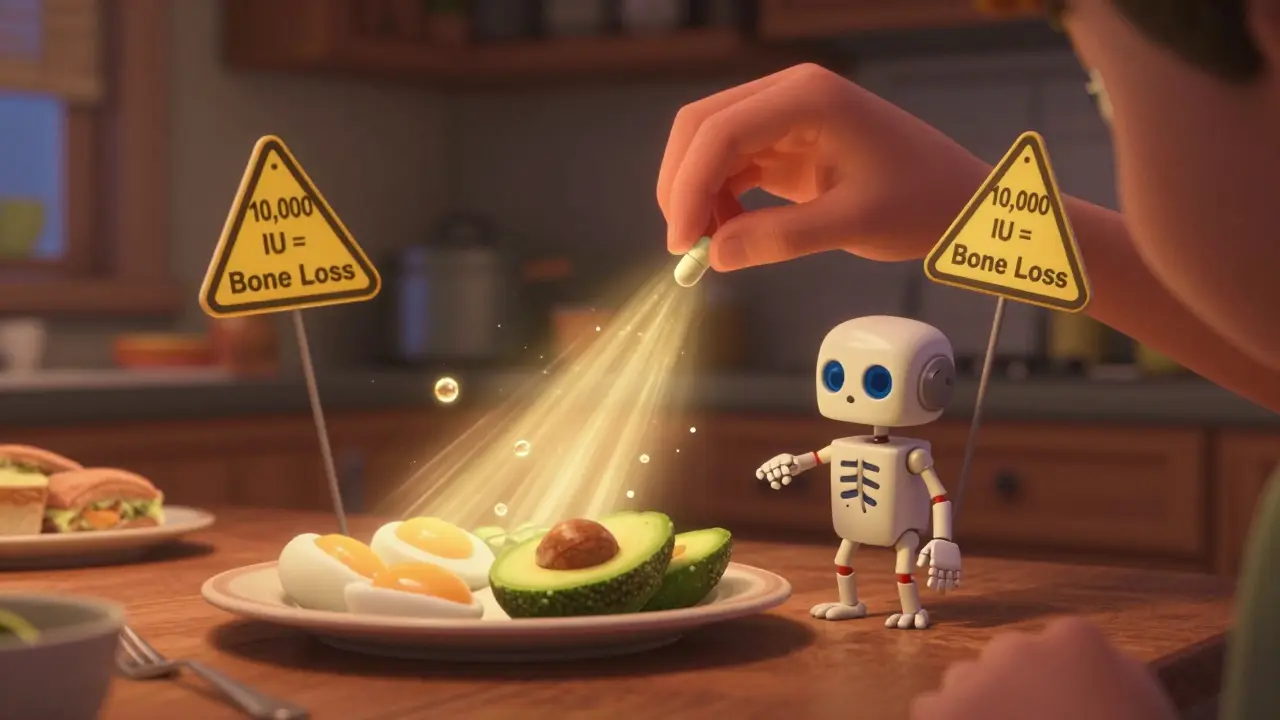
What to Do Now
If you’re over 50, or you have risk factors for deficiency:- Get a blood test for 25(OH)D. Don’t assume. Don’t guess.
- If your level is below 20 ng/mL: take 1,000-2,000 IU daily for 3 months, then retest.
- If it’s between 20-30 ng/mL: 800 IU daily is enough. No need to go higher.
- If it’s above 30 ng/mL: stop supplementing unless you have a medical reason.
- Take your supplement with your biggest meal of the day.
- Choose D3, not D2. Choose a tested brand.
- Pair it with 1,000-1,200 mg of calcium daily - from food or supplement.
Common Mistakes
- Believing “more is better” - high doses can harm bone density
- Skipping the blood test - you don’t know if you’re deficient
- Taking it on an empty stomach - you’re wasting half your dose
- Using cheap, untested brands - you might be getting 30% less than labeled
- Thinking vitamin D alone fixes osteoporosis - it’s part of a team: calcium, exercise, protein, and sometimes medication
What About Those Reddit Stories?
You’ll find people online saying, “I took 5,000 IU and my bone density improved!” And others saying, “I took 10,000 IU and lost bone.” Both are true - for them. But individual stories aren’t science. The VITAL trial had 25,000 people. That’s what matters. If you feel better on a higher dose, talk to your doctor. But don’t assume it’s helping your bones. You might just be fixing a deficiency you didn’t know you had.Final Thought
Vitamin D isn’t broken. You don’t need to fix it if it’s not broken. But if you’re at risk, don’t ignore it. Get tested. Take the right dose. Pair it with calcium. Eat well. Move your body. That’s how you build strong bones - not by popping pills hoping for magic.How do I know if I’m deficient in vitamin D?
The only reliable way is a blood test for 25-hydroxyvitamin D. Symptoms like fatigue, muscle weakness, or bone pain are vague and often missed. Don’t rely on how you feel - get tested, especially if you’re over 50, have dark skin, live indoors, or have a high BMI.
Can I get enough vitamin D from food alone?
It’s very hard. Fatty fish like salmon has about 570 IU per 3 oz. Fortified milk gives you 100 IU per cup. An egg has 44 IU. To hit 800 IU daily from food, you’d need to eat salmon every day plus drink 7 cups of milk - which isn’t realistic for most people. Supplements are usually needed if you’re not getting sun.
Is 5,000 IU of vitamin D daily safe?
For most people, 5,000 IU daily is unnecessary and potentially harmful. Studies show doses above 4,000 IU can lower bone density over time. Only take this high a dose if you have a documented deficiency and your doctor is monitoring you. Otherwise, stick to 800-2,000 IU.
Should I take vitamin D with calcium?
Yes - but only if you’re not getting enough calcium from food. The two work together. If you’re taking vitamin D without calcium, you’re not helping your bones. Aim for 1,000-1,200 mg of calcium daily from diet or supplements. Avoid high-dose calcium supplements alone - they can increase heart risk.
What’s the best time of day to take vitamin D?
Take it with your largest meal - usually dinner. Fat helps your body absorb it. A study showed absorption increased by 57% when taken with food compared to fasting. Don’t take it on an empty stomach or with your morning coffee.
Do I need to retest my vitamin D levels?
Yes - if you start or change your supplement dose. It takes about 3 months for your blood level to stabilize. Test before you start, and again after 3 months. Don’t keep taking the same dose forever without checking. Your needs can change with weight, season, or health status.
Can vitamin D supplements cause side effects?
Yes - especially at high doses. Too much vitamin D raises calcium levels in your blood, which can cause nausea, vomiting, weakness, kidney stones, or irregular heartbeat. Some people also get constipation from calcium-vitamin D combos. If you feel off, stop and get tested.

Wow this hit different. I used to take 5000 IU every day because my cousin said it fixed her fatigue. Turns out I was just dehydrated and my bones were thinning. Now I take 800 IU with dinner and my doctor says my levels are perfect. No more random muscle cramps. Honestly, I wish I’d known this years ago.
It’s wild how we all just assume more is better. Like, if a little helps, then a lot must be amazing. But your body isn’t a microwave. You can’t just blast it and expect good results.
Doctors lie. Pharma pays them. Vitamin D is a miracle cure and they want you dependent on pills. Sunlight is free. Go outside. Stop being a lab rat.
so like… the study says 2000iu does nothing right? but then they say 10000iu causes bone loss? so… 2000 is fine? or is it not? i’m confused. also why do they say ‘test first’ but never say how much a test costs. also i took d3 and my acne cleared up so maybe it’s not just about bones lol
The real tragedy here isn’t misinformation-it’s the epistemic collapse of public health discourse. We’ve replaced evidence-based thresholds with performative supplementation rituals. The VITAL trial didn’t just fail to confirm benefit-it exposed the ideological architecture of preventive medicine as a market-driven spectacle. We don’t need more vitamin D. We need a reclamation of scientific humility.
And yet, the market thrives on manufactured deficiency. The supplement industry is worth over $150 billion. Do you think they’d let go of the ‘more is better’ myth so easily? Of course not. It’s not science-it’s narrative engineering.
my grandpa took d3 every day for 20 years. never broke a bone. never went to the doctor. ate fish twice a week. walked 5 miles daily. never tested his levels. he’d probably laugh at this whole thread.
maybe the answer isn’t in the numbers. maybe its just moving your body and eating real food. just saying.
THIS IS A COVERUP. The CDC knows vitamin D cures cancer, osteoporosis, and depression. They’re suppressing the truth because Big Pharma makes billions off hip replacements and antidepressants. They don’t want you to know that 10,000 IU daily reverses bone loss. That’s why they push the ‘20 ng/mL’ lie. Your doctor is complicit. Get your own test. Demand the truth.
yo i took 10k IU for 6 months and my bones felt like they were made of glass. i could feel em creakin. then i stopped. now i feel like a normal human again. i dont care what the study says. my body told me. if you feel weird after taking d3? stop. your body ain’t lying.
also why is everyone so obsessed with numbers? i just wanna walk without my hips screaming.
you people are so lazy. you sit inside all day, eat junk, then think a pill will fix it. in my village, we get sun every day. we eat eggs, fish, milk. we dont need your fancy lab reports. you lost your bones because you forgot how to live. not because you need more vitamin D.
your culture is broken. not your body.
so the study says 4000 IU causes bone loss… but then they say 2000 is safe? what if the study is wrong? what if they just didn’t test long enough? what if the real danger is 5000? 10000? 20000? who even controls these studies? I think the government is hiding the real safe dose. I’ve been taking 8000 IU for 3 years. I feel amazing. They can’t silence me.
Thank you for this meticulously researched and balanced overview. The distinction between clinical thresholds and marketing-driven recommendations is critically underappreciated. The emphasis on third-party verified supplements and the importance of co-administration with dietary fat are particularly valuable. This is precisely the kind of evidence-based clarity that public health messaging so desperately needs.
As a clinician, I have seen too many patients harm themselves with unmonitored megadoses. This article should be required reading for all adults over 50.
I think the real question isn’t how much vitamin D you need-it’s why we’re so desperate to fix ourselves with pills in the first place. We’ve turned our bodies into machines that need calibration, when maybe what we really need is more time outside, more community, less screen time, and less fear.
My grandma took one 800 IU pill every winter. She gardened, walked, ate soup with bones in it. She lived to 92. She never tested her levels. She didn’t need to. Maybe the answer isn’t in the numbers at all.
Maybe it’s in the rhythm of the day. The sun. The food. The movement. The quiet.
i took d3 and my knees stopped hurting but then i got kidney stones so now i dont take it anymore. i think the problem is calcium. maybe its not the d3 its the calcium combo. also i think the test is a scam. why do they charge 200 bucks for a simple blood test? my cousin got it for 40 at a clinic. also i think the study was funded by a supplement company. just saying.
Let’s be honest: if you’re taking vitamin D without knowing your calcium intake, you’re just playing Russian roulette with your bones. And if you’re buying cheap supplements from Amazon? You’re not supplementing. You’re gambling.
People treat this like a vitamin you can just pop like a gummy bear. It’s not. It’s a hormone. It’s stored in fat. It alters your calcium metabolism. And you’re treating it like a caffeine boost.
If you don’t test, don’t supplement. If you don’t know your calcium, don’t take D3. If you don’t know your own body, stop pretending you know what’s best for your bones.