C. diff Symptom Checker
This tool helps determine if you should seek medical care based on your symptoms after taking clindamycin. If you've taken clindamycin in the past 12 weeks and experience any red flag symptoms, seek medical attention immediately.
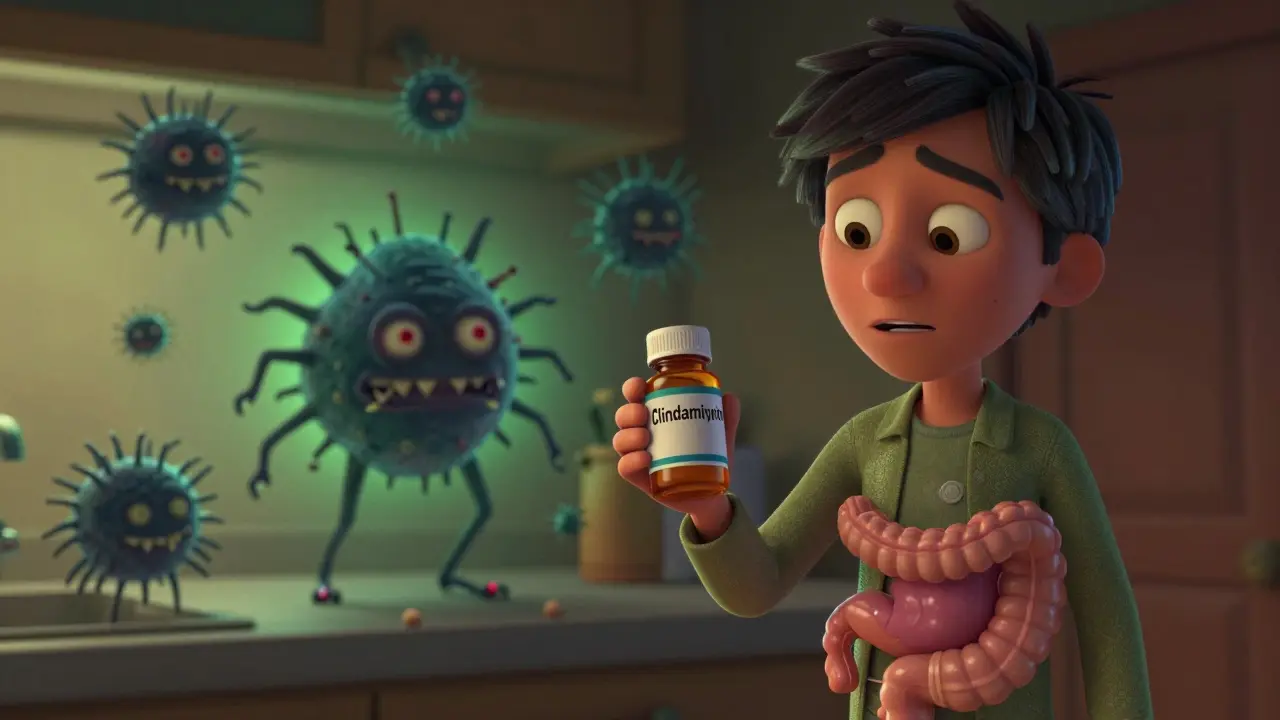
When you take clindamycin for a tooth infection, a skin abscess, or even as a pre-surgery precaution, you’re trusting it to kill the bad bacteria. But what if that same drug is quietly wiping out the good bacteria in your gut - and opening the door to something far more dangerous? Clindamycin is one of the highest-risk antibiotics for triggering a life-threatening gut infection called Clostridioides difficile, or C. diff. And most people don’t realize the danger until it’s too late.
Why Clindamycin Is Different
Not all antibiotics are created equal when it comes to gut damage. Clindamycin doesn’t just target the infection you’re treating - it wipes out a huge chunk of your healthy gut bacteria, especially the ones that normally keep C. diff in check. Studies show it’s up to 10 times more likely than other common antibiotics to cause C. diff infection. In fact, a 2019 analysis of over 150,000 patients found clindamycin carried the highest risk of any antibiotic tested. Even a single dose can be enough.Other antibiotics like doxycycline or minocycline have much lower risks. But clindamycin sticks around in your intestines longer than most - its half-life is 3 to 4 hours - meaning it keeps disrupting your gut flora for days after you take it. That’s why C. diff doesn’t just show up while you’re still on the drug. It often hits 5 to 10 days after you start, or even weeks after you’ve finished the course.
What C. diff Actually Does
C. diff isn’t just bad diarrhea. It’s a toxin-producing bacterium that attacks the lining of your colon. When it takes over, it causes inflammation, ulcers, and sometimes life-threatening swelling. The CDC classifies it as an “urgent threat” because it’s hard to treat, spreads easily, and kills thousands each year in the U.S. alone.Most cases happen in hospitals, but nearly half now start in the community - often after someone takes clindamycin for a dental infection or a mild skin rash. A 2023 CDC report found 13% of community C. diff cases were linked to dental antibiotic prescriptions, and clindamycin was the top culprit. Even if you’ve never been hospitalized, you’re not safe if you’ve taken this drug recently.
When to Worry: The Red Flags
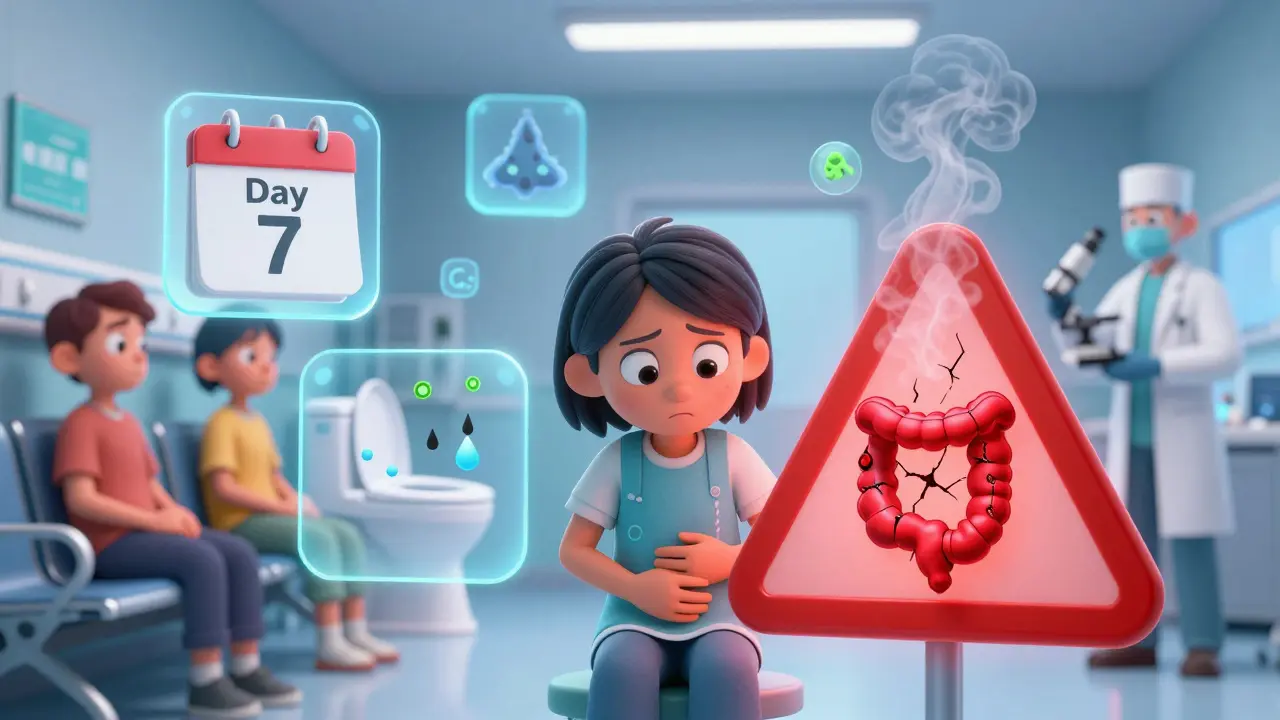
You don’t need to wait for severe symptoms to act. If you’ve taken clindamycin in the last 12 weeks and notice any of these, call your doctor today:- Three or more loose, watery stools in a single day - for two days or more
- Abdominal cramping or pain that’s worse than normal gas
- Fever over 101.3°F (38.5°C)
- Blood or pus in your stool
- Feeling dizzy, extremely tired, or unable to keep fluids down
Some people mistake early symptoms for a “stomach bug” or food poisoning. But if you’ve recently taken clindamycin, this isn’t just a coincidence. The median time from starting the drug to symptoms is 5 to 10 days. But cases have been reported as early as one day after the first dose - or as late as 12 weeks after finishing it.
Who’s at Highest Risk?
Some people are more vulnerable than others. If you’re over 65, have a weakened immune system, have had C. diff before, or have kidney problems, your risk jumps. Even if your symptoms seem mild, don’t wait. For high-risk patients, guidelines now recommend seeking care after just 24 hours of unformed stools - not the usual 48-hour window.And here’s something many don’t know: severe C. diff can hide. In advanced cases, the colon becomes paralyzed (ileus), so you might not have diarrhea at all. Instead, you’ll feel bloated, nauseous, and in severe pain. That’s a medical emergency. Waiting too long can lead to toxic megacolon, bowel perforation, or even death.
What Happens If You Delay
Every hour counts. A 2022 study from the University of Michigan showed patients who waited more than 72 hours before getting help had over twice the chance of needing surgery to remove part of their colon. Their death rate was more than four times higher than those who sought care early.Early diagnosis means faster treatment - usually with specific antibiotics like fidaxomicin or vancomycin, not just any over-the-counter anti-diarrhea pill. And if you’ve had C. diff before, you’re at high risk for it coming back. That’s why specialists now recommend testing immediately when symptoms appear in anyone who’s taken clindamycin recently.

What to Do If You’re Prescribed Clindamycin
You might be told, “It’s the best option for your allergy.” But that’s not always true. Ask your doctor: “Is there another antibiotic with lower risk for C. diff?” For skin infections, trimethoprim-sulfamethoxazole is often just as effective. For dental work, amoxicillin or penicillin are safer choices - unless you’re truly allergic.If clindamycin is your only option, know the signs. Keep a log of your bowel movements. Stay hydrated. Avoid anti-diarrhea meds like loperamide (Imodium) - they can trap toxins in your gut and make things worse.
And if you’ve finished your course? Don’t relax. Watch for symptoms for at least 12 weeks. That’s the window when C. diff can still strike.
The Bigger Picture
C. diff isn’t going away. The CDC estimates nearly half a million cases happen every year in the U.S., and community cases are rising. Outpatient antibiotic use - especially clindamycin for minor infections - is a major driver. In fact, 42% of clindamycin prescriptions in outpatient settings are considered inappropriate, according to the Society for Healthcare Epidemiology of America.New treatments are emerging. In 2023, the FDA approved VOWST, a capsule made of healthy gut bacteria spores, to prevent recurrence. Clinical trials show it cuts recurrence rates by over 70%. But prevention is still better than cure. That means using antibiotics like clindamycin only when absolutely necessary.


Bro, I took clindamycin for a wisdom tooth thing last year and thought my diarrhea was just spicy food. Turns out? C. diff. Spent three days in the ER with IV fluids and a nurse who looked at me like I’d betrayed my own gut. Never again. This doc nailed it - clindamycin isn’t a snack, it’s a grenade with a 12-week fuse.
Just wanted to say thanks for this. I didn’t know clindamycin was that risky. My cousin got sick after a tooth extraction and no one connected the dots. Now I’m telling everyone.
OMG YES 🙌 I’ve been telling my mom for YEARS that antibiotics aren’t candy! She used to take clindamycin for every little skin bump like it was vitamin C. Now she’s got a ‘C. diff alert’ note on her fridge and checks her poop like it’s a weather report 😂 Stay hydrated, stay alert, and never ignore three loose poops in a row - your colon will thank you 💪💩
So let me get this straight - we’re telling people to avoid clindamycin because it’s ‘high risk’… but we still prescribe it like it’s Advil? 🤦♂️ The system’s broken. If a drug has a 10x higher risk than others, it shouldn’t be on the ‘first-line’ list. It should be labeled ‘DANGER: MAY DESTROY YOUR GUT’ in bold red. And yet, dentists still hand it out like party favors. #AntibioticAbuse
LMAO people are acting like this is news. Clindamycin’s been a gut killer since the 70s. You think the FDA doesn’t know? They just don’t care until someone dies in a nursing home and the family sues. Meanwhile, your dentist’s still prescribing it because it’s cheap and he’s on a 3-minute clock. Wake up. This isn’t science - it’s capitalism with a stethoscope.
From India, I’ve seen this happen - my uncle took clindamycin for a small cut, then got diarrhea, thought it was ‘monsoon bug,’ waited too long… ended up in ICU. We didn’t know. No one told us. Please, share this with your family. Especially elders. They don’t read blogs. They trust the doctor. But doctors don’t always know.
It’s funny… we fear AI taking over, but we let antibiotics quietly dismantle our microbiomes like silent assassins. We live in a world where we can map the human genome but still don’t understand that our gut is a sacred ecosystem. Clindamycin doesn’t just kill bacteria - it kills balance. And balance… is the only thing that keeps us human.
took it for a pimple once. got diarrhea. thought i was just stressed. turned out it was c diff. i didn’t even know what that was. now i just say no to antibiotics unless i’m literally dying. also, drink more water. it’s weirdly life-changing.
AMERICA IS BEING POISONED BY BIG PHARMA AND DENTISTS WHO THINK THEY’RE DOCTORS 😭 CLINDAMYCIN IS A WAR CRIME FOR YOUR GUT. WHY DO WE LET THIS HAPPEN? WE HAVE AFRICAN VIOLETS THAT SURVIVE BETTER THAN OUR GUTS. STOP PRESCRIBING THIS LIKE IT’S A COFFEE SHOT. #CLINDAMYCINISNOTAFREEBIE
Clindamycin’s high C. diff risk is well-documented in IDSA guidelines, 2021 update, page 147. The mechanism involves suppression of Bacteroides and Firmicutes, allowing toxigenic C. difficile to proliferate via toxin A/B-mediated epithelial damage. If you’re not using stool PCR within 24 hours of symptom onset in a recent antibiotic user, you’re practicing outdated medicine. This isn’t anecdotal - it’s microbiology 101.
Why are people so dramatic? It’s just diarrhea. My grandma had it after antibiotics and she said, ‘It’s just my guts being dramatic.’ She lived to 92. Stop fearmongering. Maybe we just need to chill and let our bodies handle it.
Actually, the 2019 meta-analysis you cited? It included only inpatient data. Community-acquired C. diff from clindamycin is less than 1% of cases. The real danger is overtesting - we’re turning every loose stool into a pandemic. Fidaxomicin costs $3,000 a course. Vancomycin is $50. Why are we pushing expensive options when the body usually clears it? This post is fear-driven pseudoscience dressed as public health.
I just want to say - thank you for writing this with so much heart. My sister got C. diff after a root canal and we had no idea. She was in the hospital for two weeks. We didn’t even know clindamycin was the culprit until a nurse asked, ‘Has she taken any antibiotics recently?’ I wish I’d known this six months ago. Please keep sharing stuff like this. People need to hear it.
the dentist gave me clindamycin for a gum boil… i didn’t think twice. then i spent 3 days on the toilet wondering if i was dying. turns out i was. now i ask ‘is this really necessary?’ before every antibiotic. also… stop using imodium. it’s like locking the door while the house is on fire.
I’m a nurse and I see this every single week. A patient comes in with diarrhea, fever, abdominal pain - and they say, ‘I just had a tooth pulled.’ Then we ask about antibiotics - and boom. Clindamycin. Always clindamycin. I wish every patient got a printed handout when they picked it up. Not just a prescription. Something that says, ‘This could hurt your gut. Watch for these signs.’ We treat the infection, but we forget to warn about the collateral damage. Please, if you’re reading this - share it with your dentist. They need to know too.