C. diff Risk Calculator
Calculate Your C. diff Risk
Answer a few simple questions to determine your risk of developing C. diff infection after antibiotic treatment.
When you take an antibiotic, you expect it to kill the bad bacteria making you sick. But what you might not realize is that it’s also wiping out the good bacteria in your gut-bacteria that help keep digestion running smoothly. For some people, this disruption leads to diarrhea. For others, it opens the door to something far more dangerous: Clostridioides difficile infection, or C. diff.
C. diff doesn’t just cause loose stools. It can trigger severe abdominal pain, fever, dehydration, and even life-threatening colon damage. It’s not rare. In the U.S. alone, over 500,000 cases happen every year, and nearly 30,000 people die within 30 days of diagnosis. The good news? Most cases are preventable-and if caught early, treatable.
What Exactly Is C. diff?
C. diff is a spore-forming bacterium that lives in the environment and can survive for months on surfaces like doorknobs, bed rails, and toilets. It’s harmless to most people-until antibiotics upset the balance of your gut microbiome. Once your normal gut bacteria are wiped out, C. diff takes over, producing toxins that attack the lining of your colon. That’s when symptoms start.
The classic signs are watery diarrhea (three or more times a day), cramping, fever, nausea, and loss of appetite. In severe cases, you might see blood in your stool, rapid heart rate, or swelling in your abdomen. The worst cases can lead to toxic megacolon-a medical emergency where the colon becomes dangerously distended.
What makes C. diff tricky is that it doesn’t always show up in early tests. Doctors often mistake it for a virus or food poisoning, especially if the patient hasn’t recently taken antibiotics. That’s why accurate diagnosis matters-and why knowing your risk factors is key.
Who’s at Risk?
Not everyone who takes antibiotics gets C. diff. But certain people are far more vulnerable:
- People over 65
- Those who’ve been hospitalized for more than 72 hours
- Patients on long-term or broad-spectrum antibiotics
- People with weakened immune systems
- Those who’ve had previous C. diff infections
Some antibiotics are riskier than others. Fluoroquinolones (like ciprofloxacin), clindamycin, and third- or fourth-generation cephalosporins (like ceftriaxone) are the biggest culprits. Even a short course-just a few days-can be enough to trigger it.
And it’s not just hospitals. Community-acquired C. diff is rising. More people are getting infected after taking antibiotics at their doctor’s office or pharmacy, without ever stepping into a hospital. That’s why prevention needs to start before the first pill is swallowed.
How Is It Diagnosed?
There’s no single perfect test. Doctors usually start with a stool sample to check for C. diff toxins. Most labs use a two-step process: first, a quick screen for a bacterial enzyme called GDH, then a toxin test (EIA) or a more sensitive DNA test (NAAT). But even these aren’t foolproof. Some people carry C. diff without symptoms, so finding the bacteria doesn’t always mean it’s causing the problem.
Important note: If you’ve taken a laxative in the last 48 hours, your stool sample won’t be valid. That’s because laxatives flush out toxins before they can be detected. Always tell your doctor what medications you’ve taken recently.
And don’t be surprised if your doctor holds off on testing right away. Many cases of antibiotic-associated diarrhea aren’t C. diff. In fact, up to two-thirds of these cases are caused by something else-like a virus, food intolerance, or the antibiotic itself irritating the gut. That’s why doctors often wait to see if symptoms improve after stopping the antibiotic before ordering a test.
What’s the Best Treatment?
Treatment depends on how severe your infection is-and whether it’s your first time or a recurrence.
First-time, non-severe infection: The go-to choices are oral vancomycin or fidaxomicin. Vancomycin is cheaper, around $1,650 for a full course. Fidaxomicin costs over $3,300, but it’s better at preventing relapse. Studies show only 13% of people on fidaxomicin get C. diff again, compared to 22% on vancomycin.
Metronidazole used to be the standard. But it’s no longer first-line. Failure rates have jumped from under 15% to over 30% in recent years. The CDC now calls it a second-choice option, only used if the others aren’t available.
Severe infection: If your white blood cell count is above 15,000 or your creatinine is elevated, you’re in the severe category. Vancomycin or fidaxomicin are still first-line-but sometimes, doctors add intravenous metronidazole. In the worst cases, where the colon is paralyzed (ileus), rectal vancomycin may be given directly into the colon.
And here’s something many don’t know: don’t take anti-diarrhea meds like loperamide (Imodium). They may seem helpful, but they trap the toxins inside your colon, making things worse. Let your body flush it out.
What If It Comes Back?
One in five people get C. diff again after treatment. For a second recurrence, doctors often use a tapered vancomycin regimen: high doses for 10-14 days, then slowly reducing over weeks. This gives your gut time to rebuild its natural defenses.
Another option is fidaxomicin followed by rifaximin, an antibiotic that works only in the gut and doesn’t disrupt the rest of your microbiome.
But the most effective treatment for multiple recurrences? Fecal microbiota transplantation, or FMT. This isn’t science fiction-it’s FDA-approved. Doctors transfer healthy donor stool (processed into a capsule or liquid) into your colon. It’s like rebooting your gut with the right bacteria. Success rates? 85-90%. One patient on a health forum wrote: “After seven recurrences over 18 months, one FMT cleared it permanently.”
In April 2023, the FDA approved a new option: Vowst, a pill containing bacterial spores from donor stool. It’s easier to take than a colonoscopy or enema, and just as effective.
Can You Prevent It?
Yes. And prevention starts with antibiotics themselves.
More than half of antibiotic prescriptions in hospitals are unnecessary or wrong. That’s why antibiotic stewardship programs-where doctors review every prescription-are now standard in most U.S. hospitals. Hospitals with these programs have cut C. diff rates by 26% since 2011.
At home, you can help by:
- Asking your doctor: “Is this antibiotic really needed?”
- Never sharing or saving antibiotics for later
- Finishing your full course unless your doctor says otherwise
- Choosing narrow-spectrum antibiotics when possible
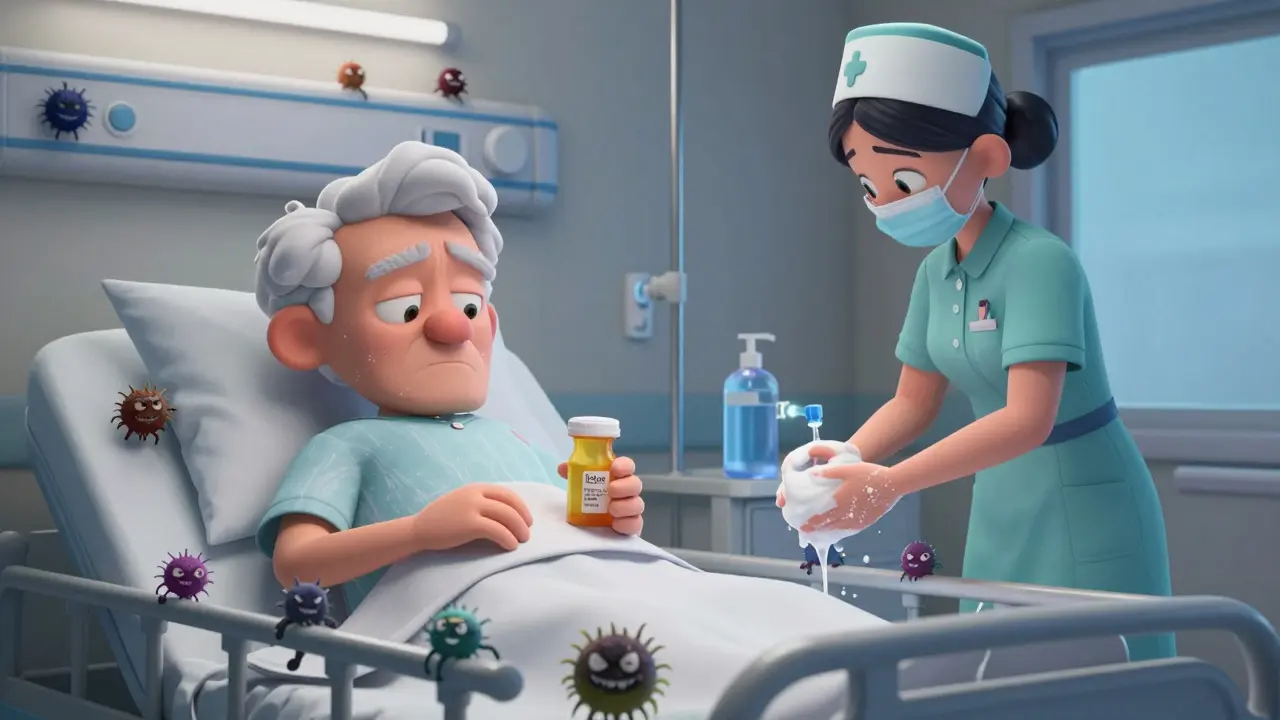
Hand hygiene is also critical. Alcohol-based hand sanitizers don’t kill C. diff spores. Only soap and water do. If you’re in a hospital or visiting someone who is, wash your hands thoroughly before and after touching surfaces.
Environmental cleaning matters too. Hospitals use special disinfectants (EPA List K) that actually kill spores. Regular cleaners? Useless.
What about probiotics? You’ve probably heard they help. Some studies suggest Saccharomyces boulardii or Lactobacillus rhamnosus GG may reduce risk by up to 60%. But the IDSA guidelines don’t recommend them routinely-evidence is still mixed. If you want to try one, talk to your doctor first. Not all probiotics are equal.
What About New Treatments?
The field is changing fast. Bezlotoxumab (Zinplava), a monoclonal antibody, was approved in 2016 to prevent recurrence. It’s given as a single IV infusion alongside antibiotics and cuts recurrence risk by 10%. But it’s expensive and only used for high-risk patients.
New antibiotics like ridinilazole are in late-stage trials. In a major 2022 study, ridinilazole outperformed vancomycin in sustaining recovery-45% vs. 30%. It’s designed to target C. diff while sparing other good bacteria.
And researchers are now looking at strain typing-identifying which C. diff variant you have-to personalize treatment. Some strains are more aggressive. Knowing that could help doctors choose the right drug from the start.
What Recovery Really Feels Like
Diarrhea might stop in a few days. But recovery isn’t over.
Patients report lingering fatigue for weeks. About 45% say they feel “brain fog”-trouble concentrating, memory lapses. That’s likely from inflammation and lingering toxins. Many avoid dairy, spicy foods, or caffeine for months. One patient said: “I thought I was healed when the diarrhea stopped. I didn’t realize my gut was still healing.”
Recovery isn’t just physical. The emotional toll is real. People feel anxious about going out, afraid of sudden accidents. Some avoid hospitals altogether-even for necessary care-because they’re terrified of getting C. diff again.
That’s why follow-up care matters. Your doctor should check in after treatment, even if you feel fine. And if symptoms return, don’t wait. Test again. Recurrence can happen quickly.
Final Thoughts
C. diff isn’t just a hospital problem. It’s a consequence of how we use antibiotics-and how we think about gut health. Every time we reach for an antibiotic, we’re making a choice that affects not just our own microbiome, but the wider community.
The tools to prevent and treat it are better than ever. But they only work if we use them wisely. Ask questions. Wash your hands. Don’t take antibiotics unless you need them. And if you’ve had C. diff before, know your options: FMT, Vowst, bezlotoxumab-they’re not last resorts. They’re lifelines.
Because in the end, the health of your gut isn’t just about digestion. It’s about your whole body-and your future.

Just had my third C. diff episode last year after a simple sinus antibiotic. I didn’t even think it could happen outside the hospital. Now I carry hand sanitizer AND soap everywhere. Also, I swear by Saccharomyces boulardii-started it the day I began antibiotics and haven’t had a recurrence since. Not saying it works for everyone, but it’s cheap and gentle.
Also, please stop taking Imodium. I did that once and ended up in the ER with a distended belly. Not fun.
Ugh. People still don’t get it. Antibiotics are not candy. You don’t need them for a cold, a sore throat that’s probably viral, or ‘just in case.’ My sister got C. diff after a dentist gave her amoxicillin for a toothache that didn’t even need it. And now she’s on a 12-week vancomycin taper. It’s not a ‘side effect’-it’s a direct result of lazy medicine.
Doctors need to stop prescribing like they’re handing out lollipops. And patients? Stop demanding them. Stop. It.
So let me get this straight-we have a pill now that’s basically poop in a capsule and it’s FDA-approved? And we’re treating it like it’s magic? I mean… cool? But also… wow. We’ve really come to this? I’m just glad I’m not the only one who thinks we’ve lost our minds.
Also, yes, wash your hands. Soap. Water. Not sanitizer. I’m not surprised it took us this long to figure that out.
I had C. diff after a 5-day course of clindamycin. I thought I was just ‘getting over the flu’ until I was literally crying on the toilet at 3 a.m. with cramps that felt like someone was twisting my insides.
My doctor didn’t test me until day 4. If I hadn’t pushed? I might’ve missed it. Please, if you’re on antibiotics and feel off-don’t wait. Ask for the stool test. Even if you think it’s ‘just diarrhea.’
Also, Vowst sounds wild but I’d take a pill over a colonoscopy any day. I’m just glad we’re getting better at this.
Let’s be real: C. diff is the price we pay for modern medicine. We’re killing our microbiomes with antibiotics, then acting shocked when they rebel.
But here’s the thing-most people don’t know that probiotics aren’t a cure-all. Some brands are useless. The ones with live cultures and clinical backing? Those matter. And yes, FMT sounds gross, but if it saves you from six recurrences, you’ll eat a spoonful of donor poop if you have to.
Stop treating your gut like a black box. It’s your second brain. Treat it like one.
There’s a fundamental flaw in the entire paradigm. We treat infection as an enemy to be eradicated, not as a symptom of systemic imbalance. Antibiotics are a blunt instrument in a world that requires a scalpel. The rise of C. diff isn’t accidental-it’s predictable. We’ve been engineering a dysbiotic society for decades.
The microbiome isn’t a collection of ‘good’ and ‘bad’ bacteria-it’s an ecosystem. When you blast it with broad-spectrum drugs, you don’t just kill pathogens-you collapse trophic levels. The spores survive because they’re adapted to chaos. And we’re shocked when the ecosystem turns hostile?
Meanwhile, we’re spending billions on monoclonal antibodies and fecal transplants while ignoring root causes: overprescribing, poor diet, chronic stress, and the myth that ‘cleanliness’ equals health.
Stop treating symptoms. Start treating context.
As someone who’s been on both sides of this-patient and healthcare provider-I can tell you this: antibiotic stewardship works. In our hospital, we cut C. diff rates by 31% in two years by requiring pre-authorization for fluoroquinolones and clindamycin. No more ‘just in case’ prescriptions.
And yes, handwashing with soap? Non-negotiable. I’ve seen nurses use sanitizer after touching a toilet handle and then touch a patient’s IV line. It’s terrifying.
Also, don’t let anyone tell you that probiotics are a scam. I’ve seen patients recover faster with S. boulardii-especially when paired with a low-FODMAP diet during recovery. It’s not magic, but it’s science.
And if you’ve had C. diff before? Talk to your doctor about bezlotoxumab. It’s not just for ‘high-risk’ people-it’s for anyone who’s been through it once. Prevention > treatment.
Finally: no, you don’t need antibiotics for a sinus infection unless you’ve got fever, purulent drainage, and symptoms lasting over 10 days. And yes, I’ve written that on 87 prescriptions this month. Please believe me.
Enough with the ‘gut health’ nonsense. We’re not living in a yoga retreat. Antibiotics save lives. If you get C. diff, that’s your fault for being weak. I’ve taken 17 courses of antibiotics in my life and never had a problem. You people are just too sensitive.
And FMT? That’s not medicine-that’s a horror movie. We’re Americans. We don’t transplant poop. We fix things with science, not ancient tribal rituals.
Also, why is everyone so scared of hospitals? You think your grandma’s going to catch C. diff from a doorknob? Get a grip. Wash your hands, stop complaining, and stop blaming doctors.
Stop coddling your microbiome. It’s not your best friend. It’s bacteria. And if it dies? Good. You’re stronger now.