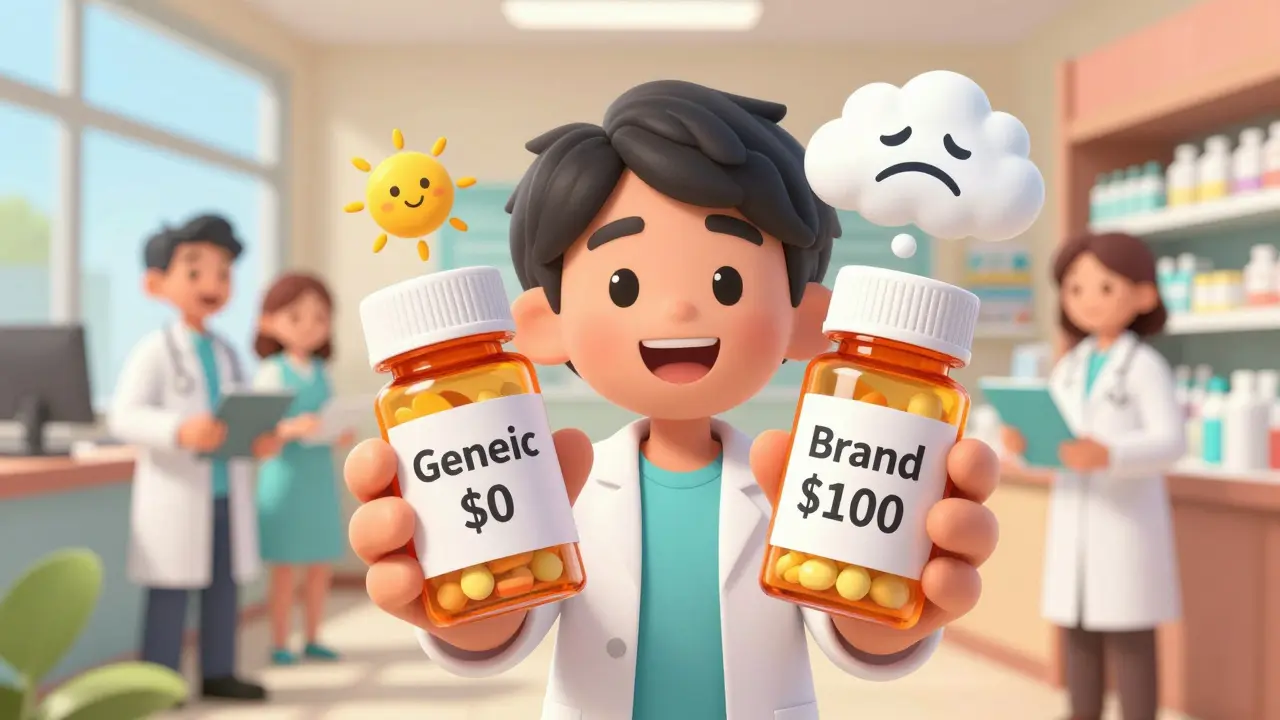
If you’re paying for prescriptions in 2024, you’ve probably noticed a big difference between what you pay for a generic pill versus a brand-name one. That gap isn’t random-it’s built into how health insurance works in the U.S. And understanding it can save you hundreds, even thousands, a year.
What’s the real cost difference?
For most people on Medicare Part D or commercial insurance, generic drugs cost way less than brand-name ones. In 2024, the average copay for a preferred generic was between $0 and $4.50. Some plans even had $0 copays. That’s right-zero. You walk into the pharmacy, hand over your card, and walk out with your monthly supply of metformin or lisinopril with no extra charge. Now compare that to brand-name drugs. The median copay for a preferred brand was $47. For non-preferred brands? It jumped to $100. That’s more than 20 times what you’d pay for the generic version. And if your drug isn’t on your plan’s preferred list? You could end up paying even more-sometimes 30% to 50% of the full drug price as coinsurance.Why does this gap exist?
It’s not about quality. Generics have the same active ingredients, same dosages, same safety profile as brand-name drugs. The difference? Money. Brand-name drugmakers spent years and millions developing their product. Once the patent expires, other companies can make the same drug for a fraction of the cost. That’s why generics are cheaper. Insurance companies reward you for choosing them by putting generics on the lowest cost tier. But here’s the catch: not all generics are treated the same. Some plans split them into two tiers:- Tier 1: Preferred generic - usually $0 to $5
- Tier 2: Non-preferred generic - $5 to $10
Medicare Advantage vs. Standalone Drug Plans
If you’re on Medicare, your plan type changes how you pay. About half of Medicare beneficiaries are in Medicare Advantage Prescription Drug (MA-PD) plans. The other half are in standalone Part D plans. MA-PD plans mostly use fixed copays. That means you know exactly what you’ll pay: $47 for a brand, $5 for a generic. Predictable. Simple. Standalone Part D plans? They often use coinsurance instead. That means you pay a percentage of the drug’s total price. For a $200 brand-name drug, 22% coinsurance equals $44. For a $500 drug? That’s $110. No cap. No warning. Just a bill based on what the drug costs that day. And if you’re on a PDP with coinsurance and take a high-cost brand? Your out-of-pocket can spike fast. One user on Reddit said they paid $180 for a single 30-day supply of a brand-name medication because their plan charged 36% coinsurance. The generic version? $6.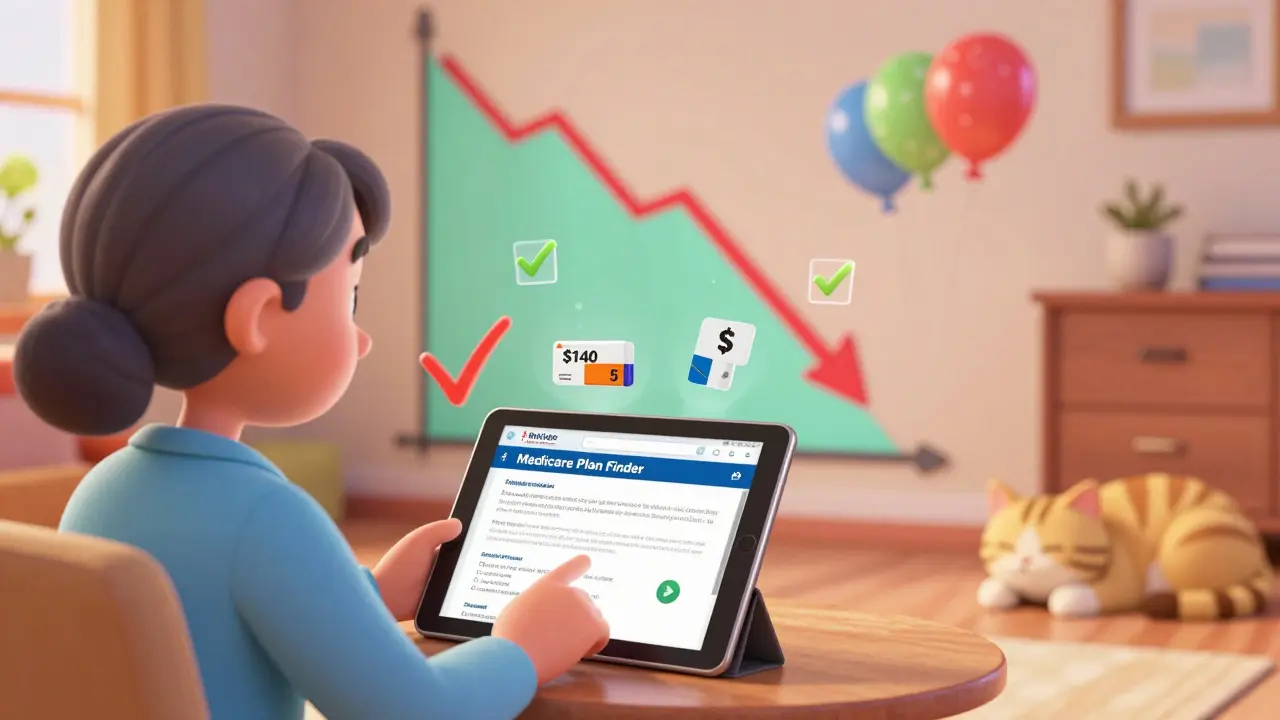
The ‘Member Pay the Difference’ Trap
Some commercial plans-especially bronze or silver-level ones-have a sneaky rule: “Member Pay the Difference.” Here’s how it works: Your doctor prescribes Lipitor. But your plan says the generic atorvastatin is just as good. If you still want the brand, you pay your normal copay PLUS the difference in price between the brand and the generic. So if Lipitor costs $120 and atorvastatin costs $10, you pay your $30 copay + $110 difference = $140. Even if your doctor wrote “dispense as written,” the plan still charges you extra. This isn’t rare. In 2024, over 60% of commercial plans in Texas and Illinois used this policy. And most people don’t realize it until they get their receipt.What about specialty drugs?
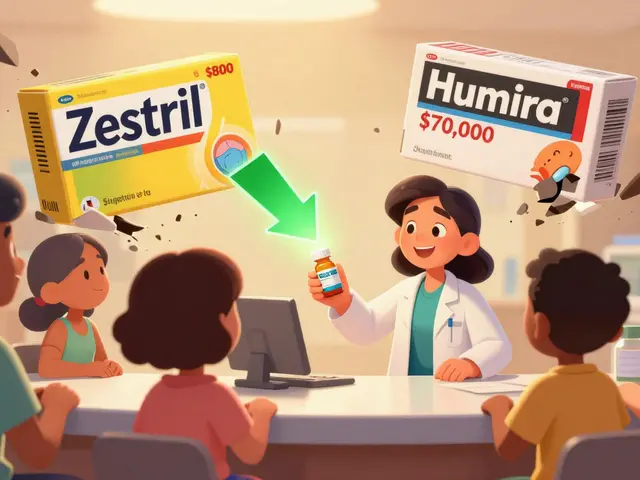
If you’re on a drug for cancer, MS, or rheumatoid arthritis, you’re probably in Tier 5-the specialty tier. These drugs aren’t just expensive. They’re designed to break the bank. Copays here can be $150 or more per month. Or you pay 33% coinsurance-up to $5,000 in a year. After that, you pay 15%. That’s not a copay. That’s a financial burden. And here’s the kicker: even though specialty drugs make up less than 2% of prescriptions, they account for nearly half of all drug spending in Medicare Part D. That’s why insurers push hard to get you on a generic alternative-if one exists.How to save money
You don’t have to just accept these prices. Here’s what actually works:- Check your plan’s formulary-every year, by October 15. Your plan must publish it. Look up your exact meds. Not just the name-check the dosage and manufacturer.
- Ask for therapeutic alternatives-72% of Medicare plans have a cheaper generic that works just as well. Your doctor might not know. Ask: “Is there another drug on Tier 1 that treats the same thing?”
- Use the Medicare Plan Finder-it’s updated daily. Enter your drugs, zip code, and pharmacy. It shows you exactly what you’ll pay across all plans.
- Compare annual costs, not monthly-a plan with $0 generics and $100 brand copays might cost $1,200 a year for your brand med. Another plan with $5 generics and $40 brand copays might cost only $480. The cheaper monthly premium doesn’t always mean cheaper overall.
- Consider cash prices-sometimes, paying cash at Walmart or Costco is cheaper than your copay. Use GoodRx or SingleCare to compare. For some generics, cash is under $5. Your copay might be $10.

What’s changing in 2025?
The Inflation Reduction Act is changing everything. Starting January 1, 2025, there’s a $2,000 annual out-of-pocket cap for all Medicare Part D enrollees. That means no matter how many expensive brand drugs you take, you won’t pay more than $2,000 total in a year. Also, 98% of 2025 Medicare plans will offer $0 preferred generic copays. That’s up from 87% in 2024. The cap on insulin-already $35 per month-is now permanent. And the government is cracking down on those “tying arrangements” that inflate generic prices. But here’s the reality: even with these changes, brand-name drugs will still cost more than generics. The system is still designed to push you toward cheaper options. And if you’re on a commercial plan without the $2,000 cap? You’re still on your own.Real stories, real savings
One woman in Florida paid $95 a month for a brand-name blood pressure med. Her doctor refused to switch her-she’d had side effects with the generic. She used the Medicare Plan Finder, found a plan with a $45 brand copay and $0 generics. She switched. Saved $600 a year. Another man in Ohio took three brand-name drugs. His copays added up to $310 a month. He asked his pharmacist about alternatives. Two of them had generics on Tier 1. He switched. His monthly cost dropped to $75. And then there’s the guy who didn’t know about “Member Pay the Difference.” He paid $140 for his brand-name statin. Later, he found out the generic cost $12. He switched. He got a refund for the overcharge.Bottom line
Generic copays are low because they’re meant to be the default. Brand copays are high because they’re meant to be the exception. The system isn’t broken-it’s working exactly as designed. But you don’t have to be the one paying the price. If you take regular prescriptions, spend 20 minutes this week checking your plan’s formulary. Compare your current drug costs to what you’d pay with a generic alternative. You might be surprised how much you’re overpaying. The money isn’t hidden. It’s just buried in fine print. Dig it out.Why are generic drug copays so much lower than brand-name copays?
Generics cost less because they don’t include the research, development, and marketing expenses that brand-name drugmakers charge. Once a patent expires, other manufacturers can produce the same active ingredient at a fraction of the cost. Insurance plans reward this savings by placing generics on lower-cost tiers, often with $0 to $5 copays, to encourage patients to choose them over more expensive brands.
Can I be charged more for a brand-name drug even if my doctor says ‘dispense as written’?
Yes. Some insurance plans, especially commercial ones, use a policy called “Member Pay the Difference.” Even if your doctor writes “dispense as written,” you’ll still pay your normal copay plus the full price difference between the brand and the generic. For example, if your brand drug costs $120 and the generic is $10, you pay your copay (say $30) plus $110. The prescription label doesn’t override the plan’s cost-sharing rules.
Do Medicare Advantage plans have lower copays than standalone Part D plans?
Generally, yes. Medicare Advantage Prescription Drug (MA-PD) plans mostly use fixed copays-so you know exactly what you’ll pay. Standalone Part D plans often use coinsurance, meaning you pay a percentage of the drug’s price. That can be unpredictable. For example, a $500 brand drug with 47% coinsurance costs $235, while a fixed $100 copay is easier to budget for.
Is there a cap on how much I’ll pay for prescriptions in 2025?
Yes. Starting January 1, 2025, Medicare Part D enrollees will have a $2,000 annual out-of-pocket cap on prescription drug costs. This applies to all drugs-generic or brand. Once you hit that limit, your plan covers 100% of the rest for the year. This is a major change from 2024, when there was no cap.
Should I switch to a generic drug even if my doctor prescribed the brand?
Ask your doctor first. Most generics work just as well as brand-name drugs. But if you’ve had side effects or poor results with the generic, tell your doctor. They can check if there’s another generic on a lower tier, or if your plan allows a medical exception. Don’t assume the brand is better-ask for alternatives. In 2024, 72% of Medicare plans had a cheaper generic alternative for at least 80% of commonly prescribed brand drugs.

Okay but like… why do we still act like this is normal? I paid $12 for a generic blood pressure pill last week and cried in the parking lot. Not because I’m weak-I’m just exhausted. They call it ‘affordable care’ like it’s a spa day. Meanwhile, my grandma’s insulin costs less than my coffee subscription. The system isn’t broken-it’s *designed* to make you feel guilty for needing medicine.
Generics are chemically identical to brand names. This is not opinion. This is chemistry. The FDA requires bioequivalence. If your doctor says otherwise they're either misinformed or being paid by pharma. Stop letting marketing dictate your health decisions.
OMG I JUST REALIZED I WAS PAYING $15 FOR MY CHOLESTEROL MED WHEN I COULD’VE PAID $3?? 😭 I’M SWITCHING TOMORROW. ALSO WHO TOLD YOU ABOUT GOODRX?? YOU’RE A LIFE SAVER. I’M CRYING IN MY KITCHEN RIGHT NOW.
Let me just say-this whole system is a grotesque farce. A pharmaceutical cartel, propped up by lobbyists, selling you the same molecule for 100x the price because they own your insurance plan’s formulary. And the worst part? You’re supposed to be grateful you’re not paying $500. That’s not healthcare. That’s psychological warfare with a pharmacy receipt.
My cousin got charged $200 for a brand name because his plan said 'member pay the difference' and he didn't even know that was a thing until the bill came. He's a teacher. He doesn't have a finance degree. This isn't about choice. It's about trapping people in debt. And nobody talks about it because the people who profit are the ones writing the rules.
Have you ever considered that the entire pharmaceutical industry is a front for shadowy global entities that control not just drug pricing but also the FDA, CMS, and even your local pharmacist? The 'generic' you buy? It's probably made in a factory in China that’s owned by a Cayman Islands shell corporation that’s funded by hedge funds who also own your insurance company. The 'difference' between brand and generic isn't cost-it's a distraction. They want you to think you're saving money by choosing the cheaper pill while they quietly raise the price of everything else-your premiums, your deductibles, your co-insurance tiers. And the 2025 cap? That's just a PR stunt to keep you from rioting. They'll just shift the cost to your premiums next year. You're not getting a win-you're getting a slower bleed.
Thank you for this comprehensive and meticulously researched breakdown. The data on tiered formularies and the 'Member Pay the Difference' policy is particularly illuminating. I would only add that pharmacists are often underutilized as clinical resources-many are trained to identify therapeutic alternatives and can advocate for prior authorizations or exceptions on behalf of patients. A simple conversation with your pharmacist may reveal savings not visible on your insurer’s website.
Wow. So the government is going to cap your out-of-pocket at $2K? That’s cute. Meanwhile, the same people who wrote that law also gave Big Pharma 12 years of exclusivity for every new drug. You think they’re going to stop charging $100K for a cancer drug just because you get a cap? Nah. They’ll just make you pay $10K in premiums instead. This isn’t reform. It’s a magic trick where the money disappears into a black hole called ‘pharma profits’.
Thank you for sharing these real stories. I’ve seen patients cry over $5 copays. It’s not about the money-it’s about the shame. They feel like burdens. Like they’re asking too much. But you’re not asking too much. You’re asking for the right to live. This system should be ashamed. Not you.
It is imperative that individuals take proactive steps to understand their formularies and consult with both their physicians and pharmacists regarding therapeutic alternatives. The financial burden of prescription medications is a systemic issue, yet personal agency-through informed decision-making and utilization of available tools such as the Medicare Plan Finder-can yield substantial savings. I commend the author for emphasizing practical, actionable strategies rather than mere critique.