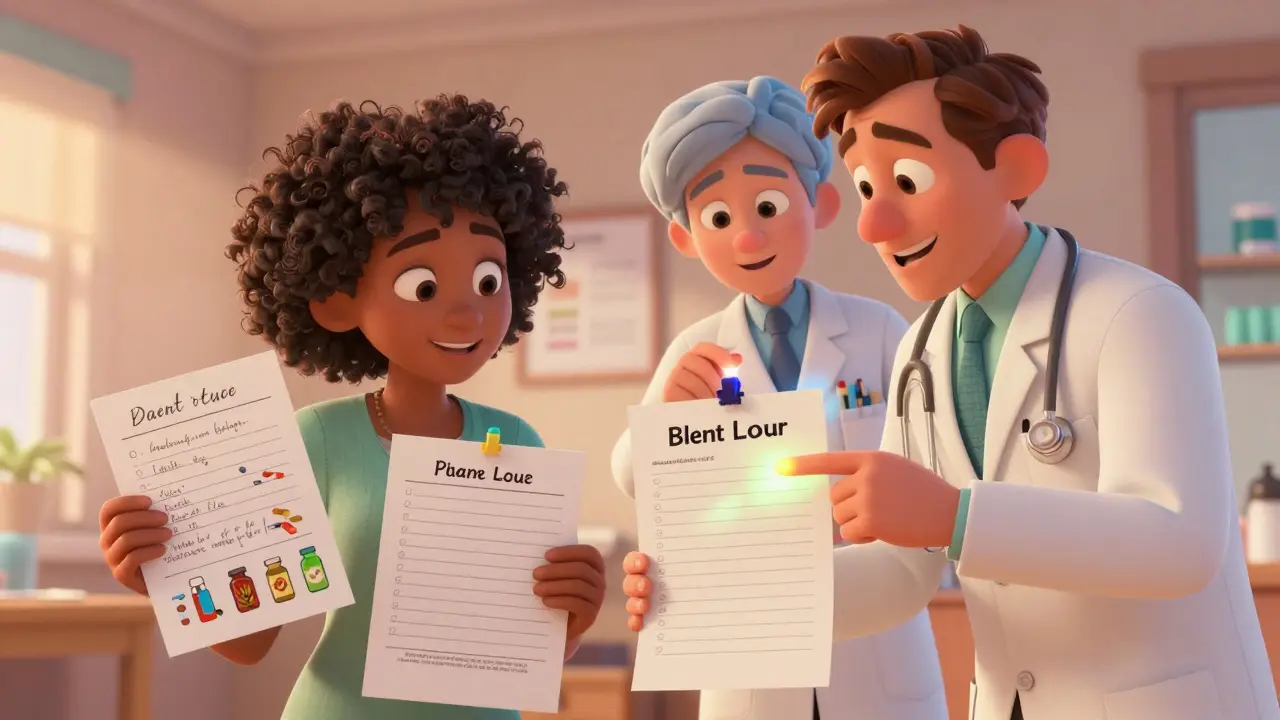
When you leave the hospital, your body is still healing. But the real danger might not be your condition-it’s the medications you’re sent home with. Too often, patients get home with a new list of pills, some old ones gone, and no clear explanation of what changed. This is where medication reconciliation comes in-not as a paperwork chore, but as a life-saving step.
Medication reconciliation is the process of comparing what you were taking before you went into the hospital with what you’re being sent home with. It’s meant to catch mistakes: a drug that was stopped and never restarted, a duplicate prescription, a dosage that’s too high, or worse-dangerous interactions between new and old meds. According to the Agency for Healthcare Research and Quality, doing this right can cut adverse drug events by 30% to 50%. That’s not a small number. It’s the difference between going home to recover and ending up back in the hospital.
Why Discharge Medication Lists Often Go Wrong
It sounds simple: just check your old meds against the new ones. But in practice, it’s messy. Studies show that 42.7% of discharge errors are due to medications that were taken at home but never listed on the discharge order. Another 24.6% involve new drugs added in the hospital that weren’t properly documented. And 11.8% of cases have the wrong frequency-like taking a pill twice a day instead of once.
The biggest source of confusion? Patient self-reporting. When asked what meds they take, people forget. They don’t mention their daily aspirin, their fish oil, or the herbal tea their aunt swore by. One study found that patient-reported lists had a 42.1% error rate. Compare that to the discharge summary, which only had a 17.3% error rate. That’s why the hospital’s own records matter more than what you think you remember.
And it gets worse for people on multiple drugs. Nearly 30% of U.S. adults take five or more medications. Each one adds another chance for a bad interaction. Anticoagulants like warfarin are especially risky. If they’re stopped during hospitalization for surgery and not restarted, the risk of a blood clot-like a pulmonary embolism-goes up sharply. One Reddit user shared a case where warfarin was stopped before an operation and forgotten at discharge. The patient was readmitted within days with a life-threatening clot.
What Happens at Discharge (And What Doesn’t)
Hospitals are supposed to do medication reconciliation before you leave. But time is tight. The ASHP MATCH Toolkit says it should take 15 to 20 minutes per patient to do it right. Yet most hospitals only give staff about 7 minutes. That’s not enough to talk through every pill, check for interactions, or make sure you understand why something changed.
And who’s supposed to do it? In many places, it’s the pharmacist. But not all hospitals have pharmacists on discharge teams. Some rely on nurses who are juggling three units. Others leave it to doctors rushing to sign papers. The result? Reconciliation is skipped, rushed, or done with outdated info.
Even when the list is correct, communication fails. Only 58% of Medicare patients recall getting clear instructions about their meds at discharge. And for those on four or more drugs? That number drops to just 38%. If you don’t understand why you’re taking something, you’re more likely to skip it-or take too much.
How to Reconcile Your Own Medications After Leaving the Hospital
You can’t wait for the hospital to get it right. You need to take charge. Here’s how to do it yourself:
- Get the official discharge medication list in writing. Don’t rely on verbal instructions. Ask for a printed copy or a PDF emailed to you. Make sure it’s signed and dated.
- Bring your own list-the one you kept at home. Include every prescription, over-the-counter pill, vitamin, supplement, and herbal product. If you don’t have one, write it down now. Don’t guess. Look in your medicine cabinet. Check your pill organizer. Call your pharmacy if needed.
- Compare side by side. Use a pen and paper. Highlight every change: what was added, removed, or changed in dose. If something is missing from the hospital list but you’ve been taking it for years, flag it. If something new shows up with no explanation, ask why.
- Ask three key questions for every medication:
- Why am I taking this? (Purpose)
- How and when do I take it? (Dose, timing, with/without food)
- What should I watch out for? (Side effects, warning signs like dizziness, bleeding, rash)
- Call your primary doctor within 48 hours. Don’t wait for your next appointment. Call and say, “I was just discharged and need to go over my meds.” Send them your list. Ask if they agree with the hospital’s changes.
- Talk to your pharmacist. Most pharmacies offer free med reviews. Bring all your bottles. Ask if any new drugs interact with your old ones. Ask about food interactions-like grapefruit with statins or spinach with warfarin.
- Use a pill organizer for the first week. Put meds in labeled compartments. It’s harder to miss a dose or double up when you can see it.
Red Flags That Mean You’re at Risk
Some situations make medication errors more likely. If any of these apply to you, double-check everything:
- You were in the ICU. Patients who spend time in intensive care are 2.3 times more likely to have meds discontinued and never restarted.
- You take more than four medications. The more you take, the higher the chance of a bad interaction.
- You’re over 65. Older adults metabolize drugs differently and are more sensitive to side effects.
- You have kidney or liver disease. These organs process meds. If they’re not working well, drugs can build up to toxic levels.
- You’re taking anticoagulants, diabetes meds, or heart drugs. These have narrow safety margins. A small mistake can be dangerous.
What’s Changing in 2026
There’s progress, but it’s slow. Starting January 1, 2024, hospitals in the U.S. are required to share your discharge medication list electronically with your primary care provider within 24 hours using a new digital standard called FHIR. This means your doctor should get your updated list automatically-no faxing, no waiting.
Some hospitals are now using AI tools to scan discharge summaries and flag missing meds or potential interactions. One system at Mayo Clinic catches 94% of omissions. But experts warn: tech can’t replace talking to the patient. A computer can’t know if you stopped taking your blood pressure pill because it made you dizzy.
Pharmacist follow-up calls at 48 hours and 7 days after discharge are being tested in 15 hospitals. Early results show an 18.7% drop in emergency visits for medication issues. If this works, it could become standard.
What to Do If Something Feels Off
Don’t wait. If you feel weird after starting a new med-dizzy, nauseous, bruising easily, or confused-call your doctor or pharmacist immediately. Don’t assume it’s “just part of healing.”
If your discharge list doesn’t match what you were taking before, ask: “Was this intentional? Why was it changed?” If you’re told, “We’ll fix it at your next appointment,” push back. Say: “I need to know now because I’m going home today.”
Keep a written log. Write down every med, dose, time, and reason. Bring it to every appointment. It’s your best defense.
And remember: you’re not just a patient. You’re the most important person in your care team. If no one else is checking your meds, you have to be.
What’s the most common mistake made during medication reconciliation after hospital discharge?
The most common mistake is failing to restart medications that were temporarily stopped during hospitalization. For example, blood pressure meds, statins, or anticoagulants are often paused for surgery or tests but never restarted before discharge. Studies show this happens in over 40% of cases, especially with patients on multiple drugs. This can lead to serious complications like heart attacks, strokes, or blood clots.
Can I rely on my pharmacy to catch medication interactions after discharge?
Pharmacists are trained to spot interactions, but they only see what’s in the prescription they’re filling. If you’re given a new drug at discharge and your old meds aren’t in the system, the pharmacist won’t know about a potential conflict. That’s why you need to bring your full list-including vitamins and supplements-to the pharmacy. Don’t assume they have your complete history.
Why do hospitals sometimes stop my long-term meds during my stay?
Hospitals often stop certain medications to avoid interactions with treatments you’re receiving, reduce side effects, or because you’re NPO (nothing by mouth) before surgery. For example, diabetes meds might be held if you’re not eating, or blood thinners might be paused before a procedure. But stopping them without a clear plan to restart them is a major error. Always ask: “Will this be restarted? When?”
What if my primary care doctor doesn’t get my discharge meds list?
Even though hospitals are now required to send your updated list electronically within 24 hours, systems can glitch. If you haven’t heard from your doctor within three days, call them. Send them the discharge list yourself. Don’t wait for them to catch up. Your health is too important to leave to chance.
Are herbal supplements included in medication reconciliation?
Yes-especially because they’re often not disclosed. Supplements like St. John’s Wort, garlic, ginkgo, or fish oil can interact with prescription drugs. St. John’s Wort can reduce the effectiveness of blood thinners and antidepressants. Garlic and ginkgo can increase bleeding risk. Always list them. If you don’t, the reconciliation process won’t catch dangerous interactions.
What Comes Next
Medication reconciliation isn’t a one-time task. It’s an ongoing conversation. Even after you’ve reviewed your list and talked to your doctor, keep checking. Your body changes. Your meds might need adjusting. New conditions arise. New prescriptions come in.
Keep your list updated. Use a phone app, a notebook, or a printed sheet. Update it every time you see a new provider. Bring it to every visit. Make it part of your routine.
And if you ever feel unsure-ask again. No question about your meds is too small. The right answer could keep you out of the hospital next time.

Just got discharged last week and honestly? I didn’t even know what reconciliation meant until I read this. I thought the hospital had it all figured out. Turns out, I forgot to mention my daily turmeric capsules. Now I’m paranoid every time I open my pillbox. Thanks for the wake-up call, seriously.
Oh please. You think this is complicated? It’s not rocket science. If you can’t keep track of four pills, maybe you shouldn’t be on them. The system isn’t broken-you’re just lazy. I’ve been managing my mom’s 12-drug cocktail since 2018. It’s called responsibility. Also, herbal ‘supplements’? That’s just unregulated poison with a marketing budget.
LET ME TELL YOU WHAT REALLY HAPPENS AT HOSPITALS-THEY’RE ALL PART OF A BIG PHARMA COVER-UP. THEY STOP YOUR MEDS ON PURPOSE SO YOU COME BACK. I KNOW A GUY WHO GOT DISCHARGED WITH NO BETA BLOCKERS. TWO WEEKS LATER, HE HAD A HEART ATTACK. THE DOCTORS KNEW. THEY KNEW. THEY JUST DIDN’T CARE. AND NOW THEY’RE SENDING YOU ‘ELECTRONIC LISTS’? HA. THAT’S JUST A DIGITAL TRAP TO TRACK YOU. THEY’RE USING FHIR TO BUILD YOUR MEDICATION PROFILE FOR INSURANCE DENIALS. I’M NOT TAKING A SINGLE NEW PILL UNTIL I’M 100% SURE IT’S NOT A CONTROLLED SUBSTANCE IN DISGUISE.
There’s a systemic failure here, not just individual negligence. The healthcare system has been commodified to the point where human interaction is treated as a liability. The 7-minute reconciliation window? It’s not incompetence-it’s design. Hospitals are incentivized to discharge quickly, not accurately. Pharmacists aren’t hired to prevent harm; they’re hired to fill prescriptions. And the patient? They’re a data point. The only solution is to treat medication management as a civil right-not a privilege contingent on your ability to advocate for yourself. We need mandatory pharmacist-led reconciliation with legal liability. No more ‘ask your doctor.’ We need enforceable standards. And until then, every discharge packet should come with a notarized affidavit of medication accuracy-or it’s legally invalid.
They're lying to you about FHIR. That's not for your safety-it's for the government to track what you're taking so they can ration your meds later. I read a leaked memo once. They're building a database of every American's drug use. If you're on blood thinners or antidepressants? You're flagged. Next thing you know, your insurance drops you. They don't care if you live or die. They care if you're 'cost-efficient.' And don't get me started on herbal stuff. St. John's Wort? That's a plant-based weapon. The FDA banned it in 2012. But they let it slide because Big Pharma can't patent it. You think your pharmacist knows what's in that bottle? They're reading a label written in 1998. You're playing Russian roulette with your liver.
Been in this game 12 years. My rule: if it’s not in the pill organizer by Day 3, it’s not happening. The hospital list? It’s a draft. The pharmacy’s version? It’s a guess. Your own list? That’s gospel. I use a color-coded system-red for anticoagulants, blue for heart meds, green for ‘probably fine if I skip.’ And yeah, I call my doc within 24. No drama. Just facts. And if they say ‘we’ll update it’? I say ‘update it before I leave the parking lot.’
You know what’s worse than a missed medication? The fact that we’ve turned this into a personal responsibility crisis. Why should I, a 68-year-old with arthritis and a bad memory, be the one to cross-check a 27-page discharge summary? Why isn’t the hospital legally required to have a face-to-face handoff with a licensed pharmacist? Why is it on me to beg for clarity? I had a nurse tell me ‘you’ll be fine’ when I asked about my new anticoagulant. I asked three times. She shrugged. That’s not healthcare. That’s negligence dressed up as efficiency. And now we’re praising apps and pill organizers like they’re magic? They’re bandaids on a hemorrhage.
I’m curious-what’s the success rate of pharmacist follow-up calls? You said 18.7% drop in ER visits. But is that across all demographics? Or just people with stable housing, transportation, and English fluency? I’ve seen elderly patients on fixed incomes who can’t afford the copay for the follow-up call. Or people who don’t have a phone that works. How do we reach them? And what about non-English speakers? The discharge sheets are in English. The apps are in English. The pharmacist only speaks English. Is reconciliation just another way to exclude people who need it most?
This hit me deep. My grandmother passed last year because no one caught that her blood thinner was stopped during a minor procedure and never restarted. We thought she was fine. She just got quieter. We didn’t know it was a clot until it was too late. I keep her pill organizer on my desk now. Every morning, I say her name and check the pills. I don’t want anyone else to lose someone because no one asked the right question. You’re right-we have to be our own advocates. But we shouldn’t have to be.
So what? I take 7 meds. I’ve been doing it for 10 years. I don’t need a lecture. Just give me the pills. I’ll take them. Stop making everything a drama. This whole thing is just fearmongering. You people act like every hospital is a death trap. It’s not. Most of us are fine. Chill out.
They’re lying about the 30-50% reduction. That’s a study funded by the AMA. Real data? It’s more like 7%. And the AI at Mayo? It’s trained on biased data. Most patients in those studies are white, middle-class, and have insurance. What about the rest of us? I’m on Medicaid. My discharge list was handwritten on a napkin. No one checked it. No one cared. And now they want me to call my doctor? I can’t afford to miss work. They’re not fixing the system. They’re just making us work harder for less.
I’ve been helping elderly neighbors in my community with their meds since I started nursing school. One thing I’ve learned: trust matters more than lists. If you sit with someone, listen to their story, and say ‘tell me what you’re scared of,’ they’ll tell you everything-the herbal tea, the skipped doses, the fear of side effects. No app can replace that. Maybe we need community health workers-people who speak the language, know the culture, and show up with tea, not a clipboard. Reconciliation isn’t a process. It’s a relationship.
Girl, I’m here for this! I work in a clinic and I’ve seen too many patients come in confused AF because their meds changed and no one explained why. I always tell them: ‘Your life is not a spreadsheet.’ Write it down. Say it out loud. Bring your cousin. Bring your dog. Whatever it takes. And if you feel weird? Call someone. Don’t Google it. Don’t wait. Just call. You’re not being dramatic-you’re being smart. Keep going, keep asking, keep fighting. We got you.
The 42.1% patient-reported error rate? That’s because most people are non-compliant. They don’t know what they’re taking. They take it with alcohol. They skip doses. They use expired pills. The hospital isn’t the problem. The patient is. And the system rewards this. We’re not fixing the patient-we’re just adding layers of bureaucracy. You want better outcomes? Enforce compliance. Require medication literacy tests before discharge. No more ‘just ask.’ We need metrics. Accountability. Not ‘talk to your pharmacist.’ We need consequences.