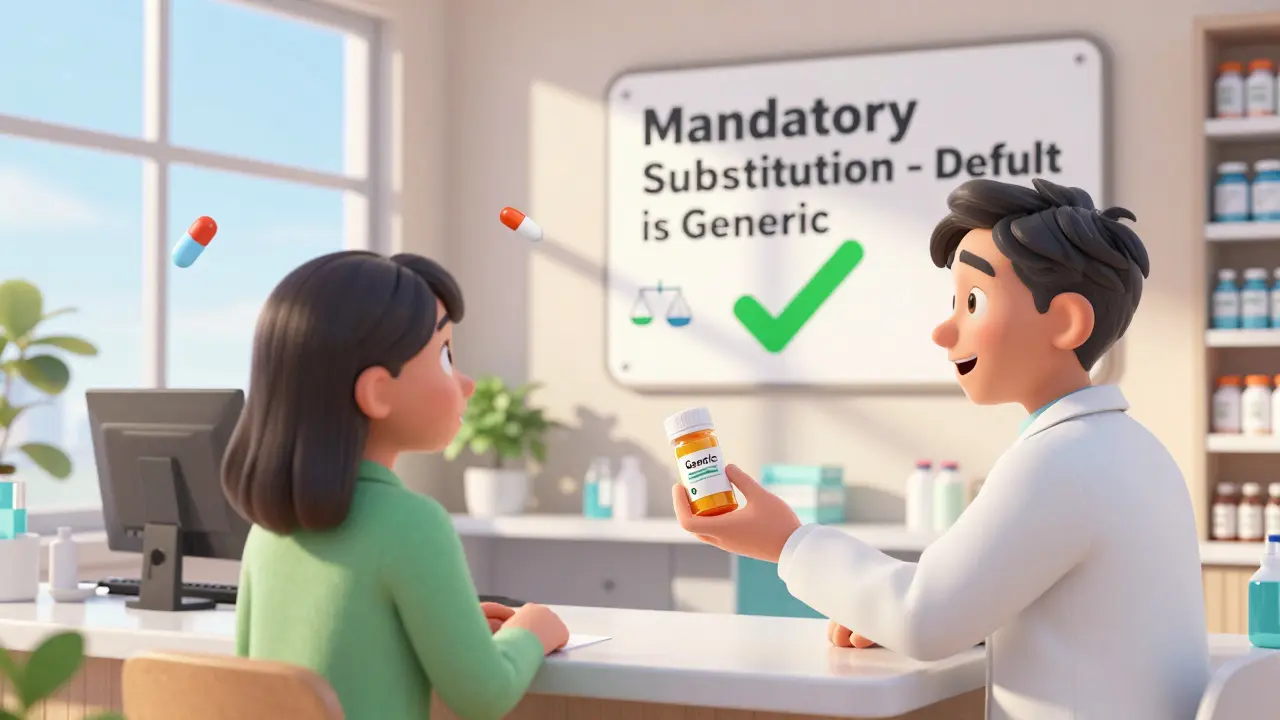
When you pick up a prescription, you might assume the pharmacist will give you the cheapest version of your medicine. But that’s not always true. It depends on where you live. In some states, pharmacists must swap your brand-name drug for a generic unless the doctor says no. In others, they can only do it if they think it’s okay-and even then, they might need your permission. This isn’t a minor detail. It affects how much you pay, whether you stick with your treatment, and even how your doctor writes your prescription.
What’s the difference between mandatory and permissive substitution?
Mandatory substitution means the law forces pharmacists to switch you to a generic drug when it’s available and approved by the FDA. The only way to stop it is if your doctor writes "Dispense as Written" or "Brand Medically Necessary" on the prescription. No exceptions. In these states, the default is generic. You get it unless someone actively blocks it.
Permissive substitution is the opposite. Pharmacists are allowed to switch you to a generic, but they don’t have to. They can choose to give you the brand-name drug even if a cheaper generic exists. In these states, the default is brand unless the pharmacist decides otherwise. That means you might end up paying more simply because no one took action to change it.
As of 2020, 19 states-including Alabama, Alaska, Arizona, Colorado, Connecticut, and West Virginia-require mandatory substitution. The rest are permissive. That’s a huge split. And it’s not just about who can switch drugs. It’s about how they do it, what they have to tell you, and whether they’re protected if something goes wrong.
Four legal layers that change everything
State laws don’t just say "yes" or "no" to substitution. They layer on rules that make a big difference in practice. There are four key parts:
- Duty to substitute - Is the pharmacist required to switch, or just allowed to?
- Notification - Do they have to tell you in writing, separate from the drug label, that you’re getting a generic?
- Consent - Do they need your signature or verbal approval before switching?
- Liability - Are they legally protected if you have a bad reaction after the switch?
Thirty-one states and Washington, D.C., require pharmacists to notify you separately about the switch. That means even if you get a generic, you’ll see a notice on your receipt or in your paperwork. Seven states plus D.C. require your explicit consent. You have to say "yes" before they can swap your medicine.
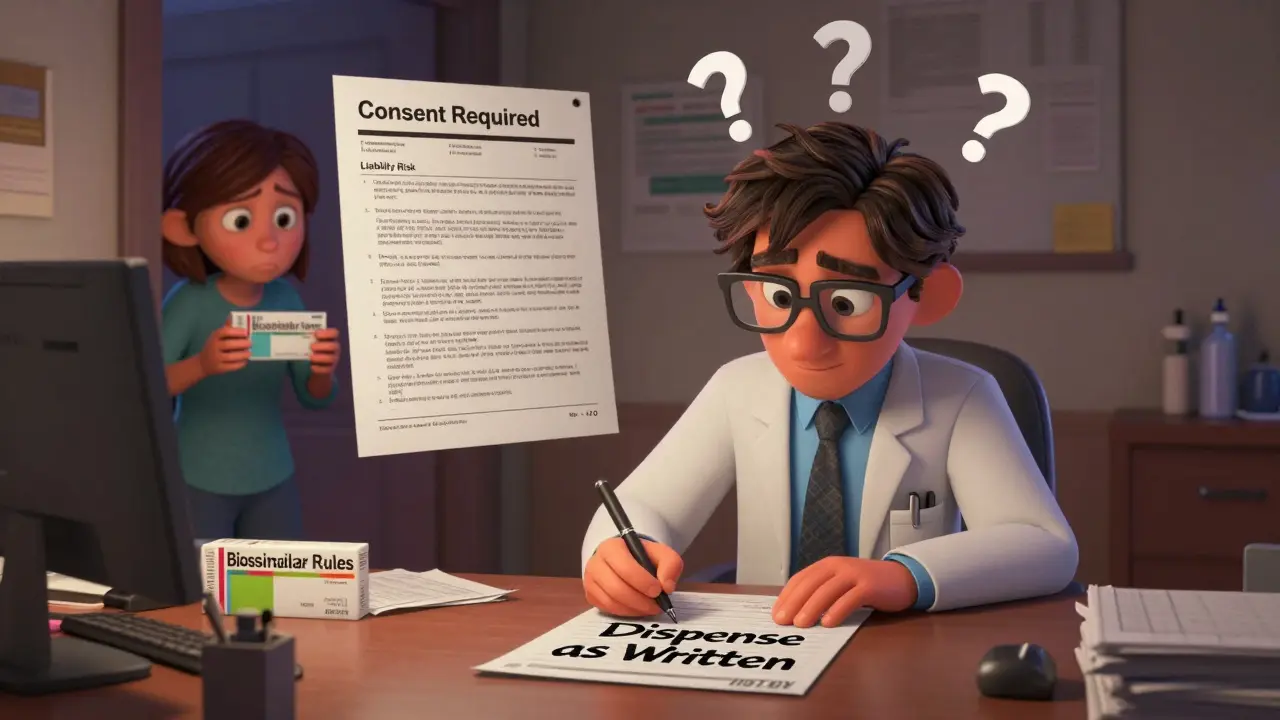
And here’s the kicker: 24 states don’t give pharmacists any legal protection if something goes wrong after substitution. That means if you have an unexpected side effect after switching to a generic, the pharmacist could be sued-even if the generic was FDA-approved and perfectly safe. That fear makes some pharmacists hesitant to switch, even in mandatory states.
How these rules impact real-world drug use
It’s not theoretical. These laws directly affect how many people get generics.
A 2011 study looked at simvastatin, a cholesterol drug, right after its patent expired. In states with mandatory substitution and no patient consent, 98.1% of prescriptions were filled with the generic. In states that required your permission, only 32.1% were. That’s a 66-point gap. Just asking for consent dropped generic use by two-thirds.
States with mandatory substitution filled 48.7% of simvastatin prescriptions with generics within six months of patent expiry. In permissive states? Just 30%. That’s an 18.7 percentage point difference-enough to save Medicaid programs millions annually. Since generics cost 80-85% less than brand-name drugs, even small increases in substitution rates add up fast. The Congressional Budget Office estimated that a 1% rise in generic use saves Medicare Part D $160 million a year.
And it’s not just about cost. People who get generics are more likely to stick with their medication. A 2020 JAMA study found that patients in mandatory substitution states had better adherence rates. When the cost is lower and the switch happens automatically, people don’t skip doses because they can’t afford it.
Why some states resist mandatory substitution
Why do some states still require consent or allow pharmacists to skip substitution? The answer is often about control-and fear.
Some doctors and patient advocacy groups worry that automatic substitution could lead to errors, especially with drugs that have a narrow therapeutic index-medications where even a small change in dose can cause harm. Think blood thinners like warfarin, epilepsy drugs like phenytoin, or thyroid meds like levothyroxine. In these cases, switching between brands and generics-even if they’re technically equivalent-might affect how the drug works in your body.
That’s why some states, even those with mandatory substitution, make exceptions for these drugs. Pharmacists in states with patient consent rules are nearly twice as likely to avoid switching these high-risk medications, even when the law says they should. It’s not always about cost-it’s about safety.
Another reason? Brand-name drug companies spend money lobbying in states with permissive laws. They know that if patients have to say "yes" to a generic, they’re more likely to stick with the brand. Marketing campaigns, free samples, and direct-to-consumer ads all play a role in keeping brand names on the shelf.
Biosimilars are changing the game
It’s not just about pills anymore. Biologic drugs-like Humira, Enbrel, and insulin-are now a huge part of the market. They’re complex, expensive, and hard to copy. But biosimilars-close but not identical versions-are starting to appear.
Here’s the twist: 45 states have stricter rules for biosimilars than for regular generics. Most require the doctor to give explicit permission before a pharmacist can switch. Some require the pharmacist to notify the doctor before making the swap. Only nine states treat biosimilars the same way they treat simple generics.
Why the extra caution? Biologics are made from living cells, not chemicals. Even tiny differences in how they’re made can affect how your immune system reacts. Doctors worry that switching back and forth between a brand and a biosimilar could trigger unintended side effects. So states are playing it safe.
But that’s also slowing down cost savings. Biosimilars can be 15-35% cheaper than their brand-name counterparts. With biologics making up 42% of Medicare Part D spending, even modest substitution could save billions. The tension between safety and savings is only growing.
What this means for you
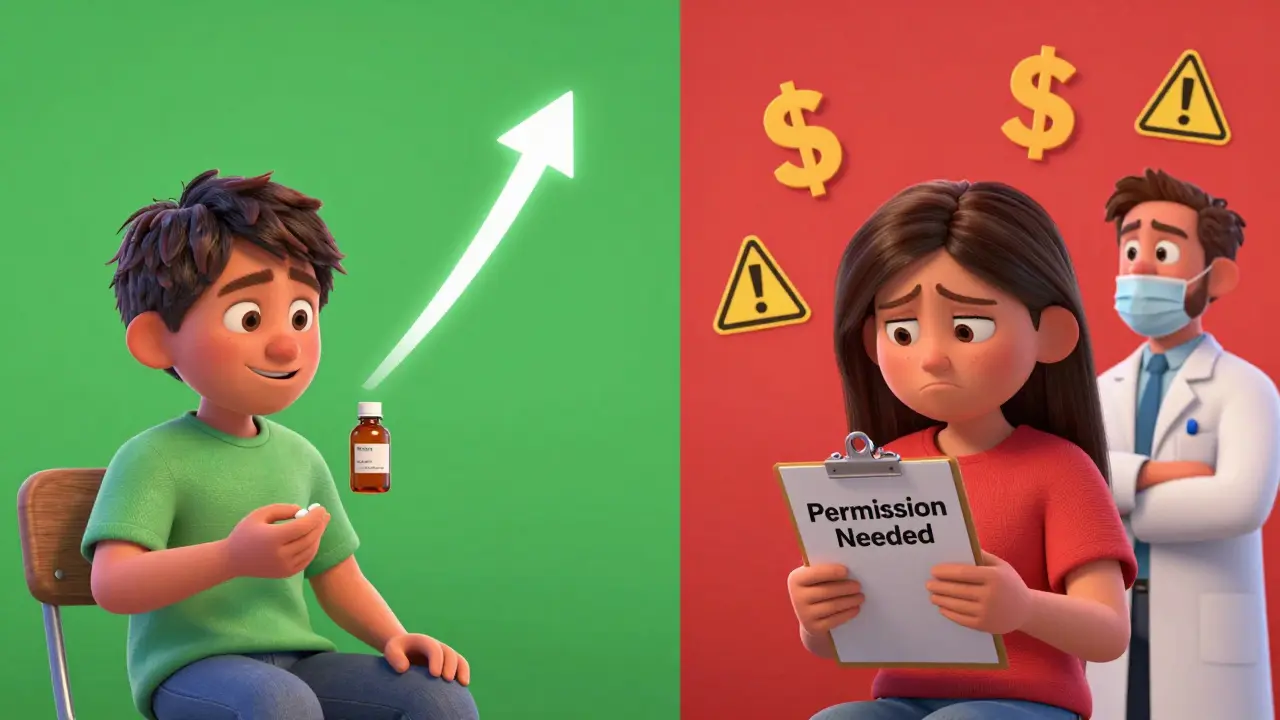
If you’re on a brand-name drug and want to save money, don’t assume the pharmacist will switch it for you. Check your state’s rules.
In mandatory states, you’ll get the generic unless your doctor writes "Do Not Substitute." If you’re not getting the cheaper version, ask why. Maybe your doctor didn’t know the law, or maybe they wrote the prescription wrong.
In permissive states, you need to ask. Say: "Is there a generic version? Can you switch me to it?" Don’t wait for them to bring it up. Many pharmacists won’t unless you prompt them.
If you’re on a high-risk drug-like warfarin, lithium, or seizure meds-ask your doctor if substitution is safe for you. Even in mandatory states, pharmacists may hold off on switching these. Don’t assume it’s automatic.
And if you’re ever given a generic without being told, check your receipt or packaging. If your state requires notification and you didn’t get it, you have a right to ask why.
What prescribers need to know
Doctors play a huge role. Your prescription format matters. In some states, you have to sign on a specific line to allow substitution. In others, you have to write "Dispense as Written" by hand. If you don’t, your patient might get a generic-even if you didn’t mean to allow it.
Know your state’s rules. If you don’t want substitution for a particular patient, write it clearly. Use the exact phrase your state requires. Don’t rely on "I told them." If it’s not on paper, it doesn’t count.
And remember: even if your state allows substitution, you can still choose to keep the brand if it’s medically necessary. But you need to document it. Otherwise, you’re leaving the decision to someone else.
The trend is clear
The number of mandatory substitution states has grown-from 14 in 2014 to 19 in 2020. That’s not a coincidence. States are realizing that automatic substitution saves money, improves adherence, and doesn’t hurt safety when done right.
States with patient consent requirements are seeing the lowest generic use. States with mandatory substitution and no consent are seeing the highest. The data is consistent. The best way to increase generic use is to make it the default-and remove unnecessary barriers.
As biosimilars become more common, we’ll see more debate. But for now, the message is simple: if you want to save money and take your meds consistently, know your state’s rules. And if you’re a doctor, write your prescriptions with intention. Your patient’s wallet-and health-depend on it.
Can a pharmacist substitute my brand-name drug without telling me?
It depends on your state. In 31 states and Washington, D.C., pharmacists must notify you separately-like on your receipt or in your paperwork-when they switch you to a generic. In the other states, they only need to label the bottle, which many patients don’t notice. If you’re unsure, ask your pharmacist directly.
Do I have to give permission to get a generic drug?
Only in seven states plus Washington, D.C. In those places, you must give explicit consent-verbally or in writing-before a pharmacist can switch your brand-name drug to a generic. In all other states, consent is not required, and substitution happens automatically unless your doctor blocks it.
Are generics as safe as brand-name drugs?
Yes. The FDA requires generics to have the same active ingredient, strength, dosage form, and route of administration as the brand. They must also meet the same quality and safety standards. The only differences are in inactive ingredients like fillers or dyes, which rarely cause problems. For most people, generics work just as well.
What if I have a bad reaction after switching to a generic?
In 24 states, pharmacists aren’t protected from liability if you have a reaction after substitution. That means they could face legal risk-even if the generic was approved by the FDA. In states with liability protection, pharmacists are shielded as long as they followed the law. Always report side effects to your doctor and pharmacist.
Can I request a brand-name drug even if a generic is available?
Yes. In every state, you can ask for the brand-name drug. The pharmacist will usually charge you the full price, and your insurance may not cover it. If you’re on a mandatory substitution state, you’ll need to pay the difference out-of-pocket. Some pharmacies may refuse unless you sign a form acknowledging the cost.
Do these rules apply to biosimilars too?
No. Most states treat biosimilars differently. In 45 states, pharmacists can’t substitute a biosimilar without the doctor’s permission or additional notification. These rules are stricter because biosimilars are more complex than regular generics, and switching between them may carry unknown risks. Always confirm with your doctor if a biosimilar is being considered.

so i got my levothyroxine switched last month and my doc never said no substitute, but i swear i felt like crap for a week. turned out the generic had a different filler and my stomach went haywire. now i just ask for the brand every time. not worth the headache.
It is frankly unacceptable that pharmacists are allowed to make medical decisions without physician oversight. This isn’t a grocery store. You don’t swap insulin for a ‘cheaper version’ because someone’s budget is tight. The FDA may say they’re equivalent, but biology doesn’t care about regulatory checkboxes. We need federal standards, not a patchwork of state laws that prioritize cost over patient safety.
imagine if we treated cars like we treat meds 🤔 like, ‘oh you bought a Honda, here’s a Toyota that’s ‘technically the same’-but the engine’s made by a different guy in a different factory, and we’re not telling you.’ would you drive it? 🤷♀️ we need transparency, not assumptions. and yes, i’m the person who reads every tiny print on my pill bottle. 📜💊
people who say generics are ‘just as good’ haven’t lived through the 3 months of panic attacks after switching from brand Zoloft. it’s not placebo. it’s chemistry. and if your pharmacist doesn’t warn you, they’re not helping-they’re just cutting corners.
Here’s the thing no one talks about: in the UK, we have mandatory substitution for generics, and we’ve had zero surge in adverse events. The fear-mongering around ‘narrow therapeutic index’ drugs is often exaggerated by industry lobbyists. Pharmacists are trained professionals-they don’t just swap pills like trading cards. We need to trust the system, not the marketing brochures.
And biosimilars? They’re not ‘new’-they’re just more complex. We’ve been using them in Europe for over a decade. The science is there. The hesitation is economic, not medical.
i just checked my state’s law-permissive with no consent required. so i asked my pharmacist last time and he looked at me like i’d asked for a unicorn. said ‘oh, we don’t usually switch unless you ask.’ so now i say ‘is there a generic?’ every single time. it’s exhausting, but my wallet thanks me. 🙏
Oh wow, so the real villain here isn’t Big Pharma-it’s the patients who don’t read the fine print. 🙄 Let me guess, you also blame the cashier when the ‘buy one, get one free’ sign says ‘exclusions apply’? Welcome to capitalism, sweetheart. If you don’t know your rights, you’re not a victim-you’re just careless.
Let’s talk about the real win here: adherence. When you make the cheaper, equally safe option the default, people don’t skip doses because they can’t afford it. That’s not just about money-it’s about dignity. Imagine being told you need a lifesaving pill, but you have to beg for the version you can actually pay for. That’s not healthcare, that’s a lottery. And guess what? The data doesn’t lie-mandatory substitution = better outcomes. Period. 🌟 We’ve been conditioned to think ‘brand = better,’ but science says otherwise. Time to unlearn that myth. Your body will thank you. And your bank account? It’ll throw a party.
As someone who’s worked in pharmacy for 22 years, I can tell you: liability fear is the #1 reason pharmacists avoid substitution-even in mandatory states. We’re not trying to be gatekeepers. We’re terrified of being sued if a patient has a reaction, even if the generic is FDA-approved. If states want higher substitution rates, they need to give us legal shields. No one wants to be the person who ‘caused’ a bad outcome because they followed the law.
And biosimilars? We’re not being extra cautious because we’re lazy. We’re being cautious because we’ve seen immune reactions in patients who switched back and forth between biosimilars and brands. It’s rare, but it’s real. We need more data, not more pressure.
Doctors: write ‘Dispense as Written’ clearly. Don’t scribble it. Don’t assume we’ll know what you meant. We’re not mind readers. We’re the last line of defense-and we’re scared.