What Quality by Design (QbD) Really Means for Generic Drugs
When you pick up a generic pill, you assume it works just like the brand-name version. But how do manufacturers prove that? For years, the answer was simple: test the final product. If it met the label claim, passed dissolution tests, and matched impurity levels, it got approved. That’s the old way. Today, Quality by Design has changed everything. Instead of waiting until the end to check if the drug is good, QbD builds quality in from day one. It’s not just a checklist. It’s a science-driven system that maps out exactly how a drug behaves-why it dissolves the way it does, why one batch performs like another, and how small changes in manufacturing won’t break it.
The Core of QbD: From Copying to Understanding
Before QbD, generic drug developers mostly copied the brand-name product. They used the same ingredients, tried to match the tablet size, and ran a few tests to show similarity. But that approach missed the point. Two pills can have identical ingredients and still behave differently in the body. QbD forces developers to ask: Why does this drug work? What makes it dissolve at the right speed? What controls the release of the active ingredient?
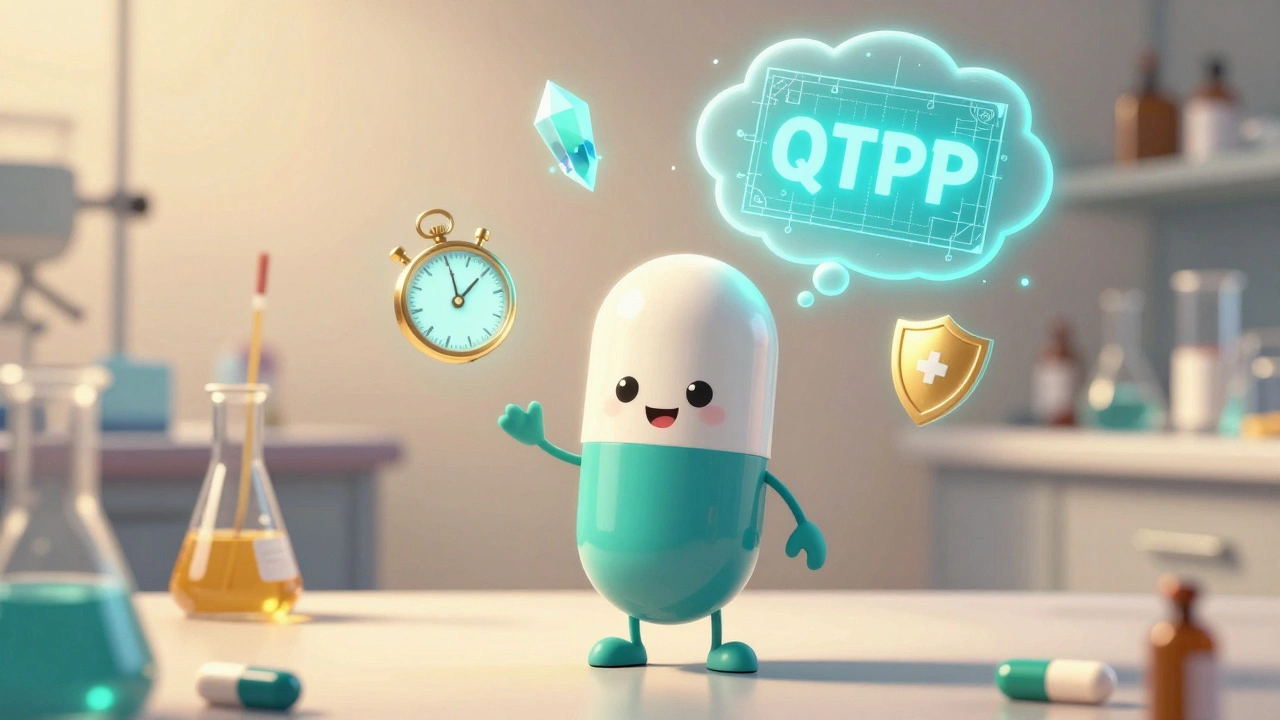
The answer starts with the Quality Target Product Profile (QTPP). This isn’t just a list of specs. It’s a detailed blueprint of what the final drug needs to do. For example, if the brand-name drug releases 80% of its active ingredient in 30 minutes, the generic must hit that same target-not just once, but consistently across thousands of batches. The FDA requires at least 95% similarity in dissolution profiles compared to the Reference Listed Drug (RLD). That’s not guesswork. It’s measurable, repeatable science.
How QbD Works: The Five Building Blocks
QbD isn’t magic. It’s a structured system with five key parts that work together.
- Quality Target Product Profile (QTPP) - Defines what the drug must achieve: how fast it dissolves, how pure it is, how stable it stays on the shelf.
- Critical Quality Attributes (CQAs) - These are the measurable traits that directly affect safety and effectiveness. For most generics, that’s dissolution rate (f2 >50), content uniformity (RSD ≤6.0%), and impurity levels (following ICH Q3B limits).
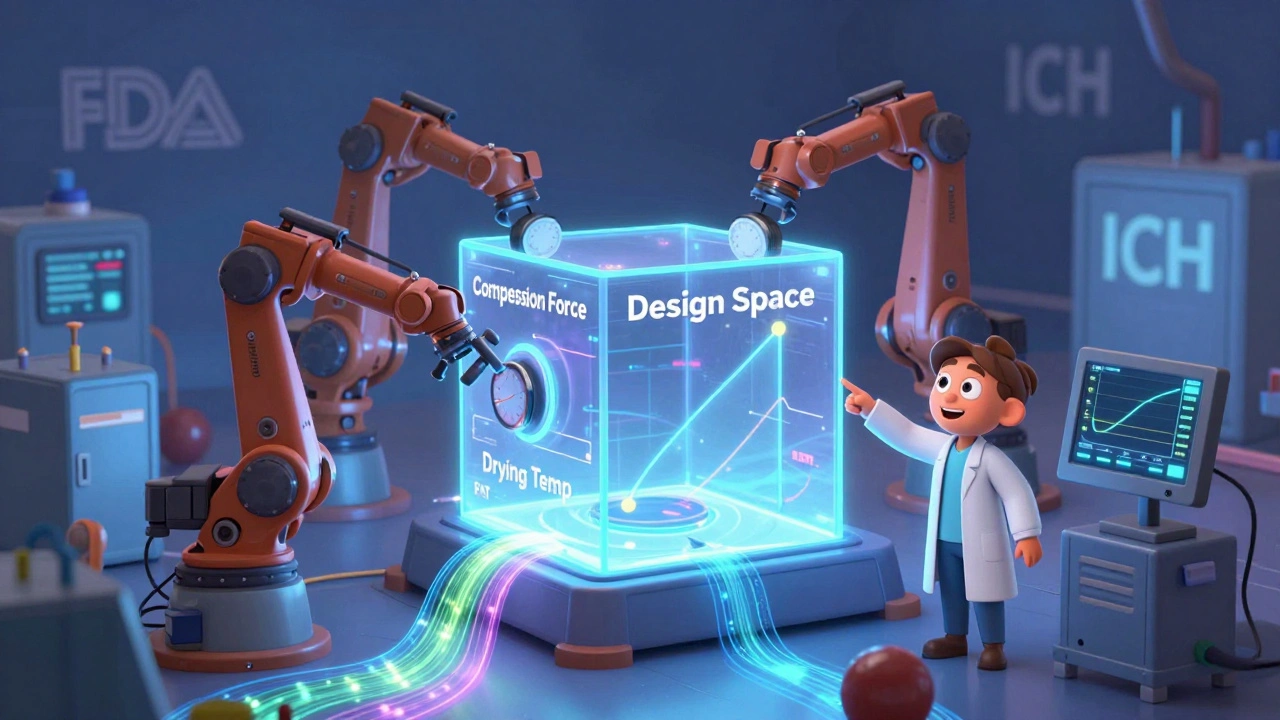
- Critical Process Parameters (CPPs) - These are the manufacturing settings that control CQAs. Granulation moisture? Compression force? Drying temperature? QbD finds the exact ranges that keep the product within specs. For example, a tablet might need compression between 10-15 kN. Go outside that range, and dissolution could drop below 80%.
- Design Space - This is the big win. Instead of one fixed setting (e.g., “mix for 15 minutes”), QbD defines a safe operating zone. If you stay inside this multidimensional space, the product is guaranteed to meet quality standards. The FDA approves design spaces based on data from 100+ simulated batches. This means manufacturers can tweak parameters without reapplying for approval-saving time and money.
- Control Strategy - How do you know you’re still in the design space? That’s where Process Analytical Technology (PAT) comes in. Tools like near-infrared spectroscopy monitor the process in real time. 87% of QbD users now use PAT to cut end-product testing by 35-60%.
Why QbD Beats the Old Way
Traditional development is like baking a cake with one recipe: mix for 15 minutes, bake at 350°F for 30. If it burns, you blame the oven. If it’s undercooked, you blame the timer. No room for error. QbD is like understanding how heat, moisture, and ingredients interact. You know that 340-360°F works, and that 28-32 minutes is fine too. You can adjust based on your oven, your altitude, your flour brand-and still get a perfect cake every time.
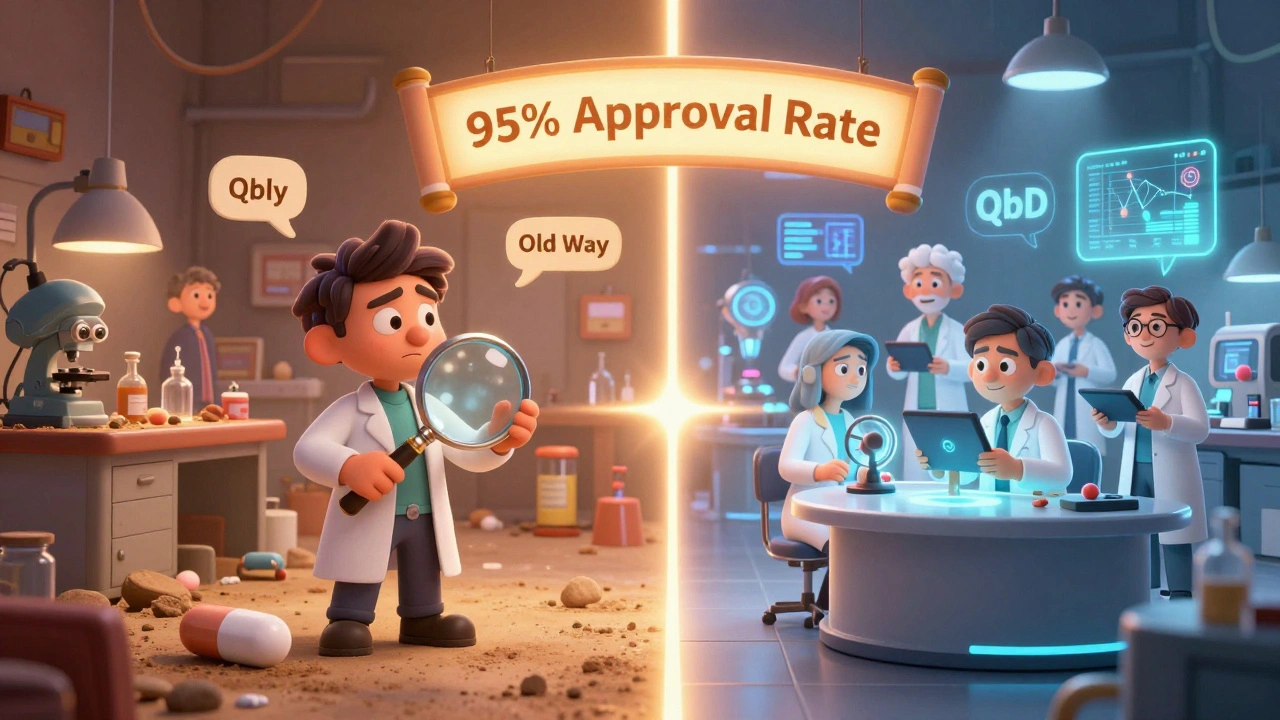
The numbers speak for themselves. Since the FDA made QbD mandatory for ANDAs in 2017, approval rates for generic drugs jumped 23%. Review times dropped by nearly 5 months per application. Companies using QbD get 31% fewer Complete Response Letters (CRLs)-the dreaded “your application is incomplete” notices. One manufacturer saved $850,000 a year just by cutting post-approval quality investigations. Another cut process change approval time by 73%.
The Hidden Costs: Why Not Everyone Uses QbD
QbD isn’t free. It’s expensive. Developing a QbD-based generic can cost 25-40% more upfront than the old way. Training scientists in risk assessment and Design of Experiments (DoE) takes 80-120 hours per person. PAT equipment? Minimum $500,000. Software like MODDE Pro? $15,000 per license per year. For a simple immediate-release tablet, that kind of investment can feel overkill.
That’s why some experts warn against over-engineering. Dr. James Polli from the University of Maryland points out that spending $450,000 on DoE studies for a basic aspirin tablet doesn’t add value-it just adds cost. QbD shines for complex products: extended-release tablets, inhalers, patches, injectables. These are hard to copy. Traditional bioequivalence methods often fail here. QbD gives regulators confidence that the generic behaves like the brand, even without clinical trials.
Smaller manufacturers, especially in emerging markets, struggle with the upfront cost. Indian companies have a 68% adoption rate, compared to 89% in the U.S. and EU. But even there, the top 10 Indian generics firms invested $227 million in QbD capabilities in 2022. They know the long-term payoff: fewer regulatory delays, faster market entry, and fewer recalls.
Real-World Wins: What QbD Looks Like in Practice
At Hikma Pharmaceuticals, implementing QbD for their generic esomeprazole cut annual quality deviations from 14 to just 2. That’s not just cost savings-it’s patient safety. At Teva, a QbD-based continuous manufacturing design for levothyroxine improved batch consistency by 28%. During the pandemic, Viatris (formerly Mylan) made 11 process changes to their simvastatin production without seeking regulatory approval-keeping supply flowing when it mattered most.
These aren’t exceptions. They’re the new standard. The FDA’s QbD Pilot Program processed 87 submissions with a 92% first-cycle approval rate. Compare that to 78% for traditional applications. That’s the power of building quality in, not checking it out.
What’s Next? The Future of QbD
QbD is evolving. The FDA’s new ICH Q14 guideline (effective December 2023) requires more robust analytical data-but rewards it with faster validation. The agency’s Emerging Technology Program has approved 27 QbD-based continuous manufacturing applications with 100% success. 3D-printed generics and complex biologics follow-ons are next on the list.
By 2027, McKinsey predicts 95% of new generic approvals will use QbD. The WHO now includes QbD criteria in its prequalification program, meaning global supply chains are aligning. This isn’t just a U.S. or EU trend. It’s becoming the global norm.
But the biggest challenge remains: scaling QbD for low-cost generics. If a drug only makes $30 million a year, spending $1.5 million on development isn’t sustainable. The solution? Proportionate implementation. Use QbD where it matters-complex products, multi-component formulations, modified-release systems. For simple tablets with well-known behavior, streamline. Don’t overdo it. The goal isn’t perfection. It’s reliable, consistent, safe medicine-without unnecessary cost.
How to Get Started With QbD
If you’re developing a generic drug today, here’s what you need:
- Start with the QTPP. Define exactly what success looks like.
- Identify 5-12 CQAs based on clinical impact and regulatory expectations.
- Use risk assessment (ICH Q9) to link CQAs to CPPs.
- Run DoE studies-don’t guess. Use statistical tools to map the design space.
- Invest in PAT. Real-time monitoring reduces reliance on end-product testing.
- Use the FDA’s free QbD training modules or PDA’s certified courses. Training isn’t optional-it’s foundational.
Don’t think of QbD as a regulatory hurdle. Think of it as your competitive edge. Companies using it get faster approvals, fewer surprises, and more control over their manufacturing. In a market where margins are thin and competition is fierce, that’s not just smart-it’s essential.
Is QbD required for all generic drugs?
Yes, for all Abbreviated New Drug Applications (ANDAs) submitted to the FDA after October 1, 2017. The FDA requires QbD elements-including QTPP, CQAs, design space, and control strategy-in every submission. The EMA and PMDA (Japan) have similar expectations, especially for complex generics like inhalers and extended-release products.
Does QbD eliminate the need for bioequivalence studies?
No, but it reduces the need for clinical trials. QbD builds confidence in in vitro performance-like dissolution profiles-so regulators can accept those as proof of bioequivalence. For simple immediate-release drugs, in vitro data alone is often enough. For complex products, clinical studies may still be needed, but QbD helps justify why they’re necessary and how to design them efficiently.
What’s the difference between a Critical Quality Attribute (CQA) and a Critical Process Parameter (CPP)?
A CQA is a property of the final product that affects safety or effectiveness-like dissolution rate or impurity level. A CPP is a manufacturing variable that controls that property-like mixing time, compression force, or drying temperature. You don’t control CQAs directly. You control CPPs to ensure CQAs stay within acceptable limits.
How long does it take to implement QbD for a generic drug?
For a simple immediate-release tablet, expect 6-9 months. For complex products like modified-release tablets or transdermal patches, it’s 12-18 months. The extra time comes from running Design of Experiments (DoE), validating analytical methods, and building the control strategy. But this upfront investment cuts months off the regulatory review process later.
Can small generic manufacturers afford QbD?
It’s challenging, but possible. The key is proportionate implementation. Focus QbD on high-risk products. Use shared labs for PAT equipment. Leverage FDA’s free training and public RLD data. Many small firms partner with CROs specializing in QbD. The goal isn’t to replicate big pharma’s resources-it’s to use the right tools for the right product.
What happens if a company doesn’t use QbD?
Their ANDA will likely be rejected or delayed. The FDA now expects QbD elements in every submission. Without a design space, control strategy, or risk assessment, regulators will issue Complete Response Letters requesting more data. This adds months to approval timelines and increases costs. In competitive markets, delays mean lost revenue and market share.